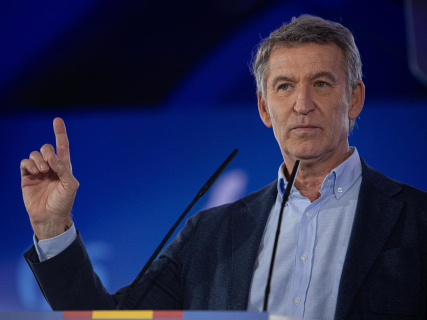
The PP suspends all campaign events after the train accident in Urda (Toledo)

The PP suspends all its campaign events after the serious railway accident between an AVE and an Iryo train in Urda (Toledo).

fotonoticia 20261025185035 1920

fotonoticia 20261025185035 1920

Add DEMÓCRATA to Google

Ask FREN

Published

Last updated

1 minute

Most read

Elecciones 29N · Encuestas

La media de las encuestas

Media a 27 de octubre de 2026 · 15 institutos

  • PP31,0 %
  • PSOE27,3 %
  • Vox18,9 %
  • Sumar6,3 %
  • Podemos2,9 %
  • ERC2,3 %
010203040ene 2024jul 2024ene 2025jul 2025ene 2026jul 2026

Media del último estudio de cada instituto en 30 días y su evolución semanal desde el 23J. Partidos con al menos un 2 %.

Todas las encuestas

Elecciones generales del 29 de noviembre · Demócrata

The Partido Popular has decided to completely suspend the campaign schedule of its main leaders after the railway accident recorded this morning in Urda (Toledo), where two wagons of a train of the Iryo company have derailed after being hit by an AVE.

"All the party's campaign schedule throughout the country is canceled as a consequence of the dramatic railway accident in Toledo pending more information," the Partido Popular has communicated.

According to the first data on the railway incident that occurred between Mora and Urda (Toledo) shortly before 9:00 a.m. this Wednesday, an AVE of Renfe could have collided from behind with an Iryo train, causing two of its wagons to leave the track, as sources from the Ministry of Transport have indicated to Europa Press.

To the accident site have moved teams from Adif and Renfe, and the incident has forced the closure of traffic on the Madrid-Andalusia high-speed line. Renfe has put into operation options for changes and cancellations of tickets for travelers affected by the interruption of service.

Adif has detailed that the "incident" has occurred between Mora and Orgaz and Urda (Toledo), at the height of kilometer point 118, and has involved a Renfe train and another from the operator Iryo that were making the Madrid-Seville route.

More key points, information and questions with FREN

AI-GENERATED CONTENT

What is the parliamentary procedure to suspend a national electoral campaign in Spain?

There is no specific parliamentary procedure in Spain that allows suspending, through a vote, an already started national electoral campaign. The Congress Rules do not contemplate such a process. It is necessary to distinguish between parties canceling their events, an emergency limiting certain activities, and legally suspending the campaign or postponing the elections: these are different decisions.

1. Canceling events does not suspend the electoral process

Parties may stop holding rallies or voluntarily interrupt their activity, individually or through a political agreement. This does not require parliamentary authorization, but neither does it halt electoral deadlines nor change the voting date.

The Organic Law of the General Electoral Regime —LOREG— regulates the campaign and the electoral calendar. It does not establish a general authorization for the Government, Congress, or the Central Electoral Board to arbitrarily suspend the entire national campaign. A parliamentary resolution or a non-legislative proposal would not suffice to create such a power.

2. Exceptional states are not a shortcut

The Constitution and Organic Law 4/1981 regulate instruments to face emergencies, with different parliamentary intervention in each case:

  • State of alarm: declared by the Government for an initial maximum of fifteen days. Its extension requires authorization from Congress by simple majority. It may justify restrictions within its legal limits but does not automatically suspend the campaign nor postpone elections.
  • State of exception: the Government needs prior authorization from Congress by simple majority. The request must specify effects, territory, and duration: up to thirty days, extendable for an equal period. Its declaration also does not equate to a general authorization to suspend elections.
  • State of siege: declared by Congress by absolute majority, exclusively at the Government's proposal, setting territory, duration, and conditions. It also does not by itself produce an electoral postponement.

The parliamentary procedure is set out in articles 162 to 165 of the Congress Rules. These routes require the corresponding emergency to concur; they cannot be activated solely to stop a campaign.

3. What happens if the Cortes are dissolved?

This is the decisive practical limitation during general elections. If Congress is dissolved or its term has expired, the Permanent Deputation assumes its powers regarding states of alarm, exception, and siege, according to article 165 of the Rules.

However, it does not replace Parliament as an ordinary organic legislator. Therefore, it cannot approve a reform of the LOREG to create a new suspension power. The continuity of parliamentary control during emergencies is also explained in the Ruling 183/2021.

4. Which route would allow regulating a suspension

To establish a general mechanism, a reform through an organic law compatible with the Constitution would be necessary. With the Chambers constituted, the path would be to present a bill or proposal, process amendments and debates, approve the whole by absolute majority in Congress, send it to the Senate, and resolve, if applicable, its changes or veto before publication.

The reform should specify causes, decision-making body, maximum duration, resumption, financing, and judicial guarantees. It would not be replaceable by an ordinary decree nor by an electoral instruction. If it contradicted constitutional limits, it would also require a constitutional reform.

In conclusion: faced with an already started campaign, there is no parliamentary vote available to “stop it.” The Central Electoral Board administers the process and the courts control its legality; neither has a general political power of suspension. Emergencies only allow legally authorized measures, not automatically altering the electoral calendar.

What powers does the president of the Popular Party have in decision-making about the party's political agenda?

The president of the Popular Party (PP) is, in practice, the highest political authority of the party and concentrates great influence over the political agenda. However, their powers are always exercised within a collective framework: party statutes, governing bodies, and internal balances. They do not decide alone, but they do set the course.

1. Political direction and definition of the general line
  • Setting the party's position: the president leads the definition of the PP's general political line on major issues (economy, territorial model, pacts, European policy, etc.). This line is later concretized in resolutions of collegiate bodies, but the initial impetus usually comes from the presidency.
  • Guiding the public discourse: decides, together with their team, what the message priorities are: which topics are highlighted, which are minimized, and what interpretative frameworks are used. This directly influences the internal political agenda (what is debated within the party) and external (what is conveyed to public opinion).
  • Defining strategic priorities: for example, choosing to focus discourse on the economy, institutional reforms, or territorial matters. This hierarchy of priorities conditions what enters and what does not enter the party's political agenda at each moment.
2. Relationship with the party's governing bodies
  • National Executive Committee: the main governing body between congresses. The president convenes and chairs it, proposing the agenda, topics to debate, and strategic decisions. Although decisions are formal and collegiate, the presidency almost always sets what is discussed and with what approach.
  • National Board and other bodies: the presidency also convenes and directs these broader bodies, where major lines of action, political documents, and organizational changes are validated. The agenda of these meetings conditions the party's general political agenda.
  • Appointment of teams: the president proposes much of the trusted positions (spokespersons, deputy secretaries, area coordinators). By choosing more moderate, tougher, more technical, or more media-oriented profiles, they indirectly influence which topics gain weight on the agenda.
3. Configuration of the parliamentary and opposition agenda
  • Coordination with parliamentary groups: although the Congress and Senate groups have their own structure, the party presidency sets the major priorities: which battles are fought in Parliament, which initiatives are prioritized (bills, non-legislative proposals, motions), and which topics are used to differentiate from the Government.
  • Decision on major political moves: for example, whether to present a motion of no confidence, force an investigative commission, or block or facilitate the processing of certain laws. These decisions define the party's political agenda in the Chamber and externally.
  • Territorial coherence: the PP is a party deeply rooted in autonomous communities and municipalities. The national president does not direct daily territorial matters but sets red lines and basic consensuses that regional leaderships must respect to maintain a relatively unified agenda.
4. Pacts, alliances, and positioning towards other forces
  • Negotiation of pacts: the presidency decides, with the competent body, the alliance strategy: with which parties to pact, on what terms, and on what programmatic bases. This strongly conditions the agenda: some topics are prioritized or toned down to facilitate agreements.
  • Position towards the Government: the PP president defines whether the line will be more confrontational or more pactist at each moment (supporting certain state laws, hardening discourse, etc.). This orientation translates into the selection of topics the party turns into banners.
5. Internal powers and limits
  • Capacity for initiative, not omnipotence: the president has great capacity to propose and guide, but the statutes assign formal decision-making to collegiate bodies. In practice, their political leadership means they are rarely openly contradicted, but checks and balances exist.
  • Indirect control of the agenda: by deciding what is discussed in bodies, whom to appoint to key positions, and what documents are presented for voting, they concentrate very relevant control over the agenda without all decisions formally being theirs.
  • Political limits: internal balances (currents, territorial barons, influential former leaders) and the risk of electoral cost limit their margins. A president who forces an agenda very far from the party's majority sentiment risks internal contestation.

In summary, the president of the Popular Party is not an “absolute boss,” but the central actor who sets ideological orientation, thematic priorities, discourse tone, and alliance strategy. All this, articulated through governing bodies and their capacity to build internal majorities, de facto shapes the PP's political agenda at each stage.

How are powers distributed between the PP president and the party's secretary general? What role do the PP's territorial barons have in defining the political agenda compared to the national president? How does the PP president influence the selection of candidates and electoral lists of the party?

What have been the results of the Popular Party in the last general elections held in Spain?

The last general elections held in Spain were on July 23, 2023. The Popular Party was the most voted formation and obtained 137 deputies in Congress, although it did not reach an absolute majority. The figures from consulted sources place its support at 8,091,840 votes and 33.05%, approximately one out of every three votes.

Main results of the PP

To interpret the result, it is useful to separate three data points: how many people voted for the party, what percentage those votes represented, and how many representatives it obtained. In the case of the Popular Party, the figures were as follows:

  • Votes: 8,091,840 ballots.
  • Vote percentage: 33.05%. Other journalistic references express it approximately as 33.1%.
  • Representation in Congress: 137 deputies.
  • Electoral position: first candidacy both in votes and number of deputies.
  • Distance from absolute majority: 39 seats, with that threshold at 176.

Information about votes, percentage, and representation appears in the reference from El Confidencial. Meanwhile, Demócrata recalls the 137 deputies and approximate 33.1% support when comparing that election with later polls.

Difference with other candidacies

The final distribution of deputies among the four candidacies with the greatest representation allows placing the PP's result in context:

  • The PP obtained 137 deputies and held first position.
  • The PSOE obtained 121 deputies, thus 16 seats behind the PP.
  • Vox obtained 33 deputies.
  • Sumar obtained 31 deputies.

These figures correspond to the election results, not to an estimation of voting intention, and are recorded in the comparison published by Demócrata. The 16-deputy advantage over PSOE confirms the Popular Party's parliamentary first position but does not equate to having its own absolute majority.

What that result meant

The main conclusion is that the PP won the elections in votes and seats but fell short of the 176 deputies needed for an absolute majority. Its 137 representatives were therefore insufficient to reach that threshold alone.

Additionally, the sum of deputies obtained by PP and Vox was 170 seats: 137 from the former and 33 from the latter. That sum was six deputies short of an absolute majority. This is an operation on the electoral result, not an additional result obtained by the PP nor a joint candidacy of both parties.

The subsequent balance also requires distinguishing between winning elections and forming the Government. The information from Demócrata about the subsequent period records Alberto Núñez Feijóo's failed investiture and Pedro Sánchez's later investiture.

Celebrated results, not polls

Polls published after July 23, 2023, do not change those results: they are estimates about a possible later election. Therefore, to answer your question, the reference is the result actually obtained at the polls: 137 deputies, first electoral position, and absence of own absolute majority. The above representation figures refer to the Congress of Deputies and should not be interpreted as Senate results.

Play

Test your knowledge with FREN!

How much do you know about this topic? Answer the following 3 questions.

Where did the railway accident that caused the suspension of the PP campaign take place?

Question 1 of 3

Which train lines were affected by the accident according to the news?

Question 2 of 3

What political activity was Alberto Núñez Feijóo scheduled to carry out on the day of the accident?

Question 3 of 3