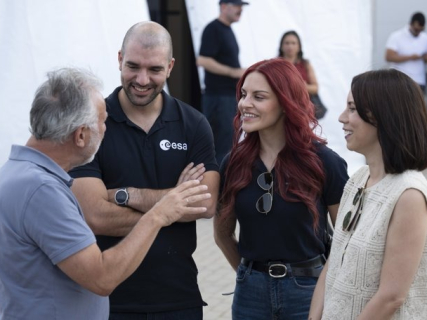

The Spanish astronauts of the European Space Agency (ESA), Sara García and Pablo Álvarez, shared their excitement this Wednesday in the moments leading up to the total solar eclipse from the Yebes Observatory, in Guadalajara, one of the official monitoring points of the phenomenon.
"How punky not to look at the phone and enjoy something unique!" García celebrated during a round table organized before the moment of greatest intensity of the eclipse.
The astronaut and molecular biologist defended that, although the phenomenon represents an important opportunity for scientific research, it is also worth stopping to consider its more human dimension.
"We are all going to look in the same direction"
García highlighted that moments in which millions of people share an experience of this nature at the same time are not common.
The astronaut focused on sensations such as the drop in temperature, the silence of animals, or the fact that thousands of people are paying attention to the same point in the sky. "That is the beautiful and unique part," she summarized.
She also compared the eclipse to the opportunity she had to apply for the astronaut selection process of the ESA.
"These are things that happen maybe only once in your life, like this eclipse, you have to seize certain opportunities if they excite you," she explained.
García also recalled that her professional trajectory mainly develops in the field of cancer research and not directly in the space sector, but she decided to apply when the ESA opened its call.
The importance of different professional profiles
The astronaut also advocated for the diversity of profiles within space crews.
In her opinion, each professional brings different tools depending on their previous training. In her case, she believes that her experience as a molecular biologist and laboratory work have shaped her way of analyzing problems and tackling tasks.
"An astronaut has to learn everything at the moment they are assigned a mission," she pointed out.
Pablo Álvarez had been waiting for this eclipse since he was eleven years old
Pablo Álvarez revealed, for his part, that this August 12, 2026 has been marked in his calendar for years.
The León astronaut explained that when he was eleven years old, he already researched when he could observe a total eclipse from Spain and discovered that the phenomenon this Wednesday would precisely cross his hometown.
"I had marked this since then because it passed over my city, León," he has said.
Álvarez had never been able to observe a solar eclipse from the path of totality until now. He does remember having experienced one when he was a child from a town in León, where the obscuration of the Sun reached approximately 99%.
The astronaut has recounted that he then resorted to his grandfather's welding glasses to try to observe it, a practice that he himself has warned should not be used as a method of protection to look directly at the Sun.
"It's never too late to stop dreaming"
Álvarez has also recalled how his desire to become an astronaut evolved throughout his life.
Although as a child he already dreamed of exploring and performing professions related to adventure, he explained that the decision to really try to become an astronaut came much later.
"I think I realized I wanted to be an astronaut when I was a 30-year-old child and here we are, it's never too late to stop dreaming," he has stated.
The two Spanish astronauts have thus participated in a historic day for astronomical observation in Spain, combining the scientific aspect of the eclipse with an experience that both have claimed is exceptional also from a personal point of view.