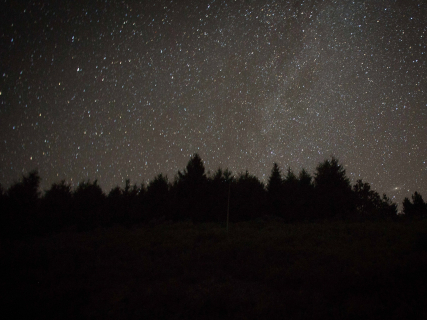
Where to see the Perseids 2026 tonight: best places, time, and tips for observing the meteor shower

The early morning of August 12 to 13 will offer the best conditions to observe the "tears of Saint Lawrence," with the maximum expected between 4:00 and 6:00 hours and without the interference of the light of the Moon.

4 minutes

EuropaPress 5378672 lluvia perseidas vista sierra os ancares 13 agosto 2023 lugo galicia espana

EuropaPress 5378672 lluvia perseidas vista sierra os ancares 13 agosto 2023 lugo galicia espana

Add DEMÓCRATA to Google

Ask FREN

Published

Last updated

4 minutes

Most read

After the total solar eclipse that has crossed Spain this Wednesday, the show continues during the early morning. The Perseids 2026 will reach their peak on the night of August 12 to 13, with especially favorable conditions due to the coincidence with the new moon.

To contemplate them, it will not be necessary to use telescopes, binoculars, or any type of eye protection. The key will be to find a place with little light pollution, have a wide horizon, and wait until the last hours of the night, when the activity will be greater.

What time to see the Perseids 2026 tonight

The best moment to observe the Perseids will come during the early morning from Wednesday to Thursday.

The National Geographic Institute places the peak of activity between 4:00 and 6:00 AM on August 13. It will be in that range when the chances of seeing a greater number of meteors will increase.

However, it will not be necessary to wait exactly until four in the morning. The Perseids can be observed throughout the night, and the possibilities will progressively increase as the early morning advances and the radiant of the shower gains height in the sky.

The activity of the Perseids also extends over several weeks. According to the calendar of the International Meteor Organization, the phenomenon remains active between July 17 and August 24, although the night of August 12 to 13 concentrates its peak.

Where to best see the Perseids

There is no single point from which the Perseids can be observed. The best location will be any place far enough away from the lighting of towns and cities.

Rural environments, mountainous areas, or open spaces with a clear horizon usually offer better conditions than large urban areas.

To choose a good observation point, it is advisable to look for:

  • Dark skies, away from streetlights and large urban centers.
  • A place with a wide field of vision, without buildings, trees, or mountains that block a good part of the sky.
  • Areas where it is possible to stay for a time without exposure to artificial lights.
  • Safe spaces equipped for staying overnight.

The greater the light pollution, the fewer weak meteors can be distinguished.

It is not necessary to look towards Perseus

Although they are called Perseids because the meteors seem to come from an area near the constellation of Perseus, it is not necessary to locate it or keep your gaze fixed on that point.

The shooting stars can appear practically anywhere in the sky.

In fact, looking at something away from the radiant can allow you to observe longer trails crossing the sky. The most advisable thing is to find a comfortable position from which the largest possible surface area of the sky can be covered.

The new Moon will especially favor observation

One of the factors that makes this dawn one of the best nights to observe the Perseids is the absence of moonlight.

The new Moon coincides this year with August 12, so there will practically be no moonlight that can hide the less bright meteors.

It is an important difference compared to other years. A full or very bright Moon can significantly reduce the number of shooting stars visible to the naked eye, even when the activity of the shower is high.

How many Perseids can be seen

The International Meteor Organization estimates for 2026 a zenithal hourly rate close to 100 meteors per hour under ideal conditions.

This figure does not mean that any observer will see a hundred shooting stars in sixty minutes.

It is a theoretical value calculated for a completely dark sky, with perfect atmospheric conditions and the radiant located in an optimal position.

From a rural area and under good conditions, the actual rates during the peak could be approximately between 30 and 50 Perseids per hour.

How to prepare for observation

Unlike the solar eclipse, the Perseids can be viewed directly with the naked eye.

No special glasses are needed and it is also not advisable to use telescopes or binoculars, because these instruments considerably reduce the field of view.

Before starting, it is advisable to let the eyes adapt to the darkness. Constantly looking at the phone screen can hinder that adaptation and make it more difficult to distinguish weak meteors for a few minutes.

It is also advisable to have a comfortable position, as a meteor shower requires patience. The meteors do not appear regularly: several can be seen in a few minutes and then there can be a period without any visible.

Why they are called "tears of Saint Lawrence"

The Perseids are also popularly known as "tears of Saint Lawrence", because their peak occurs every year around August 10, the feast day of Saint Lawrence.

Despite the name of meteor shower, the flashes do not come from real stars.

They are small particles from the comet 109P/Swift-Tuttle that penetrate the Earth's atmosphere at high speed and generate an intense luminous phenomenon.

The Perseids reach speeds close to 59 kilometers per second, which is why many of their flashes are barely visible for a few seconds.

From the eclipse to the Perseids in the same night

The early morning will also have a particularly unique character in Spain.

Only a few hours earlier, millions of people have witnessed the total solar eclipse of August 12, which has traveled across the country from west to east.

The sunset does not mean this time the end of the astronomical day. Those who stay awake will be able to go, in just a few hours, from watching how the Moon hid the Sun to searching for the Perseids crossing a sky practically without moonlight.

More key points, information and questions with FREN

AI-GENERATED CONTENT

What legal requirements or permits are needed to organize a public meteor shower observation in protected natural areas in Spain?

To organize a public meteor shower observation in a protected natural area in Spain, generally a prior authorization from the managing body of the area (national park, natural park, SAC/SPA, SPA, etc.) is required, compliance with the public use plan and the planning instrument of the area (PORN, PRUG, etc.), and adherence to regional regulations on protected areas and, if applicable, on public shows and recreational activities. In national parks and other areas of the state network, the basic state legislation applies (especially the Law 30/2014 on National Parks and the Law 42/2007 on Natural Heritage and Biodiversity) and the derived planning. Additionally, insurance requirements, safety/self-protection plans, and if there is a charge or ancillary services, authorizations for economic or recreational activity may be required.

State framework for conservation and public use

The Law 42/2007, on Natural Heritage and Biodiversity (basic text, amended by Law 7/2018 and Law 33/2015) establishes the general regime for protected natural areas and the Natura 2000 Network. Its principles include the prevalence of environmental protection and the promotion of public use compatible with conservation; it also provides for preventive protection regimes that prevent granting authorizations that could deteriorate the values of the area without a favorable environmental report.

In national parks, the central regulation is the Law 30/2014 on National Parks. This law:

  • Subordinates all activity to the priority conservation objective.
  • Provides that the Management and Use Plan (PRUG) and other instruments specify the public use zones, capacities, and permitted or authorized activities.
  • Establishes that no new authorizations or concessions that modify the physical or biological reality can be granted without a prior environmental report.

The Master Plan of the National Parks Network, approved by Royal Decree 389/2016, sets specific objectives regarding public use: ensuring public use services for knowledge and enjoyment of the parks, always subordinated to conservation, and configuring a visitor service offer designed by the administration with accessibility criteria. This means that activities such as an organized night observation must be integrated into that official offer or be expressly authorized.

More broadly, the Sectoral Plan for Nature Tourism and Biodiversity 2014-2020 promotes nature tourism, but clearly states that compatibility between enjoyment and conservation must be maintained. It serves as a political framework for autonomous communities to regulate guided activities, night visits, etc., in protected areas.

Relevant sectoral and regional regulations

Besides the basic legislation, specific requirements depend on the autonomous community and the area. Communities have their own laws on protected natural areas and, in many cases, specific public use programs. For example, Andalusia has approved public use programs for Doñana and Sierra de Grazalema through orders published in the BOJA (Doñana sectoral public use program; Sierra de Grazalema public use program). In Catalonia, natural area planning is articulated, among others, through the Pla d'espais d'interès natural and laws of specific parks such as Montgrí, les Illes Medes i el Baix Ter (Law 15/2010), partially developed at the state level by Royal Decree 1005/2017.

In parallel, many communities have laws on public shows and recreational activities (whose articles have even reached the Constitutional Court, as reflected in rulings such as the constitutional question on the Valencian shows law or the question on the Basque law). Although the consulted sources do not detail their content, it is common that certain events with an audience are considered recreational activities subject to license or prior communication, especially if there is an entrance fee, use of sound equipment, or installation of structures.

In some territories, there are also specific environmental regulations on nighttime environment protection, such as the Catalan law on environmental lighting regulation (Law 6/2001), which conditions the use of artificial lighting, something relevant if lighting access points, parking lots, or meeting areas is intended.

Common permits and practical requirements

Based on this regulatory framework, for a one-time meteor shower observation activity in a protected area, the following are usually required:

  • Express authorization from the managing body of the area (regional ministry or park managing entity), describing the exact location, schedule, number of participants, material means, and responsible person.
  • Compliance with zoning and the public use plan of the area (only in public use areas, respecting capacities and established schedules).
  • Environmental conditions: not leaving trails or enabled areas, not using lighting that affects sensitive fauna, not generating noise or waste, and respecting possible seasonal restrictions (breeding season, fire risk, etc.).
  • When applicable, license or communication of recreational activity to the autonomous community or municipality, especially if there is profit motive or ancillary services (catering, music, product sales).
  • Civil liability insurance and, depending on capacity and location, a basic safety or self-protection plan.
  • In marine-coastal or marine areas (marine Natura 2000 Network, RAMPE regulated by Royal Decree 1056/2022), strict compliance with specific conservation measures.

Operational recommendation

Since detailed regulation is regional and by area, the key step is to contact the managing office of the specific park or protected area and request the authorization in writing, expressly stating that it is a low-impact educational or outreach activity. From there, the administration itself will indicate whether that environmental authorization suffices or if complementary recreational or municipal activity licenses must be processed.

Other texts mentioned in the sources (for example, laws declaring national parks such as Monfragüe, Doñana, Sierra Nevada, or Picos de Europa: Monfragüe, Doñana, Sierra Nevada, Picos de Europa) and other royal decrees and sectoral orders in the BOE, as well as regional regulations on fees and management (Andalusia, Catalonia, among many others), complete the framework but do not add specific additional requirements for one-time activities such as a meteor shower observation in the consulted sources.

How do these requirements vary if the meteor shower observation is done within a specific national park, such as Doñana or Monfragüe? What role do the management and use plans (PRUG) play in authorizing astrotourism activities in protected areas? What examples are there of autonomous communities that have specifically regulated astrotourism or night sky protection in their natural areas?

What are the competencies of the National Geographic Institute regarding astronomical outreach and observation of celestial phenomena?

The National Geographic Institute (IGN), as the general directorate of the Ministry of Transport and Sustainable Mobility, has the competence to provide official information on astronomy, plan and operate its astronomical infrastructures, and manage networks and instruments of radio astronomy, space geodesy, and geophysics. These functions are complemented by coordination of seismic and volcanic monitoring and a prominent role in cartography and geospatial information, which serve as the basis for public observation tools of celestial phenomena (for example, eclipse visualizers). Additionally, the IGN chairs the National Astronomy Commission and participates in scientific dissemination campaigns and outreach resources associated with major astronomical events.

Institutional framework and normative basis

The current legal framework of the IGN's competencies is set out in modifications to the organizational structure of the Ministry of Transport, especially in Royal Decree 495/2021 and the new wording of article 17 of Royal Decree 645/2020, further developed in Royal Decree 308/2022 (RD 308/2022). From these texts, and the geographic information dissemination policy approved by Order FOM/2807/2015 (dissemination order), a clear core of functions in astronomy, space geodesy, territorial observation, and dissemination of geographic and astronomical information is defined.

Complementarily, the Statute of the National Center for Geographic Information (CNIG), approved by Royal Decree 310/2021 (CNIG statute), places this autonomous body under the IGN's orbit as the operational arm to produce and disseminate geographic and geospatial information, including cartographic visualizers linked to celestial phenomena.

Astronomical functions and observation of celestial phenomena

According to article 17 reworded by Royal Decree 495/2021 (RD 495/2021) and updated by Royal Decree 308/2022, the General Directorate of the IGN exercises, among others, the following key competencies in astronomy and celestial phenomena:

  • Own astronomical instrumentation: planning and scientific exploitation of astronomical instrumentation and infrastructures, including research work in radio astronomy.
  • Official information in astronomy: provision of official information on astronomy and conservation of the heritage of the Royal Observatory of Madrid.
  • Radio astronomy and space geodesy: technological development and operational management of infrastructures for radio astronomy, space geodesy, and geodynamics, as singular scientific installations.
  • Geodesy and reference frames: planning and management of national geodetic and gravimetric networks, high-precision leveling network, and tide gauge network that support the Spanish Geodetic Reference System.
  • Associated geophysical phenomena: coordination of the National Plan for seismic, volcanological, and other geophysical phenomena monitoring, and management of observation systems for seismicity, volcanic activity, geodynamics, gravimetry, and geomagnetism.

In practice, these functions are embodied in observatories such as Yebes, the IGN's main astronomical center, which has been designated by the Government as the official site for monitoring the total solar eclipse of August 12, 2026, according to various institutional notes and coverage by Demócrata (economic impact of the eclipse, eclipse chronicle).

Astronomical outreach and public tools

The outreach dimension is reinforced both by the public dissemination regulation of geographic information (Order FOM/2807/2015) and by the specific activity deployed around the “Eclipse Trio” 2026–2028. The Ministry of Transport has explained that the IGN “has the competencies to provide official information on astronomy through the National Astronomical Observatory” and that, in view of the eclipses of 2026, 2027, and 2028, it has launched a web portal with information, searchers, and visualizers for more than 8,000 municipalities (eclipse website; Transport version: Transport note).

A later note details that the IGN and CNIG have developed a specific cartographic visualizer and an app “IGN Eclipses” to plan safe observation of the August 12, 2026 eclipse (digital eclipse resources). Demócrata has described this interactive viewer, which allows consulting the shadow path, schedules, duration, percentage of obscuration, and horizon conditions in each municipality (IGN interactive map), and has highlighted the official Spanish broadcast produced from Yebes and integrated into the IGN website (IGN official signal).

The outreach function extends to other phenomena: Demócrata reports, for example, how the IGN sets the peak of the Perseids (Perseids 2026) or the exact moments of solstices (start of summer 2026), and how it disseminates safe observation recommendations, including certified glasses sold through the CNIG (IGN glasses, safety advice).

Collegiate bodies and interministerial coordination

The IGN also has an institutional leadership role: the general director chairs the National Astronomy Commission and the Spanish Commission of Geodesy and Geophysics, and holds one of the vice presidencies of the Superior Geographic Council (art. 17 RD 495/2021 and RD 308/2022). Additionally, the Ministry of Science and the Ministry of Transport share ownership of the National Astronomy Commission and the Interministerial Commission of the “Eclipse Trio,” responsible for coordinating scientific dissemination, safety, mobility, and tourism regarding these phenomena, as detailed by Demócrata (Eclipse Trio commission).

In summary, the IGN's competencies in astronomical outreach and observation of celestial phenomena combine an express legal mandate for planning and operating astronomical infrastructures, providing official information on astronomy, and coordinating geophysical observation, with a consolidated practice of generating maps, visualizers, broadcasts, and campaigns to bring these phenomena closer to the public with safety and scientific rigor.

Other documents and news illustrating this institutional and competency ecosystem include, among others: commemorative eclipse stamp, astronomy and cartography scholarships, 50 years of Yebes, note on the eclipse from Science, geographic information protocol, internship agreement with URJC, agreement with ULPGC, IGN scholarship bases, delegation in the Ebro Observatory Foundation, Regulation of the National Astronomy Commission, as well as numerous analyses and guides by Demócrata on the eclipse and its institutional management (official points, Civil Guard deployment, prudence message, complete guide, recommended zones, how to watch live, NASA's choice of Villalibado, National Cartographic Plan).

What specific role does the National Astronomical Observatory have within the IGN and how is its scientific and outreach activity organized? How does the IGN coordinate with the Ministry of Science and other agencies (AEMET, AEE, IAC) the public management of major astronomical phenomena such as eclipses? What is the relationship between the IGN's competencies in space geodesy and the monitoring of natural risks such as earthquakes or volcanic eruptions?

How many meteor showers does Spain experience on average each year and which have been the most observed in the last decade?

I do not have specialized or updated information on astronomy, so I cannot rigorously answer how many meteor showers Spain experiences on average each year or which have been the most observed in the last decade. My scope is focused on politics and socio-political current affairs in Spain: parliamentary activity, government decisions, parties, public actors, regulations, and social debates. Any data I provided about astronomical phenomena would be speculative and could be misleading, so it is better to refer to specialized scientific sources. Below I explain in more detail what I can offer and how this question could be approached from a political or institutional perspective if you are interested.

Scope in which I can help you

I am designed to work mainly with information on:

  • Spanish national politics: Government, opposition, parties (PSOE, PP, Vox, Sumar, PNV, Bildu, Junts, Republican Group, etc.) and their positions in major public debates.
  • Parliamentary activity: bills and legislative proposals, royal decree-laws, government oversight, appearances, votes, and their political impact.
  • Executive activity: Council of Ministers agreements, draft bills, government strategies and plans in various areas (climate, energy, housing, digitalization, etc.).
  • Social and economic current affairs with political dimension: labor reforms, pensions, fiscal policy, ecological transition, equality policies, health and education from a regulatory and governance perspective.
  • Relationship with the European Union when connected to Spanish politics: European funds, transposition of directives, debates on economic or climate governance, always from an institutional perspective.

When it comes to topics such as astronomy, physics, pure biology, or any scientific field not linked to a political, regulatory, or institutional debate, I step outside my specialization and cannot provide reliable data or historical series, such as the exact number of meteor showers visible from Spain or which have been the most observed in terms of magnitude or citizen tracking in the last decade.

Specific case of your question and possible political approach

Although I cannot answer the technical content of your question, I could help if you are interested in the topic from a political, institutional, or social perspective. For example:

  • If there were parliamentary initiatives related to promoting astronomy and sky observation in Spain (star parks, protection against light pollution, support for observatories), I could explain how they have been processed and which groups have supported them.
  • If the Government had approved plans or strategies on night sky protection within environmental policy, I could analyze their objectives, instruments, and degree of development.
  • If a public debate had arisen about the proliferation of satellites, their impact on astronomical observation, or the regulation of outer space in a European or international key, I could contextualize Spain's position and that of different political actors.

That is, if you reformulate your question towards aspects such as “what is the Government or Spanish Parliament doing to promote astronomical observation,” “what regulations exist on light pollution,” or “what role does Spain play in European space policies,” I could offer you a structured answer supported by political and institutional dynamics.

Types of questions I can answer in detail

To give you a clearer idea of how I can be useful, here are some examples of questions that fit my specialization:

  • “Which parties have supported the latest reform of the Climate Change Law in Spain and what changes does it introduce?”
  • “What is the parliamentary status of bill X and what relevant amendments have been presented?”
  • “What major decisions has the Council of Ministers made on energy in recent months?”
  • “How is the current coalition government structured and what do its majorities in Congress depend on?”
  • “What regulatory measures are being debated on housing or rent in Spain?”

If you are interested in continuing with the night sky topic, I can try to approach it from the regulatory or public policy angle (light pollution, protection of natural areas, support for science and research), always within the limits of the information available in the Spanish political sphere.

What political initiatives or regulations exist in Spain to protect the night sky and reduce light pollution? What role have the Congress and Government played in promoting astronomical research in Spain in recent years? Which Spanish autonomous communities have specific strategies or laws related to sky observation and star tourism?

Play

Test your knowledge with FREN!

How much do you know about this topic? Answer the following 3 questions.

On what date do the Perseids 2026 reach their peak?

Question 1 of 3

Why is it recommended to observe the Perseids from places away from urban centers?

Question 2 of 3

Why are the Perseids also known as 'tears of Saint Lawrence'?

Question 3 of 3

Hola, soy Fren. ¿Cómo te ayudo?