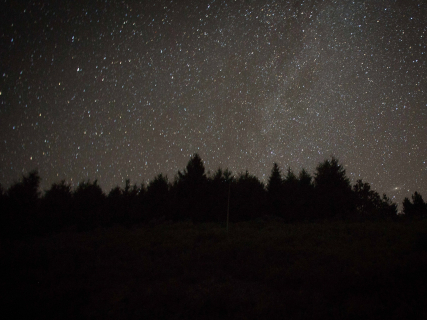
After the eclipse, the Perseids 2026 arrive: what time to see the meteor shower tonight

The peak of the Perseids will arrive during the early morning of August 12 to 13, just a few hours after the total solar eclipse, and will coincide with the new moon, which will leave especially favorable conditions to observe the "tears of Saint Lawrence."

4 minutes

EuropaPress 5378672 lluvia perseidas vista sierra os ancares 13 agosto 2023 lugo galicia espana

EuropaPress 5378672 lluvia perseidas vista sierra os ancares 13 agosto 2023 lugo galicia espana

Add DEMÓCRATA to Google

Ask FREN

Published

Last updated

4 minutes

Most read

The sky of Spain chains together this Wednesday two of the great astronomical events of 2026. After the total solar eclipse on August 12, visible at sunset from a good part of the country, the maximum of the Perseids 2026 will arrive during the early morning.

The popular meteor shower will reach its peak activity on the night of August 12 to 13 and, this year, will have an exceptional circumstance for its observation: the new Moon will practically reduce lunar light pollution to zero.

From the eclipse to the Perseids in just a few hours

The solar eclipse on August 12, 2026 will be the first total solar eclipse visible from the Peninsula in more than a century. The path of totality will cross Spain from west to east during sunset and will pass through numerous capitals, from A Coruña to Palma, while other areas of the country will be able to see it partially.

But the astronomical spectacle will not end when the sun sets. Once night falls, the best period to observe the Perseids will begin, a meteor shower that occurs every summer and is popularly also known as "tears of Saint Lawrence" due to the proximity of its peak to the celebration on August 10.

The coincidence makes August 12 an especially unique astronomical day: Spain will be able to go from contemplating a total solar eclipse to enjoying one of the most popular meteor showers of the year in just a matter of hours.

What time to see the Perseids 2026 tonight

The maximum of the Perseids 2026 is expected for the night of August 12 to 13. The National Geographic Institute places the point of maximum activity between 4:00 and 6:00 AM, so those who want to enjoy the best conditions will have to wait until the last hours of the night.

The shower, however, is not limited exclusively to those two hours. The Perseids are active over a much broader period and can be observed for several nights around the peak. The calendar of the International Meteor Organization (IMO) establishes an activity period for 2026 from July 17 to August 24.

Therefore, it will be possible to start looking for shooting stars before dawn, although the probabilities will improve as the night progresses and the radiant of the Perseids gains height above the horizon.

The new Moon will favor the Perseids of 2026

One of the best pieces of news for those who want to observe the Perseids tonight will be the absence of moonlight. The calendar of the International Meteor Organization confirms that the New Moon occurs precisely on August 12, providing very favorable conditions around the peak of the shower.

The difference can be significant. The brightness of a full moon or one close to full can obscure the weaker meteors and considerably reduce the number of shooting stars visible to the naked eye. This year that obstacle will practically disappear.

The IMO estimates for the Perseids of 2026 a zenithal hourly rate (ZHR) of around 100 meteors per hour under ideal conditions. This figure does not mean that anyone will see a hundred shooting stars in an hour: it is a theoretical rate calculated under optimal conditions, with a completely dark sky and the radiant positioned in an ideal location. From a rural place, the organization notes that the observed rates can typically be around 30 to 50 Perseids per hour at the peak.

Where to look to see the Perseids

The Perseids get their name because their meteors seem to come from a point located near the constellation of Perseus, known as the radiant. However, it is not necessary to look directly at Perseus to enjoy the shower.

Meteors can appear in different areas of the sky and, in fact, looking away from the radiant allows for longer trails to be seen. The important thing is to have the largest possible field of vision and to allow the eyes to adapt to the darkness.

Unlike the solar eclipse, to observe the Perseids no glasses or any optical instruments are needed. They are seen with the naked eye, so binoculars and telescopes do not provide an advantage for following a meteor shower.

How to choose the best place to see the Perseids

The main enemy of the Perseids 2026 will be light pollution. The darker the sky, the greater the number of weak meteors that can be distinguished.

Therefore, it is advisable to move away from urban centers, streetlights, well-lit roads, and other sources of artificial light. A rural environment with a wide and clear horizon will offer better conditions than the center of a large city.

It is also advisable to stay away from bright screens for a while to help the eyes adapt to the darkness. Observing a meteor shower requires patience: meteors do not appear at regular intervals and several can occur in a few minutes and then there can be a period without noticeable activity.

What are "shooting stars" really

Although we commonly talk about meteor shower, the Perseids are not stars. Meteors are luminous phenomena produced when small particles of matter penetrate the Earth's atmosphere at high speed and heat up during their journey.

In the case of the Perseids, those particles come from the comet 109P/Swift-Tuttle. Every year, when the Earth passes through the region of its orbit where remnants released by the comet remain, the number of visible meteors significantly increases.

The Perseids reach speeds of around 59 kilometers per second, which explains the quick flashes that cross the sky for just a few moments.

An exceptional day: daytime eclipse and Perseids at dawn

The 12th of August 2026 will be marked on the Spanish astronomical calendar by the coincidence of both phenomena. First, the total solar eclipse will occur at sunset and, during the early morning of Thursday the 13th, the Perseids will reach their peak.

The astronomical conditions for the meteor shower will also be particularly good due to the coincidence with the New Moon, although the actual visibility will also depend on clouds, light pollution, and the weather conditions of each locality.

Those who want to take advantage of both events will therefore have a long day ahead: eclipse at sunset and Perseids during the early morning, with the period between 4:00 and 6:00 hours as a reference to try to observe the maximum of the "tears of Saint Lawrence".

More key points, information and questions with FREN

AI-GENERATED CONTENT

What legal procedures or requirements are needed to organize public astronomical observation activities in Spain?

To organize public astronomical observation activities in Spain (workshops, meetups, events open to the public), the key is that, legally, they usually fit as public shows or recreational activities and/or as occupation of public domain, with very decentralized regulation. In practice, the basic regime is given by the state regulations on citizen security, civil protection, minors, and local treasuries, but the specific requirements (license, responsible declaration, capacity, schedules, etc.) are set by the autonomous community and the municipality where the event is held. Added to this are cross-cutting demands such as civil liability insurance, possible self-protection plans, and compliance with regulations on minors and air safety (in case of use of lasers or light beams).

Regime of public shows and recreational activities

The competence in public shows matters is transferred to the autonomous communities, which have enacted their own laws. By way of example:

  • Andalusia: Law 13/1999, on Public Shows and Recreational Activities of Andalusia (Law 13/1999), developed by several decrees on occasional and extraordinary activities and admission of persons.
  • Catalonia: Law 11/2009, on administrative regulation of public shows and recreational activities (Law 11/2009).
  • Community of Madrid: Law 17/1997, on Public Shows and Recreational Activities (Law 17/1997), amended by Law 4/2013 (Law 4/2013).

These regulations usually distinguish between:

  • Permanent or periodic activities (e.g., observatory open to the public), which require opening and activity licenses.
  • Occasional or extraordinary activities (one-off workshops, themed nights), which require specific authorization or, in some territories, a responsible declaration, setting conditions on schedule, capacity, security, presence of responsible personnel, etc.

Additionally, Organic Law 4/2015, on citizen security protection (LO 4/2015) foresees the intervention of authorities in matters of public shows and recreational activities and sanctions as a serious infraction the holding of shows or recreational activities despite prohibitions or suspensions for security reasons.

Occupation of public roads and public domain

If the observation is done in parks, squares, viewpoints, or other public use areas, a municipal authorization for occupation of public roads is usually required, with payment of the corresponding fee. The Consolidated Text of the Local Treasuries Law (Royal Legislative Decree 2/2004) allows municipalities to establish fees for the exclusive use or special exploitation of local public domain (e.g., installation of telescopes, tables, tents).

Municipal ordinances specify the procedure: prior application (often with a plan and schedule of the event), acceptance of conditions on cleaning, noise, and, if applicable, regulations on protection of natural spaces.

Security, self-protection, and insurance

In events with some attendance, a self-protection plan or at least organizational security measures may be required. The repealed but still temporarily applicable Basic Self-Protection Standard, approved by Royal Decree 393/2007 (RD 393/2007), obliges holders of centers, establishments, and premises where activities that may cause emergency situations are carried out to have a self-protection system, with their own means for prevention, alarm, evacuation, and rescue.

Although many astronomical observations are of low risk, when there is large attendance or auxiliary infrastructures are used (stages, electrical installations, etc.), the autonomous community or municipality may require a self-protection plan or at least a basic security document. In any case, it is common practice and sometimes a regulatory requirement to have a civil liability insurance that covers personal or material damages caused to third parties; the Penal Code (Organic Law 10/1995, LO 10/1995) provides for civil liability for negligent damages, and insurers can be direct civil liable parties.

Protection of minors

If the event is aimed at families or schoolchildren, child protection regulations come into play: Organic Law 1/1996, on Legal Protection of Minors (LO 1/1996), amended by Organic Law 8/2015 (LO 8/2015) and Law 26/2015 (Law 26/2015), and Organic Law 8/2021, on comprehensive protection of children and adolescents against violence (LO 8/2021).

These laws impose on organizers a heightened obligation to prevent violence and to care for the environment in which minors participate: clear signage, access control, adequate accompaniment, and basic protocols for incidents. In school activities organized by educational centers, educational regulations and teacher responsibility also apply.

Use of lasers and light beams

In some observations, laser pointers or projectors are used to point out objects in the sky. Organic Law 4/2015 considers it a serious infraction to project light beams onto drivers or pilots of means of transport with risk of causing an accident; this requires extreme caution not to direct lasers towards roads, airways, or aircraft approach zones. If high-power equipment or those near airports are used, prior coordination with Air Safety may be necessary.

Practical summary of usual procedures

  • Check if the activity, by capacity and format, fits into the autonomous regime of public shows/recreational activities, and if it requires authorization, prior communication, or responsible declaration.
  • Request from the municipality the authorization for occupation of public roads (parks, squares, viewpoints) and pay the corresponding fee.
  • Contract a civil liability insurance and, if applicable, prepare a brief security/self-protection plan (evacuation points, first aid kit, communication with emergencies, etc.).
  • Adopt specific measures for protection of minors if it is a family or school activity.
  • Expressly regulate the use of lasers or projectors to avoid risks to traffic and aircraft, in accordance with LO 4/2015.

Other cited regulatory links

Some additional relevant texts: Basic Civil Protection Standard 2023, Madrid shows catalog, occasional activities Andalusia, admission of persons Andalusia, Andalusian catalog, extraordinary activities Madrid, Pyrotechnic regulation, Roads Law, Law 33/2003 Heritage, Law 13/1996.

What practical differences exist between autonomous communities when authorizing astronomical activities open to the public? How is a simple self-protection plan adapted to an astronomical observation meetup prepared? What civil liability insurances do astronomical associations usually contract for their public activities?

What are the competencies of the National Geographic Institute in the dissemination and study of astronomical phenomena?

The National Geographic Institute (IGN) is, by norm and administrative practice, the main State authority in matters of positional astronomy and astronomical phenomena visible from Spain. Its competencies combine scientific planning and exploitation of its observatories (through the National Astronomical Observatory and the Yebes Observatory) with the function of providing official astronomical information and developing a broad role of dissemination and public service in eclipses, solstices, planetary alignments, or meteor showers. This position is supported by the Royal Decree on the structure of the Ministry of Transport and by recent Government practice, which has entrusted it with the scientific preparation of the so-called “trio of eclipses 2026‑2028.” From there, the IGN acts both as a scientific reference center and as a one-stop shop for citizens regarding safe and accessible astronomical information.

Regulatory and organizational framework of astronomical competencies

The agreements published in the BOE state that the General Directorate of the IGN, attached to the Undersecretariat of the Ministry of Transport and Sustainable Mobility, exercises its functions according to Royal Decree 253/2024, of March 12, which develops the basic organizational structure of the Ministry. That Royal Decree assigns it, among others, the specific competence of “scientific planning and exploitation of its own astronomical instrumentation and infrastructures, as well as their technological development and operational management”, as cited in the annex of the agreement resolution with the University of Las Palmas de Gran Canaria, published in the BOE (IGN–ULPGC agreement).

Another official text, the protocol between Treasury, Transport, and the National Geographic Information Center (CNIG), again refers to article 16 of the same Royal Decree 253/2024 and adds relevant functions for the dissemination aspect: the management of historical, cartographic, and documentary funds of the IGN “promoting their knowledge in society” (CNIG–Treasury–Transport protocol). Although this clause is formulated thinking of cartography, in practice it includes the funds of the Royal Observatory of Madrid, which today functions as the headquarters of the National Astronomical Observatory.

Additionally, the Ministry of Transport has explicitly stated in an official note that “the IGN is the directing center […] that has the competencies to provide official information in astronomy through the National Astronomical Observatory” when presenting the website dedicated to the eclipses of 2026, 2027, and 2028 (note about the eclipse website).

Scientific functions: observatories and study of astronomical phenomena

From a scientific point of view, the IGN manages a network of astronomical observatories, among which stand out the Royal Observatory of Madrid and the Yebes Observatory (Guadalajara). La Moncloa has presented Yebes as a “world reference for astronomy, space geodesy, and Earth observation,” in a note on the 50th anniversary of the center (Yebes Observatory anniversary).

Royal Decree 253/2024, through the texts that cite it, makes clear that the IGN not only maintains these infrastructures but must plan their scientific exploitation, promote their technological development, and coordinate observation networks linked to geodesy and geophysics. Added to this is the historical weight of the institution in astronomy, highlighted by Transport when commemorating the bicentenary of Carlos Ibáñez de Ibero, where the IGN is claimed as a reference in “geodesy, geophysics, astronomy, cartography, and geographic information” for 155 years (bicentenary of the IGN founder).

Dissemination and provision of official astronomical information

The other major competency area of the IGN is dissemination and provision of astronomical information to the public. On the eclipse website launched by Transport, the IGN and CNIG offer detailed calculations of the shadow path for more than 8,000 municipalities, as well as searchers and cartographic viewers developed by the CNIG (institutional eclipse website). Demócrata has reported that, based on this, the IGN maintains a specific interactive viewer for the total eclipse of 2026 that allows consulting, municipality by municipality, the time, duration, and type of eclipse (interactive map of the 2026 eclipse).

This work extends to other periodic phenomena. Demócrata repeatedly cites the calculations of the National Astronomical Observatory, dependent on the IGN, to set the exact time of solstices and equinoxes, as in the information about the start of summer 2026 (summer solstice time), or to describe lunar eclipses and other ephemerides (lunar eclipse and “blood moon”). It also systematically uses IGN forecasts for meteor showers, planetary alignments, or critical phases of the Moon, which de facto consolidates its role as the official source of astronomical ephemerides.

Specific competencies in the “trio of eclipses” 2026‑2028

The sequence of three major solar eclipses between 2026 and 2028 has reinforced the institutional visibility of the IGN. The Ministry of Science promoted an Interministerial Commission to coordinate the so-called “Trio of Eclipses 2026‑2027‑2028” (creation of the interministerial commission), in whose first meeting experts from the National Astronomical Observatory, the Canary Islands Astrophysics Institute, and other specialized bodies participated (first meeting of the commission).

In the news coverage, Demócrata highlights that the IGN itself calls this succession the “Iberian trio of eclipses” and that, besides the calculations, the body is deploying scientific dissemination and visual safety campaigns (explanation of the Iberian trio). This work includes issuing safe observation protocols, recommendations for using certified glasses, and participation in the commercialization, through the CNIG, of specific glasses for solar observation (guide on safe glasses and sale of IGN glasses).

Yebes Observatory as official monitoring center

An important derivative of these competencies is the designation of the Yebes Astronomical Observatory, managed by the IGN, as the “official monitoring center” of the total eclipse on August 12, 2026. According to several reports collected by Demócrata, the Government has entrusted Yebes with hosting the institutional and media device of the event, with live broadcasts and participation of specialists from the IGN and other scientific bodies (economic impact of the eclipse and safe observation guide). This choice confirms the role of the IGN as interface between the scientific community, administrations, and citizens in major astronomical phenomena.

In summary, the ministerial structure regulations and recent practice show that the National Geographic Institute concentrates in the General State Administration the functions of applied research, operation of observatories, and public dissemination in classical astronomy and phenomena visible from Spain, with the National Astronomical Observatory as the scientific arm and the CNIG as cartographic and commercial support.

How many meteor showers similar to the Perseids can be observed in Spain throughout the year and what are their main characteristics?

The question you raise is very interesting but falls outside the scope for which I am designed. I am a tool specialized in politics and sociopolitical current affairs in Spain (parliamentary activity, Government, parties, public actors, regulations, public policies, etc.), and I do not have technical or updated information on astronomical phenomena such as meteor showers, including the Perseids or others similar.

Specifically, I cannot reliably provide you with:

  • A reliable count of how many important meteor showers are observed in Spain throughout the year.
  • Their astronomical parameters (frequency, radiant, meteor speed, average apparent magnitude, progenitor bodies, etc.).
  • Observation recommendations (best hours, sky direction, Moon impact, light pollution levels, or amateur observation tips).

My training and sources focus on:

  • Spanish politics: central Government, General Courts, state political parties and, partly, autonomous ones.
  • Parliamentary activity: bills and legislative proposals, royal decree-laws, debates, votes, questions and interpellations, appearances and committees.
  • Executive activity: Council of Ministers agreements, regulatory projects, strategic plans, and sectoral public policies.
  • Sociopolitical current affairs: public debates on legal reforms, economic, social, energy, educational, health policies, etc., and the role of various institutional and social actors.

In other words, I am prepared to answer, for example:

  • How a law on science, space, or astronomical research is processed in the Congress of Deputies.
  • What policies support space research or astronomical observation exist in Spain (R&D plans, public funding, international agreements).
  • What position the main parties have on investment in scientific research, including astrophysics.
  • What parliamentary initiatives have been presented related to the Spanish Space Agency or scientific projects linked to space.

However, pure scientific content questions, such as detailed descriptions of meteor showers, constellations, stellar evolution, comet or planet orbits, are not part of the scope I can cover with the required accuracy guarantees.

If you are interested in the political or public policy dimension related to astronomy, I could be useful. For example, I could help you with questions like:

  • What role the Spanish Space Agency has in national scientific policy and what political decisions have marked its development.
  • What public funding lines exist for astronomical observatories or research centers in Spain.
  • How the Spanish Parliament has addressed light pollution regulation and its impact on night sky observation.
  • What international agreements Spain has signed regarding space exploration or scientific cooperation in this field.

To answer in detail your astronomical question about meteor showers (annual number, main characteristics, similarities with the Perseids), I would recommend consulting specialized astronomy sources, such as:

  • Spanish astrophysics institutes and observatories (for example, the main public research institutes in the Canary Islands, Andalusia, Catalonia, etc.).
  • Astronomy amateur associations, which usually publish detailed calendars of meteor showers visible from the peninsula and the islands.
  • International scientific organizations that compile data on meteor showers and their visibility from different latitudes.

If you reformulate your question towards the political or regulatory field (for example, asking about Spanish scientific policy in astronomy, the creation and competencies of the Spanish Space Agency, or state or autonomous regulations on light pollution affecting meteor shower observation), I can offer you a detailed response adapted to the current Spanish context.

What public policies and R&D plans does Spain have to support astronomy and space observation? How was the Spanish Space Agency created and what political debates took place in Parliament about it? Is there any state or autonomous regulation in Spain on light pollution that affects night sky observation?

Play

Test your knowledge with FREN!

How much do you know about this topic? Answer the following 3 questions.

What astronomical phenomenon will be observable in Spain on August 12, 2026, besides the Perseids?

Question 1 of 3

Why will the observation of the Perseids be especially favorable in 2026?

Question 2 of 3

What do the 'shooting stars' of the Perseids actually come from?

Question 3 of 3

Hola, soy Fren. ¿Cómo te ayudo?