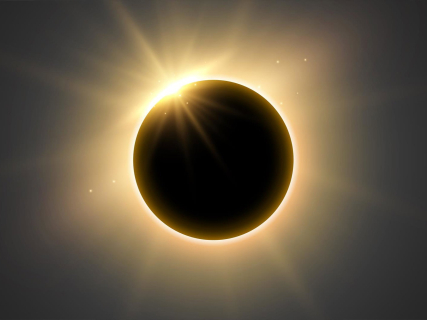
Complete guide to the solar eclipse 2026 in Spain: what time it starts, where to see it, and what glasses to use

The total solar eclipse of August 12 will be observable at sunset from Spain, although the visibility, the duration of totality, and the height of the star above the horizon will change considerably depending on the locality.

5 minutes

fotonoticia 20260505095620 1920

fotonoticia 20260505095620 1920

Add DEMÓCRATA to Google

Ask FREN

Published

Last updated

5 minutes

Most read

Spain lives this Wednesday, August 12, 2026 the first total solar eclipse visible from the Peninsula in over a century. The shadow of the Moon will travel across the territory from west to east and will allow the totality to be seen from a good part of the northern half and the Balearic Islands. In the rest of Spain, the phenomenon will be observable as a partial eclipse.

The most awaited moment will arrive around 8:30 PM, although the exact time will depend on each locality. Since it occurs at sunset, with the sun very low on the horizon, the choice of location will be especially important. It will also be essential to use appropriate eye protection during the partial phases.

When the solar eclipse of 2026 starts and where it will be total

The solar eclipse of August 12, 2026 will begin at sunset. The path of totality will first cross the Arctic Ocean, Greenland, and Iceland, then cross the Atlantic and enter the Iberian Peninsula through Galicia before continuing eastward to reach the Balearic Islands.

In Spain, the path of totality will cover part of Galicia, Asturias, Cantabria, Basque Country, Castile and León, La Rioja, Navarre, Aragon, Catalonia, Valencian Community, and the Balearic Islands.

In the southern half of the Peninsula and in the Canary Islands, the eclipse will be partial, so in these areas the solar disk will not be completely covered by the Moon.

What time the solar eclipse will be seen in Spain

There is no single time for the entire territory. The start, maximum, and end of the solar eclipse of 2026 will vary depending on the point from which it is observed.

In A Coruña, for example, it will start at 7:31 PM and reach its maximum at 8:28 PM. In Burgos, it will begin at 7:33 PM and reach the maximum at 8:29 PM, while in Palma it will start at 7:38 PM and reach its central point at 8:32 PM.

The most awaited phase will therefore arrive approximately at 8:30 PM. The duration of totality will also change: it will be around 76 seconds in A Coruña and will reach approximately 104 seconds in Burgos.

Where to look to see the eclipse

The eclipse will have a particularity that will especially condition its observation in Spain: it will occur with the sun very close to the horizon.

One will have to look towards the west, the direction in which the star will be setting. Experts from the National Geographic Institute (IGN) recommend choosing an open space and checking beforehand that buildings, trees, mountains, or other obstacles do not block the horizon.

The height of the sun during the maximum will also change significantly depending on the location. It will be approximately 12 degrees in A Coruña, eight degrees in Burgos, and barely two degrees in Palma. Therefore, an elevated place does not have to be automatically the best option, and factors such as access, capacity, mobility, and the possibility of leaving the area in an orderly manner should also be evaluated.

Official points to observe the solar eclipse

The autonomous communities located within the areas with the best visibility conditions have enabled official observation points for the eclipse to facilitate organized public viewing.

The choice of these locations does not depend solely on the duration of totality. Issues such as access, capacity, mobility, and the ability of emergency services to act are also taken into account.

Authorities recommend avoiding improvised travel, using public transport when possible, and following the established traffic and emergency guidelines.

What glasses to use to see the eclipse

To observe the eclipse directly, specific solar observation glasses that comply with the EN ISO 12312-2:2015 standard must be used. If they are marketed within the European Union, they must also include the CE marking, identify the manufacturer, and include instructions on their use and maintenance.

Before using them, it is necessary to check their condition. They should not have scratches, perforations, bends, or discolored areas, as any deterioration could compromise their protective capacity.

Conventional sunglasses are not suitable for observing an eclipse, regardless of how dark they are. X-rays, compact discs, smoked glasses, photographic negatives, or other improvised filters should also not be used.

Why looking at an eclipse without protection can damage the retina

Observing the sun directly without proper protection can cause eye damage and even loss of vision, warns the National Geographic Institute.

The decrease in ambient light during the eclipse can also create a false sense of security. As explained by the Knowledge Transfer Office of the Complutense University of Madrid, when ambient light decreases, the pupil dilates, but solar radiation continues to reach the eye.

This exposure may provoke a solar retinopathy. Ultraviolet radiation can cause damage to photoreceptor cells, while infrared energy can generate a thermal effect on the retinal tissue.

When glasses can be removed during a total eclipse

Even using proper protection, the IGN advises not to look at the sun for more than one minute in a row. The glasses should be put on before directing the gaze towards the star and removed only after averting it.

There is an exception during a total eclipse. Only those within the path of totality will be able to remove their glasses during the brief moments when the Moon completely covers the solar disk.

During all partial phases, it will be necessary to maintain protection, and the glasses will have to be put back on before any bright part of the sun reappears. In places where the eclipse is only partial, they must be used throughout the observation.

Care with cameras, binoculars, and telescopes

Eclipse glasses do not allow safe observation of the sun through a camera, binoculars, a telescope, or a telephoto lens.

These instruments concentrate solar radiation and require specific filters placed correctly in front of the lens. Looking through them using only eclipse glasses can be dangerous for the eyes.

Those who do not have proper protection can also resort to methods of indirect observation, such as a pinhole camera, which allows projecting the image of the sun without having to look at it directly.

What the weather will be like during the eclipse on August 12

The weather will be another of the decisive factors to enjoy the solar eclipse 2026 in Spain. The forecast from the State Meteorological Agency for this Wednesday points to a generally stable situation in much of the country, although there will be areas where clouds may hinder observation.

According to the forecast collected for this August 12, it will probably be very cloudy in areas of northern Galicia, the Cantabrian Sea, the Pyrenees, and northern Canary Islands. Clouds will also grow in mountainous areas of the eastern peninsula, although their final impact on observation presents greater uncertainty.

Therefore, in addition to checking the schedule and looking for a clear west horizon free of obstacles, it will be advisable to consult the updated weather forecast for the locality before traveling.

What will be seen during totality

As the Moon covers the solar disk, the ambient lighting will begin to change and the temperature may drop. In the moments immediately before totality, what are known as Baily's beads may appear, small points of light caused by the passage of sunlight through the irregularities of the Moon's surface.

When the disk is completely hidden, the solar corona can be observed, the faint halo that surrounds the sun and is normally hidden by the enormous brightness of its surface.

The darkness will last from a few seconds to nearly two minutes depending on the location. Afterward, sunlight will reappear and the reverse process will begin, at which point it will be necessary to immediately use the protective glasses again.

More key points, information and questions with FREN

AI-GENERATED CONTENT

What legal requirements must official observation points for astronomical phenomena organized by autonomous communities in Spain comply with?

Official observation points for astronomical phenomena organized by autonomous communities generally do not have specific state regulations on "astronomical observation with the public." They are governed by the set of general rules on citizen security and civil protection, occupational risk prevention, accessibility, environment, and use of public domain, plus the autonomous legislation on public shows and recreational activities and, where applicable, specific rules on night sky protection. This usually implies administrative authorization (or prior communication) as a show/recreational activity, a self-protection plan when there is a large attendance, civil liability insurance, compliance with accessibility regulations, and respect for environmental and land use restrictions. In specific territories (Canary Islands, Catalonia, Aragon...), there are also relevant specific rules on light pollution and activities in natural spaces.

1. Citizen security and civil protection

From the state perspective, any public gathering is subject to the framework of citizen security of Organic Law 4/2015, on the protection of citizen security (LO 4/2015), and the civil protection system of Law 17/2015, of the National Civil Protection System (Law 17/2015). Based on this, communities usually require:

  • Classification of the event as a public show or outdoor recreational activity.
  • Prior authorization or communication, with an organizational report and estimated capacity.
  • In mass events, a self-protection plan, taking as reference the Basic Self-Protection Standard (developed via state and autonomous regulations; for example, the Canary Islands Self-Protection Regulation, Decree 67/2015, [link]).

2. Occupational risk prevention

For the organizing staff, Law 31/1995 on Occupational Risk Prevention (Law 31/1995) and its regulatory development (such as Royal Decree 171/2004 on coordination of business activities, RD 171/2004) apply. This requires:

  • Specific risk assessment of assembly, night access, vehicle circulation, etc.
  • Adoption of preventive measures (minimum safety lighting, marking, PPE when appropriate).
  • Coordination of prevention if several companies are involved (security, transport, hospitality, etc.).

3. Civil liability and insurance

There is no specific state insurance for this type of activity, but autonomous laws on shows usually impose minimum civil liability insurance for events with the public. Representative examples include:

  • Catalonia: Law 11/2009, regulating public shows and recreational activities (Law 11/2009).
  • Aragon: Law 11/2005, regulating public shows, recreational activities, and public establishments (Law 11/2005 Aragon), developed by Decree 143/2018 ([link]).
  • Canary Islands: Law 7/2011, on classified activities and public shows (Law 7/2011) and its Regulation approved by Decree 86/2013 ([link]).

In practice, it is required to justify a civil liability policy covering personal and material damages to attendees and third parties.

4. Use of public domain and natural spaces

If the observation point is installed in:

  • Forests or forested areas, Law 43/2003 on Forests (Law 43/2003) and Law 42/2007 on Natural Heritage and Biodiversity (Law 42/2007) apply, requiring compatibility with conservation and, in protected areas, authorization from the managing body.
  • National parks, Law 30/2014 on National Parks (Law 30/2014) and the Network Master Plan (RD 389/2016) govern, conditioning organized public use to what is foreseen in the PRUG and specific authorizations.
  • Coastal zones and beaches, Law 2/2013 on protection and sustainable use of the coast and the General Coastal Regulation, approved by Royal Decree 876/2014 (RD 876/2014), require concession or authorization for occupation of the maritime-terrestrial public domain.

5. Environment and light pollution

Regarding atmosphere and lighting, the following are relevant:

  • Law 34/2007 on air quality and atmosphere protection (Law 34/2007).
  • Regulation on energy efficiency in outdoor lighting installations, approved by Royal Decree 1890/2008 (RD 1890/2008), which limits power and light emissions in outdoor lighting.
  • In the Canary Islands, the specific protection regime for the astronomical quality of IAC observatories, developed by Royal Decree 243/1992 (RD 243/1992), very relevant if the point is in Tenerife or La Palma.
  • In Catalonia, Law 6/2001 on environmental regulation of lighting for night environment protection (Law 6/2001) and its deployment by Decree 190/2015 (Decree 190/2015), which set strict criteria for outdoor lighting.
  • In Aragon, Law 11/2014 on Environmental Prevention and Protection (Law 11/2014 Aragon), which frames environmental authorizations for activities in natural spaces.

At observation points, this translates into minimizing artificial lighting, using downward-directed luminaires, and complying with zones and protection levels defined by autonomous plans for the “night sky.”

6. Accessibility for people with disabilities

Regarding accessibility, the state reference is the consolidated text of the General Law on the rights of people with disabilities and their social inclusion (RDLeg 1/2013) and Royal Decree 193/2023, which regulates basic conditions of accessibility and non-discrimination in goods and services available to the public (RD 193/2023). For an observation point, this implies, among other aspects:

  • Accessible routes (slopes, surface, signage) to the observation area, as far as the terrain allows.
  • Accessible information (legible signs, alternative formats, etc.).
  • Avoiding architectural barriers in temporary service areas (portable toilets, tents, etc.).

7. Authorizations and autonomous regime of shows

The specific authorization, deadlines, maximum capacities, requirement of health services or private security, and insurance amounts depend on the autonomous legislation on public shows and recreational activities. Besides the already mentioned Canary Islands and Catalonia, the Aragonese regulation on occasional and extraordinary shows (Order PRE/665/2017 and D 143/2018, both from BOA: [link] and [link]) illustrates how communities detail the processing for outdoor events.

In summary, an official astronomical observation point is legally configured as an outdoor show or recreational activity that must: be authorized (or communicated) according to the autonomous law on shows, have the required security and self-protection measures, respect land use and natural space regimes, minimize light pollution, and guarantee basic accessibility conditions.

What specific requirements do autonomous communities usually demand in the authorization files for public outdoor shows for astronomical observation events? How is the organization of an official astronomical observation point coordinated within a national park with Law 30/2014 and the Network Master Plan of National Parks? What regulatory differences exist between the Canary Islands, Catalonia, and Aragon regarding night sky protection and how do they affect astrotourism activities organized by administrations?

What are the competencies of the National Geographic Institute regarding astronomical events?

The National Geographic Institute (IGN), through its General Directorate and the Royal Observatory of Madrid, exercises the state functions in Spain regarding astronomy, understood mainly as services of observation, calculation, and dissemination of astronomical and geophysical information. These competencies are framed within the functions of the Ministry of Transport, today Ministry of Transport and Sustainable Mobility, which is responsible for the promotion and direction of state services related to astronomy, geodesy, geophysics, and cartography. The consulted regulations specify mainly the organizational framework and the role of the Royal Observatory of Madrid as a scientific and outreach center, but do not detail each type of event (eclipses, meteor showers, asteroids, etc.). No further information is available in the consulted sources that expressly describes, in the BOE, the specific competence of the IGN regarding each of those specific phenomena.

Organizational framework: astronomy as a state service

The astronomical competencies of the IGN are inserted within the general functions of the Ministry in astronomy, defined in several royal decrees of structure:

  • Royal Decree 1475/2000 assigns to the then Ministry of Development, among others, the function of “promotion and direction of state services related to astronomy, geodesy, geophysics, cartography, and metrology,” as stated in its article on the Department's competencies, to which the IGN is attached (Royal Decree 1475/2000).
  • Later, in developing and modifying that structure, Royal Decree 1037/2009 maintains that the Ministry is responsible for the “promotion and direction of state services related to astronomy, geodesy, geophysics, and cartography” (Royal Decree 1037/2009).
  • This same formulation is updated for the current Ministry of Transport, Mobility, and Urban Agenda (today Transport and Sustainable Mobility) by Royal Decree 308/2022, which again expressly mentions astronomy within the Department's competencies (Royal Decree 308/2022).

In these texts, astronomy appears integrated into a set of “state services” promoted and directed by the Ministry, which in practice are channeled through the IGN and its specialized centers. The organizational regulations do not enumerate, however, in detail each astronomical task (type of ephemerides, event catalog, tracking of near-Earth objects, etc.).

Role of the Royal Observatory of Madrid

The Royal Observatory of Madrid, historically linked to the IGN, is configured as the main state astronomical center for scientific-technical and outreach activities. The Resolution of October 27, 2010 of the National Geographic Information Center, regarding public visit fees and dissemination of its scientific-technical activities, mentions it precisely in this dual scientific and outreach role (Resolution on visits to the Royal Observatory).

From this resolution, it follows that the Observatory, integrated into the IGN structure, develops:

  • Scientific-technical activities in astronomy and related disciplines.
  • Outreach programs and public visits, including explanation of astronomical phenomena and making available to the public content on relevant events (such as eclipses, conjunctions, etc.).

Although the regulation focuses on the economic regulation of these activities (public visit fees), it confirms the Observatory's role as a key instrument of the IGN in astronomy.

Material scope of astronomical competencies

Based on the general formulations of the royal decrees of structure and the function of the Royal Observatory of Madrid, the IGN's competencies in astronomical events can be summarized as follows:

  • Provision of state astronomy services: includes observation, analysis, and generation of scientific information on astronomical phenomena, within the general framework of “state services related to astronomy.”
  • Preparation and dissemination of information and ephemerides: although the consulted regulations do not explicitly mention astronomical “ephemerides,” the state service function of astronomy and the historical role of the IGN and the Royal Observatory suggest that the calculation and publication of astronomical data (solar and lunar positions, eclipse visibility, etc.) are integrated into their technical-scientific tasks. No further information is available in the consulted sources that expressly describes this in the BOE.
  • Outreach and scientific education: confirmed by the regulation of visits and dissemination activities of the Royal Observatory of Madrid, which makes the IGN an institutional reference for public explanation of major astronomical events.

No explicit references have been found in the analyzed regulations attributing to the IGN, by name, specific functions regarding meteor showers, potentially hazardous asteroids, specific planetary transits, or official time. There is also no explicit mention of impact risk catalogs or systematic observation of near-Earth objects. These tasks may be covered by administrative practice, scientific agreements, or other provisions not located in the search, but are not detailed in the consulted texts.

Other detected regulations

The analysis has found numerous BOE regulations mentioning the IGN or related areas (geography, cartography, scholarships, scientific infrastructures), but which do not add relevant detail on astronomical events. For informational purposes, among them are, for example, Order TRM/746/2024 on IGN scholarships ([link]), Order FOM/2807/2015 on dissemination of geographic information ([link]), and several sectoral or academic provisions without direct relation to astronomy, with links including: [link], [link], [link], [link], [link], [link], [link], [link], [link], [link], [link], [link], [link], [link], [link], [link], [link], [link], [link], [link], [link], [link], [link], [link], [link], [link], [link], [link], [link], [link], [link], [link], [link], [link], [link], [link], [link], [link], [link], [link], [link], [link], [link], [link], [link], [link], [link], [link], [link], [link], [link], [link], [link], [link] and [link], as well as other labor and academic resolutions such as [link], [link], [link], [link] and [link].

What exact role does the Royal Observatory of Madrid play within the IGN in the observation and dissemination of eclipses and other phenomena visible from Spain? Is there any specific regulation governing responsibility over official time in Spain and what is its relation to the astronomical functions of the IGN? How does the IGN coordinate its astronomical activities with other national or international bodies, for example regarding asteroid monitoring or space debris?

Which other autonomous communities or European countries have implemented similar measures for the safe observation of solar eclipses?

The most advanced safe observation measures for the eclipse recorded in the sources are concentrated in Spain: in addition to the state campaign distributing glasses, several autonomous communities and municipalities have their own protocols, while outside Spain, only a clear package of health and civil protection recommendations exists in Portugal. No specific data appear in the sources about comparable initiatives in other European countries for previous eclipses (2015, 2021, or 2024). In the educational field, the prominence is also mostly Spanish, with specific training for teachers and materials for schools. Therefore, the best-documented reference model in the EU is the Spanish one, with the added example of Portugal's preventive guidelines.

Measures in Spain beyond the central government

Besides the state campaign of two million glasses distributed by the Ministry of Science and the ONCE Social Group, described by the newspaper Demócrata in pieces such as Government and ONCE will distribute two million, free glasses to see the eclipse or where to get free glasses, several communities and municipalities have activated their own plans:

  • Galicia (Xunta): the campaign "Unha vista única. Coídaa," presented in A Coruña, reinforces the message of exclusive use of certified glasses and relies on massive distribution coordinated with ONCE, according to the Xunta note Unha vista única. Coídaa.
  • Aragon: the autonomous government, cited by Demócrata in Aragon claims to be the best prepared region, includes in its strategic plan the distribution of certified glasses and safety recommendations for all Early Childhood and Primary students, as well as a mobility and show control device.
  • Balearic Islands: the Health Department has issued specific recommendations, discouraging children under 6 from looking directly at the eclipse and reinforcing inspections of non-certified glasses (with destruction of irregular units), as Demócrata reports in Balearic measures and debate on Serra de Tramuntana.
  • Murcia (municipality): the Murcia City Council has organized a special activity at El Castillejo with free distribution of certified glasses for all visitors and prior distribution of glasses and outreach material in Summer Schools, according to the municipal note activity at El Castillejo.
  • València (municipality): has a “Special Solar Eclipse 2026 device” with an Official Observation Point on urban beaches, coordination of Local Police, reinforced public transport, and a specific campaign on the use of ISO 12312-2 glasses, described in municipal protocol. It has also disseminated a safety advice decalogue for citizens, insisting on certified glasses from the beginning to the end of the phenomenon, according to València decalogue.
  • Pamplona (municipality): will distribute 7,000 glasses among vulnerable populations, accompanied by a usage protocol (putting them on looking down and removing them also with the head lowered to avoid glare), as reported in distribution of 7,000 glasses in Pamplona.

Other communities have enabled official observation points and specific planning (Asturias, Castile and León, Community of Madrid, Castile-La Mancha, Catalonia, Valencian Community, Balearic Islands...), as detailed by Demócrata in official observation points and interactive eclipse map. The central government, for its part, has approved a Specific Civil Protection Plan and centralized official information on the eclipse trio website, according to the Moncloa note “114 years later, Spain will live again a total solar eclipse” and the Transport reference digital resources to plan the eclipse.

Educational and health measures in Spain

In the educational field, the Ministry of Education has launched a massive online course, “The Sun and the eclipse trio 2026-2027-2028,” aimed at teachers and citizens, which includes guidelines for safe observation and didactic proposals for Early Childhood, Primary, and High School, according to the official note training on the eclipse trio.

In the health field, professional associations of opticians and pharmacists have issued national recommendations on the use of certified glasses, collected both by Demócrata (for example in opticians' alerts, ophthalmologists' warnings or OCU's position) as well as by specialized health media, which insist on ISO 12312-2 glasses and avoiding homemade methods, as seen in Infosalus 2025, on solar radiation, protection of adequate glasses, government call to avoid travel and clinical analyses in Gaceta Médica, as well as outreach pieces in general press such as Eldiario.es, another guide on partial eclipse and the contextual report from El País.

Examples in other European countries

Outside Spain, the only explicit reference to recent institutional measures in the sources is that of Portugal. The Portuguese government has published an official note with health and safety recommendations for the eclipse, emphasizing the need for self-protection measures, the importance of visual protection, and precautions in rural and forest areas due to the expected public influx, according to Portuguese government statement.

No further information is available in the consulted sources about other European countries that have articulated mass distribution campaigns of glasses, partial closures of centers, or school protocols as detailed as those described for Spain, nor about measures for previous eclipses (2015, 2021, or 2024). In this sense, the available evidence places the Spanish case — with interministerial coordination, participation of autonomous communities and municipalities, and strong involvement of the health and educational system — as one of the most complete models currently documented in Europe.

What specific role are the autonomous communities playing in the Interministerial Commission of the Eclipse Trio? What obligations do Spanish educational centers have regarding the eclipse according to the Ministry of Education's guidelines? Has any European country considered making ISO 12312-2 certification mandatory in the sale of eclipse glasses?

Play

Test your knowledge with FREN!

How much do you know about this topic? Answer the following 3 questions.

In which areas of Spain will the total solar eclipse of August 12, 2026, be visible?

Question 1 of 3

Why should conventional sunglasses not be used to observe a solar eclipse?

Question 2 of 3

What phenomenon can occur in the eyes if the eclipse is observed without proper protection?

Question 3 of 3

Hola, soy Fren. ¿Cómo te ayudo?