Colombia and Venezuela, two earthquakes of similar magnitude but very different consequences

The 7.4 magnitude earthquake in Colombia comes just a month and a half after the double earthquake in Venezuela. Magnitude, depth, damage, and victims explain why its consequences are so different.

4 minutes

fotonoticia 20260809153944 1920

fotonoticia 20260809153944 1920

Add DEMÓCRATA to Google

Ask FREN

Published

Last updated

4 minutes

Most read

The earthquake of magnitude 7.4 that has shaken Colombia this Monday comes just a few weeks after the devastating double seismic event in Venezuela, where two earthquakes of magnitude 7.2 and 7.5 separated by only 39 seconds ended up causing one of the largest recent natural disasters in South America. Although the magnitudes are comparable, the initial assessments show very different scenarios.

In Colombia, the movement has had its epicenter in San José del Palmar, in Chocó, and has caused serious damage in cities such as Cali, Pereira, Quibdó, and Manizales. Authorities continue to evaluate buildings, assist injured people, and search for possible trapped individuals. In Venezuela, on the other hand, the combination of two consecutive and very shallow earthquakes triggered massive destruction that, almost a month later, had already surpassed 5,000 fatalities.

An almost identical magnitude

On paper, the three movements belong to a similar category. The Colombian earthquake has reached a magnitude of 7.4, while the two that struck Venezuela on June 24 were 7.2 and 7.5.

But magnitude alone does not determine the level of destruction.

In Venezuela, a particularly rare phenomenon occurred: a "double" seismic event, that is, two earthquakes of similar size occurring almost in the same place and in an extremely short time interval. The first, of magnitude 7.2, was followed just 39 seconds later by another of 7.5.

This meant that buildings and infrastructures hit by the first movement had virtually no chance to stabilize before receiving a second shock that was even stronger.

Depth makes a decisive difference

One of the main known differences between both episodes lies underground.

The Venezuelan earthquakes were very shallow. According to the USGS, the first had an approximate depth of 22 kilometers and the second of just 10 kilometers.

The Colombian earthquake occurred much deeper. The estimates released during the first hours have been revised, although sources agree on placing it at several tens of kilometers below the surface. Associated Press reports a depth of about 107 kilometers; the Colombian Geological Service has been reviewing its parameters throughout the day.

This difference is relevant because, in general terms, a shallow earthquake can transmit a much more intense shake to the areas close to the epicenter than another of similar magnitude originating at greater depth.

In the Colombian case, the greater depth also helps explain why the movement could be felt over a huge geographical area, from Bogotá and Medellín to Ecuador.

Venezuela suffered two blows in less than a minute

The Venezuelan sequence was especially destructive due to the combination of magnitude, shallow depth, and temporal proximity.

The two earthquakes occurred on the northern coast, near Morón, in an area linked to the boundary between the Caribbean and South American plates. The second movement, of magnitude 7.5, came when the buildings had already suffered the first shake.

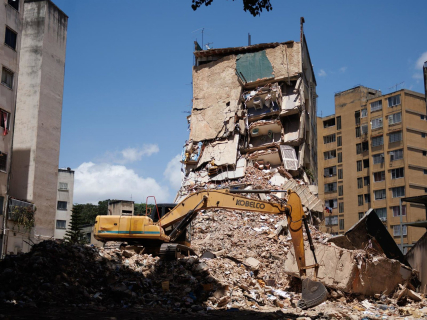
La Guaira became one of the most affected areas. Entire buildings collapsed, there were power outages, the country's main airport had to close temporarily, and thousands of people were trapped or missing during the first days.

The toll continued to rise for weeks. By mid-July, Venezuelan authorities had already counted more than 5,000 dead, 16,740 injured, and 17,907 people without housing. In addition, 856 buildings had been damaged and 190 had completely collapsed.

Colombia continues assessing the damages

In Colombia, it is still too early to establish a definitive comparison in terms of victims.

The earthquake has caused serious structural damage. In Cali, there have been landslides with people trapped, while in Quibdó the governor of Chocó has reported injuries and severe damage. Collapses have also been documented in Pereira and the fall of part of a tower of the cathedral of Manizales.

President Abelardo de la Espriella has directly taken charge of coordinating the emergency and has announced the installation of a Unified Command Post in San José del Palmar.

For now, there is no comparable toll to that of Venezuela, and Colombian authorities continue conducting inspections, rescues, and assessments.

Two distinct seismic scenarios

There is also an important tectonic difference.

The double Venezuelan earthquake was the result of a lateral slip movement on faults near the boundary between the Caribbean and South American plates, according to the USGS.

Colombia is located, for its part, in a tectonically very complex region where the plates of Nazca, South American, and Caribbean interact, in addition to numerous continental fault systems. For this reason, it registers seismic activity much more frequently. The earthquake this Monday occurred in western Colombia, in one of the areas of greatest seismic activity in the country.

The magnitude is not enough to measure a catastrophe

The comparison between both episodes allows us to understand why two earthquakes with similar magnitudes can produce radically different consequences.

Venezuela suffered two large movements separated by less than a minute, both very shallow and near densely populated areas. Colombia has so far recorded a single main earthquake, of comparable magnitude but considerably deeper.

To this, other factors are added that can only be analyzed when there is a definitive balance: the quality and age of the constructions, the distance of the cities to the epicenter, the duration of the shaking, the local geology, and the response capacity of emergency services.

For this reason, a 7.4 does not automatically equate to another 7.4. The magnitude informs of the energy released, but the level of destruction depends on how, where, and at what depth that energy is released.

Just a few weeks separate both events. Venezuela is still facing the consequences of a tragedy that has left thousands dead and tens of thousands affected, while Colombia is now beginning to measure the real extent of its own earthquake.

More key points, information and questions with FREN

AI-GENERATED CONTENT

What is the emergency coordination process in Colombia after a major earthquake and what powers does the president have in this area?

After a major earthquake in Colombia, emergency coordination is structured around the National Disaster Risk Management System (SNGRD), following a "bottom-up" logic: first, municipal and departmental authorities act, and when their capacity is exceeded, the National Unit for Disaster Risk Management (UNGRD) and the central Government fully intervene. The President of the Republic plays a decisive role: he leads the political direction of the emergency, can declare disaster situations or states of exception, and order the priority mobilization of civilian and military resources. His powers allow him to coordinate ministries, armed forces, and territorial governments, and to adopt extraordinary measures to protect the population and rebuild affected areas.

Basic institutional framework

Colombia organizes earthquake management under the General Disaster Risk Management Law (Law 1523 of 2012), which creates and articulates the SNGRD. This system groups national entities (ministries, UNGRD, armed forces, National Police), departmental and municipal entities, as well as organizations such as firefighters, the Red Cross, and Civil Defense.

The UNGRD is the national technical-operational body: it coordinates preparation, response, and recovery for large-scale disasters. In each territory, there are Municipal and Departmental Risk Management Councils, which are the "first line" of coordination during the first hours after an earthquake.

Coordination phases after a major earthquake

1. Immediate local response

At the moment of the earthquake, mayors and governors, through their Risk Management Councils, activate their emergency and contingency plans. Firefighters, rescue organizations, police, and local health services are mobilized. Rapid damage assessments are carried out on critical infrastructure (hospitals, roads, bridges, electrical and water networks) and unified command posts (PMU) are set up to coordinate search, rescue, and evacuation operations.

2. Escalation to the national level

If the earthquake's magnitude exceeds local or departmental capacity, the UNGRD activates the national Emergency Operations Center (COE). From there, functional "tables" or "groups" coordinate health care, logistics, shelters, water and sanitation, communications, and security. USAR teams (urban search and rescue) can be deployed from other cities, as well as logistical resources (mobile bridges, water treatment plants, field hospitals).

At the same time, sectoral ministries (Health, Transport, Housing, Defense, etc.) adjust their actions to prioritize the affected area, usually under guidelines issued by the Presidency and the UNGRD.

3. Disaster declaration and high-level political coordination

When the impact is very severe, the national Government can formally declare a disaster situation at the national or regional level. This declaration enables accelerated access to resources, exceptional use of budgets, reallocation of funds, and simplification of certain administrative and contracting procedures to address the emergency.

In parallel, the National Council for Disaster Risk Management is convened, which includes the main ministers and senior officials. This body defines action priorities, victim assistance strategies, and guidelines for the reconstruction and rehabilitation phase.

Powers of the President of Colombia

Within this framework, the president exercises key powers:

  • Political direction of the emergency: He is the highest authority of the SNGRD and can convene and preside over the National Risk Management Council, setting national priorities for response and reconstruction.
  • Declaration of disaster situations and states of exception: He can declare national disasters and, within the framework of the Constitution, states of exception (for example, economic, social, and ecological emergency) when the earthquake generates a large-scale crisis. This enables him to issue decrees with the force of law aimed at addressing the catastrophe.
  • Mobilization of armed forces and police: He can order the deployment of the Army, Navy, and Air Force for rescue operations, transportation of humanitarian aid, security in affected areas, and reconstruction of basic infrastructure.
  • Allocation and prioritization of resources: He leads the reallocation of the national budget towards the emergency, authorizes extraordinary credits, and coordinates with the Ministry of Finance and National Planning the design of reconstruction programs.
  • Relations with the international community: He authorizes and coordinates the request and reception of international aid (rescue teams, funds, technical assistance), negotiating bilateral support or with multilateral organizations.

From emergency to reconstruction

After the critical search and rescue phase, the president promotes, together with the UNGRD and ministries, plans for the reconstruction of housing, public infrastructure, and basic services. He also promotes economic support programs for affected families and productive sectors hit by the earthquake. This entire phase is articulated within the SNGRD, but with strong political leadership from the Presidency, which must balance urgency, transparency in the use of resources, and coordination with mayors and governors.

What are the differences between a disaster declaration and a state of economic, social, and ecological emergency in Colombia? How exactly do the UNGRD and the mayors of affected cities coordinate after a strong earthquake? What role do the Colombian armed forces play in rescue and reconstruction tasks after a seismic event?

What technical and regulatory requirements exist in Colombia and Venezuela for the construction of earthquake-resistant buildings?

At this moment, I cannot provide you with a technical and detailed description of the requirements of NSR‑10/NSR‑22 in Colombia nor of COVENIN 1756 in Venezuela (structural design, zoning maps, material control, permits, supervision, etc.), because the information available in the sources I handle does not go into that level of detail and, furthermore, my specialization is in Spanish normative and political reality. However, I can confirm, based on the news consulted, that both countries have their own seismic-resistant regulations and, in the Venezuelan case, explicitly cite COVENIN 1756.

Scope of available information

The ecosystem of sources I have access to is focused on Spain (state and regional legislation, parliamentary activity, press releases from Spanish administrations) and on the political and social current affairs coverage by the newspaper Demócrata. This allows following with some detail the construction and safety standards in Spain (for example, the Spanish Seismic Construction Standard NCSE‑02 and the Technical Building Code), but does not provide the technical text or systematic summaries of the standards of other Latin American countries.

In the specific case of your question, searches on NSR‑10/NSR‑22 in Colombia have not returned documents explaining their chapters, seismic classifications, design coefficients, material requirements, or construction supervision. Therefore, there is insufficient information to rigorously summarize what this regulation demands.

Regarding Venezuela, an analysis piece by Demócrata on the double earthquake of June 2026 indicates that the country has had a specific seismic-resistant regulation for years, and explicitly mentions the standard COVENIN 1756 for Seismic-Resistant Constructions, approved in 2001 and revised and updated in 2018 and 2019, but without detailing its technical content.

What can be stated about Venezuela

From the news of the newspaper Demócrata focused on recent earthquakes in Venezuela, several general ideas emerge, although not a "specification" of requirements like a technical guide:

  • Existence of specific regulation: the analysis on the seismic doublet indicates that Venezuela "has had a specific seismic-resistant construction regulation for years" and identifies it as COVENIN 1756, a "Seismic-Resistant Constructions" standard approved in 2001 and updated in 2018-2019.
  • Purpose of the standard: the article's context makes clear that the objective of this regulation is to adapt building construction to the country's seismic risk, reinforcing the capacity of structures to withstand strong earthquakes and reduce collapse risk.
  • Gap between regulation and built reality: several reports by Demócrata emphasize that massive damages concentrate in vulnerable buildings (unreinforced masonry, informal constructions, progressive extensions, etc.), suggesting that a significant part of the building stock does not fully comply, or only partially complies, with the more demanding standards pursued by COVENIN 1756.

Beyond these mentions, calculation parameters, soil categories or seismic zones, and formal procedures for project review and licensing in Venezuela are not detailed, so it would not be correct to invent or extrapolate them.

Limits regarding Colombia (NSR‑10 / NSR‑22)

For Colombia, the available sources only provide general seismic context (for example, notes on earthquakes on the border with Ecuador), but none delve into the content of the "Colombian Seismic-Resistant Construction Regulation NSR‑10" nor the update process towards a possible NSR‑22. The following are not described:

  • Official seismic hazard maps or zone classifications.
  • Structural design requirements (seismic coefficients, ductility, allowed typologies, etc.).
  • Material specifications (concretes, steels, quality controls).
  • Project review procedures, urban licenses, or equivalents to construction supervision.

Since this information is not available in the consulted sources, no further data on Colombia can be reliably provided.

What kind of issues I can better address

Although your question is technical and focused on Colombia and Venezuela, my specialization lies in the field of politics and regulation in Spain. I can respond more precisely, for example, on:

  • How seismic risk is integrated into Spanish urban planning and building regulations (NCSE‑02, Technical Code, civil protection plans).
  • Political and parliamentary debates in Spain or the EU on structural safety, disaster resilience, and reconstruction after earthquakes.
  • The political response and reconstruction plans in Venezuela after the 2026 earthquakes, as covered by Demócrata.

If you need a strictly technical analysis of NSR‑10/NSR‑22 or COVENIN 1756 (chapters, formulas, numerical values, detailed licensing procedures), the safest and most rigorous approach would be to consult the official texts of those standards or guides prepared by the engineering and architecture professional bodies of each country.

Can you explain what the current seismic-resistant regulations in Spain require and how they differ from the recent Venezuelan case? What political and reconstruction measures has the Venezuelan Government announced after the 2026 earthquakes? How is the adaptation of infrastructure to earthquake and other natural disaster risks being debated politically and in parliament in Spain?

How many earthquakes of magnitude greater than 7 have been recorded in South America in the last decade and what has been their impact?

The information you request about the number of earthquakes of magnitude greater than 7 in South America in the last decade and their impact falls within the field of seismology and geophysical sciences, not politics, public authority actions, or political-social current affairs. As an assistant specialized in politics and regulation, I do not have technical data or updated statistics on natural phenomena, so I cannot provide you with a rigorous or detailed answer to that specific question. For precise figures and historical series on earthquakes, the most appropriate is to consult scientific sources and specialized seismic monitoring organizations.

However, your question contains an element that does connect with my field: the impact of those earthquakes, understood not only as physical damage but also as political, social, and regulatory consequences. Although I cannot quantify or list the seismic events, I can explain how, in general, large earthquakes in South America in recent years have generated debates and decisions in the areas of public policies, civil protection, and urban planning, which is where my specialization lies.

Assistant's area of specialization

This assistant is designed to work on:

  • Spanish politics: Government activity, the General Courts, political parties, legislative reforms, parliamentary agreements, etc.
  • Political-social current affairs: major public debates, social conflicts, public policies in Spain (and, more limitedly, European and international).
  • Norms and regulation: explanation of laws, bills and legislative proposals, royal decree-laws, government strategies, sectoral policies.
  • Political and organizational actors: parties, parliamentary groups, socially relevant organizations in political debate.

I am not specialized in:

  • Geology, meteorology, or seismology.
  • Technical data on natural disasters (magnitudes, exact location, scientific cataloging).
  • Scientific information requiring access to databases such as those of national or international geological services.

How an earthquake connects with politics and public policies

Although I cannot give you the count of earthquakes of magnitude greater than 7 in South America, it is possible to generally describe how a major seismic event usually triggers political and regulatory responses. In most countries in the region, a strong earthquake impacts several fronts:

  • Civil protection and emergencies: activation of national and regional emergency plans, deployment of armed forces and security bodies, coordination with international organizations and NGOs. Afterwards, a debate usually arises about whether early warning, evacuation, and response systems were adequate.
  • Urban and construction legislation: major earthquakes tend to question the quality of buildings and compliance with seismic codes. This can lead to legal reforms to toughen building codes, strengthen construction inspections, and define responsibilities of developers, engineers, and administrations.
  • Public budgets: reconstruction requires significant resources. Governments usually approve extraordinary credits, budget reallocations, or even tax reforms to finance housing, infrastructure, schools, hospitals, and damaged transport networks.
  • Social policy: the most vulnerable sectors are usually the most affected by natural disasters. Consequently, direct aid programs, rental subsidies, population resettlement, and reinforcement of social services in affected areas are promoted.
  • Transparency and accountability: emergency management and reconstruction are usually subject to intense public and parliamentary scrutiny. Investigation commissions may be created, stricter contracting rules approved, or control mechanisms over reconstruction spending strengthened.

What kind of questions I can answer

If you are interested in the intersection between natural disasters and politics, I can help you with issues such as:

  • How the National Civil Protection System is structured in Spain and the role of the central Government, autonomous communities, and municipalities in the event of a major earthquake.
  • What kind of urban and building regulations have been debated or approved in Spain to improve resilience against earthquakes or other natural risks.
  • How public aid after disasters is politically and legislatively articulated (credit lines, subsidies, tax benefits, etc.).
  • What debates have taken place in the Spanish Parliament following major disasters, even if not seismic, and what lessons have been transferred to the legal framework.

Recommendation to obtain seismic data

To accurately answer your original question about how many earthquakes of magnitude greater than 7 have been recorded in South America in the last decade and their direct impact (victims, material damage, location), it is advisable to consult databases and specialized organizations in seismic monitoring and geological event catalogs, which offer detailed and expert-reviewed statistics.

What civil protection legal framework exists in Spain to face major earthquakes or other natural disasters? What recent parliamentary debates have taken place in Spain on emergency and disaster management? How do the central Government, autonomous communities, and municipalities coordinate in Spain in the face of a large-scale natural disaster?

Play

Test your knowledge with FREN!

How much do you know about this topic? Answer the following 3 questions.

Where was the epicenter of the magnitude 7.4 earthquake in Colombia?

Question 1 of 3

Why were the earthquakes in Venezuela especially destructive?

Question 2 of 3

What was the approximate depth of the Colombian earthquake according to Associated Press?

Question 3 of 3

Hola, soy Fren. ¿Cómo te ayudo?