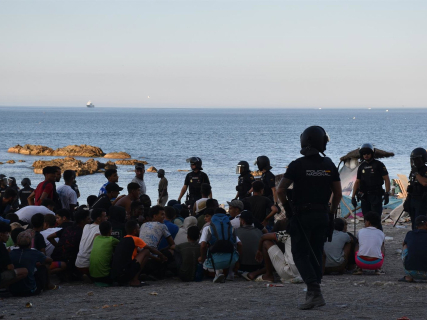
Survey crisis in Ceuta: 82% support militarizing the border with Morocco and 72% of PSOE voters also request it, according to Sigma Dos

The Sigma Dos survey for El Mundo places support for militarizing the Ceuta border again after the migration crisis at 82.4%. The measure is backed by 97.5% of PP voters, 99.7% of Vox voters, and 72.5% of socialists, while Sumar is the only major electorate where rejection predominates.

5 minutes

fotonoticia 20260808113002 1920

fotonoticia 20260808113002 1920

Add DEMÓCRATA to Google

Ask FREN

Published

Last updated

5 minutes

Most read

The militarization of the Ceuta border has become the measure with the greatest social support following the migration crisis opened in the autonomous city.

According to the Sigma Dos survey for El Mundo, 82.4% of Spaniards believe that Spain should militarize again the border, compared to 17.6% who reject that option. Support is practically unanimous among PP and Vox voters, but it also reaches a wide majority of the socialist electorate.

97.5% of those who voted for PP and 99.7% of Vox voters support that measure. Among PSOE voters, support reaches 72.5%. Sumar is the only large electorate where rejection predominates: 55.5% oppose, although 44.5% also support militarizing the border.

A transversal support for militarizing the border

The main data from the survey is the breadth of support for a tougher response at the southern border.

It is not just a position of the conservative electorate. The militarization is supported by more than eight out of ten Spaniards and by almost three out of four socialist voters.

The difference by sex is small: 81% of men and 83.7% of women support it. The measure, therefore, is not concentrated in a specific demographic profile, but rather crosses almost the entire political and social board.

The clearest exception is in Sumar. Among its voters, 44.5% support militarizing the border and 55.5% oppose it.

47.6% see pressure from Morocco as the main cause

The survey also asks about the main reason for the crisis that occurred in Ceuta.

The most pointed option is the pressure from Morocco, with 47.6% of the responses. This is followed by the regularization of migrants in Spain, with 18.4%, and the Government's immigration policy, with 16.5%.

Only 6.2% consider that human trafficking mafias are the main reason for the crisis.

This data is especially relevant pbecause it questions the explanation focused on the mafias and places Morocco as the most mentioned actor by the respondents.

PSOE and Sumar voters are those who most point to Morocco

The attribution of responsibility to Morocco is majority among socialist voters.

61.9% of those who voted for PSOE believe that the main cause of the crisis was the pressure from the Moroccan government. Among Sumar voters, that percentage rises to 75.7%.

On the right, the reading is more divided. Among PP voters, 35.1% point to Morocco, 27.4% blame the Government's migration policy, and 26.1% point to the regularization of migrants.

Among Vox voters, the most mentioned option is the regularization of migrants, with 33.8%. 28.9% blame the Government's migration policy and 28.2% point to Morocco.

The photograph is striking: the thesis of Moroccan pressure has more support among the PSOE and Sumar electorate than among PP and Vox.

Only 6.2% primarily blame the mafias

The data on the mafias is one of the most delicate from the survey.

Only 6.2% of those surveyed believe that human trafficking mafias were the main reason for the Ceuta crisis.

This percentage is low across all electorates: 3.6% among PP voters, 9.9% among socialists, 2.1% among Vox voters, and 3.5% among Sumar voters.

The survey does not deny the existence of networks or organized dynamics, but it shows that public opinion does not identify them as the main factor. In parallel, El País has published that the mass assault on Ceuta was described as an organized operation and not as a spontaneous movement, according to an analysis of the prior digital mobilization.

68.7% believe that warnings from intelligence services were ignored

Another politically impactful piece of data is the perception of prior warnings.

68.7% of those surveyed believe that the Government ignored warnings from intelligence services about what could happen in Ceuta. 31.3% do not believe so.

Here, a much clearer division appears by voting memory.

Among PP voters, 97.3% believe that warnings were ignored. Among Vox voters, the percentage reaches 99.6%.

In contrast, the majority of PSOE and Sumar voters do not share that idea. 61.5% of socialists and 74.1% of Sumar voters believe that those warnings were not ignored.

The Government's management, suspended

The survey also asks to evaluate the actions of different actors during the crisis.

The Ceuta society is the best rated, with a 7 out of 10. The Ceuta Government receives a 5.5 and also passes.

The Ministry of Defense receives a 3.6; the countries of the European Union, a 3.4; the European Union, another 3.4; the PP, a 3.3; the Government of Spain, a 3.1; Vox, a 3; and the Ministry of the Interior, a 2.8.

The Government of Morocco comes in last place, with a rating of 0.8.

The data reinforces the idea that the crisis is perceived as a shared failure, but with greater punishment towards Morocco, the Interior, and the central Executive.

64% rejects relocating unaccompanied minors to the Peninsula

The survey also addresses what to do with unaccompanied migrant minors who remain in Ceuta.

64% shows little or no agreement with relocating them to the Peninsula. 30.1% is totally or somewhat in agreement, and 5.8% does not know or does not answer.

The division by blocks is once again clear.

Among PP voters, the rejection reaches 83.4%. Among Vox voters, 92.8%. In Sumar, the opposite occurs: 65.6% is totally or somewhat in agreement with the relocation.

The socialist electorate appears practically split in two. 47.2% agrees with relocating minors to the Peninsula and 45.4% opposes it.

63.6% would apply the same rules to minors and adults

The survey also asks whether the same rules should be applied to unaccompanied minors as to adults in circumstances like the Ceuta crisis.

63.6% responds that yes. 36.4% answers that no.

Among PP voters, support for this idea reaches 79.2%. Among Vox voters, 88.7%. In the PSOE, 48.8% is in favor and 51.2% is against. In Sumar, the majority rejects equating minors and adults: 67.6% says that the same rules should not apply.

This point is one of the most sensitive in the survey, as it comes into tension with the specific legal framework for child protection.

59.5% would suspend free movement if it happened in another EU country

The survey also poses a European scenario: what Spain should do if a similar situation occurred in another EU country.

59.5% states that they would agree to suspend the free movement of people with that country. 40.5% opposes it.

Support is very high among PP voters, at 82.3%, and Vox voters, at 92.3%.

In the PSOE and Sumar, rejection predominates. 62.6% of socialist voters and 86.9% of Sumar voters oppose suspending free movement.

Ceuta and Melilla are not seen as threatened in the short term

Despite the concern over the crisis, the majority does not believe that Ceuta and Melilla will become part of Morocco.

62.9% considers that this will never happen. 14.4% believes it could happen in the next 10 years and 9.3% in the next five.

The confidence that Ceuta and Melilla will continue to be Spanish is majority in all major electorates: 59.6% among PP voters, 70.6% among PSOE voters, 56.6% among Vox voters, and 82.8% among Sumar voters.

More key points, information and questions with FREN

AI-GENERATED CONTENT

What is the legal process for militarizing a border in Spain and what parliamentary procedures would be necessary?

In the Spanish legal system, there is no specific legal figure called “militarizing a border.” What does exist are different legal frameworks for: the ordinary control of borders by security forces, the occasional support of the Armed Forces, and the states of alarm, exception, and siege, which may involve enhanced powers and a central role for the military. In most cases, the Government can deploy military means without prior parliamentary authorization, but always under political control of the Cortes. Only in extreme scenarios (state of exception or siege, or missions abroad) is a formal act of Congress with specific majorities required.

1. “Normal” border control: internal security

Under ordinary circumstances, border control is a function of the State Security Forces and Corps, not the Armed Forces. The Organic Law 2/1986 on Security Forces and Corps and the Organic Law 4/2000 on Foreigners establish that the Civil Guard and National Police assume the surveillance of borders, ports, airports, and the management of entries, inadmissions, returns, expulsions, and foreigner internment centers.

Within this framework, the Government acts through regulations and executive decisions (royal decrees, ministerial orders) that do not require a specific prior parliamentary procedure, beyond the approval of enabling laws through the ordinary legislative procedure described by the Cortes.

2. Use of the Armed Forces on national territory

The Constitution (art. 8) and the Organic Law 5/2005 on National Defense assign to the Armed Forces the defense of sovereignty, territorial integrity, and the constitutional order. That same law foresees that the Government “orders the missions of the Armed Forces” both nationally and internationally, and that they may carry out maritime and airspace surveillance operations and other actions in crisis situations.

For internal support (for example, reinforcement at borders in a specific crisis), the Government can order military operations on national territory without prior authorization from the Cortes, as long as it acts within the current legal framework. Regulations such as Royal Decree 194/2010 regulate the functions of the military police and the status of military personnel as agents of authority in certain missions, and Royal Decree 1438/2010 details the military-type missions that can be assigned to the Civil Guard.

In these cases, there is no “militarization procedure” in the Cortes; parliamentary control is exercised through ordinary channels (questions, interpellations, appearances, investigative commissions), as reflected in the parliamentary practice of government oversight.

3. States of alarm, exception, and siege

When the Government intends to grant itself exceptional powers that may intensely affect the rights and faculties of the Security Forces and Corps and the Armed Forces, the regime of article 116 of the Constitution and Organic Law 4/1981 applies:

  • State of alarm: declared by the Government by royal decree (Council of Ministers) for 15 days, with immediate report to Congress. Any extension requires authorization from Congress, which sets conditions and scope. The law foresees that all civil authorities and police forces remain under the orders of the “competent authority,” which may affect deployment at the border.
  • State of exception: requires prior authorization from Congress, which determines effects, scope, and duration (up to 30 days, extendable once). It allows more intense restrictions on rights and reinforced command over security forces and, in practice, a much more visible military presence.
  • State of siege: declared by Congress by absolute majority, exclusively at the Government’s proposal. It is the highest figure of internal “militarization”: Congress sets scope, duration, and conditions and, de facto, enables a central role for the Armed Forces in controlling the affected territory, including the border.

In all three cases, in addition to the initial declaration or authorization, Organic Law 4/1981 obliges the Government to inform Congress of the measures adopted and their evolution, subjecting the action to political parliamentary control and also to constitutional and judicial control (as shown by several Constitutional Court rulings published in the BOE).

4. Military operations abroad linked to border control

If the plan is to project forces outside Spain (for example, in an international operation to stop flows towards the Spanish border), the scheme of Organic Law 5/2005 and Law 2/2014 on Foreign Action and Service applies: the Government decides politically, but for missions abroad not directly related to the defense of Spain or national interest it must carry out a prior consultation and obtain authorization from the Congress of Deputies. In urgent cases, it may act first and then submit the decision for parliamentary ratification; it must also periodically inform Congress about the development of operations.

5. What role would the Cortes Generales have?

In summary, the “militarization” of a border can be done:

  • Within the ordinary framework (military support reinforcement): Government decision, without prior authorization, but subject to ordinary parliamentary control.
  • Through a state of alarm: Government decree and, for extension, authorization from Congress.
  • Through state of exception or siege: these require from the start decisive intervention of Congress (prior authorization or declaration by absolute majority).
  • If it involves missions abroad: for many of them prior authorization from Congress is required according to the National Defense Law.

Any structural modification of the border regime or the distribution of functions among bodies (for example, giving the Armed Forces a permanent competence in border control) would require a legal reform (probably organic) following the full legislative procedure in Congress and Senate.

Additional key regulations cited in the research: LO 1/1984, INTA Resolution 2018, Order 284/2001, Correction LO 1/1984, Law 22/2021 PGE, RD 521/2020, Order DEF/808/2019, Order DEF/316/2015, RD 194/2010, STC 183/2021, STC 148/2021, STC 83/2016, Resolution 200/38061/2019, Order DEF/2097/2015, RD 679/2014, Correction RD 194/2010, RD 872/2014, Order INT/28/2013, Order PCM/577/2021, Order PRE/2593/2015, Order PRE/422/2013, Order INT/985/2023, Order INT/859/2023, Congress Resolution 29.4.2010, RD-law 3/2010, LO 4/2015, Unconstitutionality appeal 3848/2015, Unconstitutionality appeal 2896/2015, STC 387/1993, LO 2/2009, Order INT/1926/2009, Correction LO 4/2000, Order 3.4.1995, LO 14/2003, STC 17/2013, Law 11/2023, RD-law 11/2018, Correction RD 194/2010, RD 1438/2010, Order PRE/2840/2015, Law 46/2007, LO 12/2007, LO 11/2011, LO 11/2007, Law 112/1966, Law 60/1964, Decree 93/1962, LO 4/2010, LO 9/2015, STC 73/1994, STC 55/1990, Order 8.2.1988.

In what specific cases could the Government resort to the state of exception or siege to control a migratory crisis at the border? What parliamentary control mechanisms have been used in recent practice when military personnel have been deployed in support of the Civil Guard at borders or coasts? What legal reforms would be necessary if the Armed Forces were to be given a permanent and explicit competence in controlling Spanish borders?

What are the competencies of the President of the Government in managing migratory crises in Ceuta and Melilla according to current legislation?

The competencies of the President of the Government in a migratory crisis in Ceuta and Melilla do not appear in a “special law” for these cities, but derive from the general framework of immigration, defense, and national security. In summary, the president politically directs the response (migration policy, defense, and national security), can declare a situation of interest for national security, order the use of the Armed Forces under the terms of the National Defense Law, and activate and coordinate the National Security System. Operational management then falls to the Council of Ministers, ministries (Interior, Defense, Foreign Affairs, Inclusion/Migration), and the Government Delegates in Ceuta and Melilla.

1. General political direction and Government Law

Law 50/1997, on the Government, configures the Government as the “supreme body of direction of the internal and external policy of the Kingdom of Spain” and recognizes a clear principle of presidential direction, by which the president “determines the political guidelines that the Government and each of the Departments must follow” (preamble of Law 50/1997). From this derive, applied to a border crisis:

  • Set the political line of the response (criteria on border control, relationship with Morocco, humanitarian approach, coordination with the EU, etc.).
  • Convene and preside over the Council of Ministers, setting the agenda and guiding decisions (for example, approval of emergency royal decree-laws, agreements on means and resources, etc.).
  • Delegate own competencies to vice presidents and ministers, except those non-delegable (directly attributed by the Constitution), according to art. 20 of the Government Law, which foresees delegation by the president to ministers and avocation by the Council of Ministers of especially relevant matters.

2. Immigration and foreigner policy

Organic Law 4/2000, on the rights and freedoms of foreigners, assigns to the Government “the definition, planning, regulation, and development of immigration policy” (article appearing in the initial window of Organic Law 4/2000). It also states that:

  • The State will guarantee the principle of solidarity “taking into account the special circumstances of those territories where migratory flows have a special impact,” a mention that in practice includes Ceuta and Melilla.
  • The General State Administration “will cooperate with the Autonomous Communities, the Cities of Ceuta and Melilla, and the Town Councils” in the integration of immigrants and unaccompanied foreign minors.

In a migratory crisis, this means that, under the political direction of the president, the central Government (especially the Ministry of Inclusion/Migration and Interior) defines and executes measures for entry control, diversion, reception, and cooperation with Ceuta and Melilla. The Law does not assign specific and personal functions to the president in foreigners matters, but his role as head of Government means he guides these policies and the decisions of the Council of Ministers.

3. National defense and use of the Armed Forces

Organic Law 5/2005, on National Defense, specifies personal competencies of the president when a migratory crisis has a security and defense dimension (e.g., massive pressure on the fence or need for military support):

  • “Corresponds to the President of the Government the direction of defense policy and the determination of its objectives, the management of crisis situations affecting defense and the strategic direction of military operations in case of use of force” (art. 6 of Organic Law 5/2005).
  • He can “order the missions of the Armed Forces” and “arrange their use.”

In Ceuta and Melilla, this translates into that, if the crisis is considered to affect defense, the president can order the deployment of the Armed Forces (for example, Military Emergency Unit or surveillance and support units) and preside over the National Defense Council, a body that “assists him in managing crisis situations affecting defense” and of which the ministers of Defense, Interior, and Foreign Affairs, among others, are members.

4. National Security and crisis management

Law 36/2015, on National Security, is key for large migratory crises, as it configures a policy and a National Security System “under the direction of the President of the Government and the responsibility of the Government” (art. 3 of Law 36/2015). It establishes that:

  • The president directs the National Security policy and the National Security System and can “declare the Situation of Interest for National Security” (article included in the position window 15000‑22500).
  • The National Security Council, chaired by the president, “directs and coordinates crisis management actions” and supervises the National Security System.
  • The Government Delegates in the cities with Statute of Autonomy of Ceuta and Melilla are considered “competent bodies in National Security matters” (art. 9), making them a key piece of execution on the ground, under the political direction of the president and Government.

Therefore, in a major migratory crisis in Ceuta or Melilla, the president can: qualify it as a situation of interest for national security, activate the National Security System, preside over the National Security Council, and set coordination guidelines among Interior, Defense, Foreign Affairs, Inclusion/Migration, and the authorities of Ceuta and Melilla.

5. Distribution with Council of Ministers and ministries

From that presidential leadership, the basic distribution is:

  • Council of Ministers: declares states of alarm and exception, approves royal decree-laws, regulatory norms, and plans that materialize the response.
  • Ministry of Interior: border control, Civil Guard and National Police; application of the foreigners regime (including border distancing measures provided in LO 4/2000).
  • Ministry of Defense: execution of the president’s orders on the use of the Armed Forces.
  • Ministry of Foreign Affairs: relations with Morocco and the EU on migratory matters.
  • Ministry of Inclusion/Migration: reception, territorial diversions, coordination with autonomous communities and with Ceuta and Melilla.

No specific norm has been found in the consulted sources that assigns the president singular competencies different from those cited just for being Ceuta and Melilla; his position is supported by the overall direction of immigration, defense, and National Security policy and the capacity to activate and coordinate the legal instruments already described.

What exactly does the “situation of interest for national security” consist of and how would it apply to a migratory crisis in Ceuta or Melilla? What specific role do the Government Delegates in Ceuta and Melilla have during a migratory crisis according to Law 36/2015 and the Foreigners Law? What parliamentary controls exist over the decisions of the president and Government in managing migratory crises at the border?

What laws regulate the protection of unaccompanied foreign minors in Spain and what conditions must be met for their relocation?

The protection of unaccompanied foreign minors in Spain is supported by a block of immigration, child protection, and asylum laws, complemented by a specific Framework Protocol and by distribution agreements and subsidies among administrations. Relocation (transfer) can be internal, between autonomous communities, or international, to the country of origin or, in certain cases, to another Member State where institutional protection already exists. In all cases, the guiding criterion is the best interest of the minor and the mandatory intervention of public child protection entities. Below is the framework and main conditions.

Basic state legal framework

Immigration and asylum
  • Organic Law 4/2000, on the rights and freedoms of foreigners (LO 4/2000). Its article 35 establishes the applicable regime for unaccompanied minors and refers to regulatory development (Immigration Regulation, REX) that details actions and coordination (arts. 189‑198, mentioned in the 2014 Framework Protocol).
  • Law 12/2009, regulating the right of asylum and subsidiary protection (Law 12/2009). It dedicates Title V to minors and vulnerable persons; especially, article 48 sets guarantees for unaccompanied minors requesting international protection (notification to the Public Prosecutor, age determination, appointment of representative, reception in child protection), expressly cited in the Framework Protocol.
Child protection
  • Organic Law 1/1996, on Legal Protection of Minors (LO 1/1996). Defines neglect, assumption of guardianship by the public entity, obligation to act in risk situations, and the principle of the best interest of the minor, which also applies to foreign minors.
  • Reforms of the protection system (Law 26/2015, modifying the child and adolescent protection system, Law 26/2015, and Organic Law 8/2021 on comprehensive protection against violence, LO 8/2021) reinforce the centrality of the best interest and the obligations of administrations.

2014 Framework Protocol and age determination

The Resolution of October 13, 2014 publishes the Framework Protocol on certain actions regarding unaccompanied foreign minors. It is the key technical piece:

  • Defines the UFM as a foreigner under 18 from a third country who arrives in Spain without a responsible adult, and extends its scope to minors at risk (e.g., possible victims of trafficking or stowaways).
  • Orders action from location to documentation and placement with the public child protection entity, including police record, registration in the Registry of Unaccompanied Foreign Minors (RMENA), and notification to the Public Prosecutor.
  • Details rules on documentation and doubts about age, including the evidentiary value of passports and the possibility of medical tests when there is no certainty, and refers to article 48 of Law 12/2009 for asylum seekers.
  • Foresees specific intervention when there are indications of human trafficking, with reference to Directive 2011/36/EU and other international instruments.

Relocation between autonomous communities

Basic legislation does not establish a mandatory “quota,” but a system of co-responsibility and cooperation between State and autonomous communities:

  • LO 4/2000 obliges the General State Administration to cooperate with communities and municipalities, and includes among the objectives of the strategic immigration plan the care of unaccompanied foreign minors.
  • The communities, under article 148.1 CE and LO 1/1996, assume guardianship and custody when there is neglect, regardless of the community where the minor is located.

In practice, relocation is articulated through agreements in the Sectoral Conference and royal decree subsidies that finance transfers and reception. Among the most recent:

  • Royal Decree 881/2021, on subsidies for the reception of unaccompanied migrant minors from Ceuta in other autonomous communities (RD 881/2021). Its article 3 declares subsidizable both the transfer from Ceuta and the immediate care, schooling, social inclusion, and psychosocial support in the destination community.
  • Royal Decree 767/2022, direct subsidy to Canary Islands, Ceuta, and Melilla for care and reception of unaccompanied migrant minors (RD 767/2022), which reinforces this logic of solidarity distribution.

The material conditions derived from these norms and the Framework Protocol for internal relocation are essentially:

  • Strict respect for the best interest of the minor, as required by LO 1/1996 and the Protocol.
  • Existence of a collaboration agreement between the community holding guardianship and the destination one, usually channeled through the Sectoral Conference and supported by state funding.
  • Guarantee of adequate reception resources at destination (protection place, schooling, psychosocial support), explicitly stated as subsidizable expenses in RD 881/2021.
  • Continuity of public guardianship by the competent entity of the destination community, without protection gaps.

In parallel, the Constitutional Court Ruling 43/2025 (STC 43/2025) reminds that autonomous communities cannot exclude from their protective function unaccompanied migrant minors rescued at sea or intercepted on the coast, reinforcing the basic protection obligation before any possible transfer.

Transfer to other States

The Framework Protocol foresees, on the one hand, that the policy on UFM is primarily oriented to family reunification or return to the country of origin when it is in the best interest of the minor, and on the other, that transfer to another EU Member State “where their institutional protection or public guardianship is already exercised” can be managed, according to article 35 of LO 4/2000 and articles 191 and following of the Immigration Regulation (cited in the Framework Protocol itself). These transfers require international administrative and judicial cooperation and a case-by-case evaluation of the best interest of the minor.

What specific procedures does an autonomous community follow to assume guardianship of a newly arrived unaccompanied foreign minor? How is the age determination of foreign minors carried out in practice and what guarantees do they have against errors? What role does the Sectoral Immigration Conference play in agreements on the distribution of migrant minors among autonomous communities?

Play

Test your knowledge with FREN!

How much do you know about this topic? Answer the following 3 questions.

What percentage of Spaniards support militarizing the Ceuta border according to the Sigma Dos survey?

Question 1 of 3

What is the main cause of the Ceuta crisis according to the majority of respondents?

Question 2 of 3

Which group of voters shows the greatest rejection of militarizing the Ceuta border?

Question 3 of 3

Hola, soy Fren. ¿Cómo te ayudo?