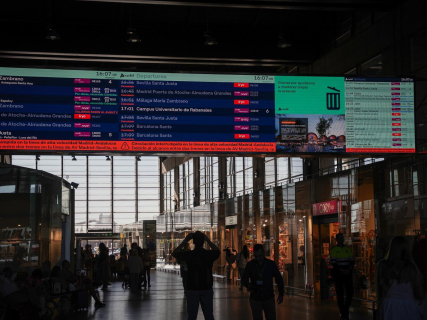

The work of a railway controller is carried out in front of systems that allow traffic to be monitored and organized. The screens show a representation of the infrastructure and of the information received by the center; they are not a direct view of everything that is physically happening at each point on the track.
Adif explains that its control centers operate 24 hours a day and bring together signaling, communications, electrification, and traffic management tools. The large panels in the rooms make it possible to visualize the lines under their control.
What Centralized Traffic Control is for
Centralized Traffic Control, known as CTC, makes it possible to remotely operate interlockings. These devices intervene in the control of signals and points to establish safe routes.
A switch or turnout allows a train to be directed toward a specific track. Signaling regulates its movement. The center uses these tools to organize traffic within the safety conditions of the system.
In high speed, the DaVinci platform integrates information from different systems, including those related to energy, communications, and detectors. Not all installations have exactly the same configuration.
What decisions the traffic manager makes
The traffic manager has regulated functions over railway movements. The Railway Traffic Regulations establish procedures for directing maneuvers and for managing abnormal situations.
Certain authorizations require prior checks and formalized communications. A railway telephone message is a regulatory communication: its content and its conditions matter in determining which movement was authorized.
Human intervention is therefore supported by technical information and procedures. Explaining its role requires knowing both the order transmitted and the conditions under which it had to be issued and carried out.
What would have to be reconstructed to know what happened in Urda
The general description of a center does not make it possible to establish what a specific worker was seeing during the accident. To answer that question it would be necessary to compare the records of the systems, the alarms, the communications, and the state of the facilities.
The temporal sequence would also have to be reconstructed: what information was available before each decision and what changes occurred afterward.
An isolated conversation can provide part of that sequence. By itself, it does not reproduce all the indications on the screens nor does it allow the distribution of responsibilities to be resolved.