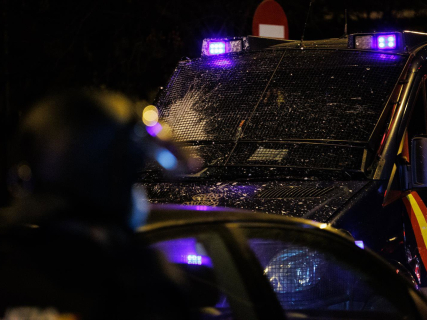

Blocus has become one of the main concerns of the Spanish security forces after the serious disturbances recorded last October 24 in Barcelona and the spread of new calls for this Saturday, October 31, coinciding with Halloween. Under a name inspired by French student protests, dozens of social media profiles have promoted mobilizations in cities such as Madrid, Barcelona, Valencia, Bilbao, Málaga and Algeciras, some of them accompanied by messages that explicitly call for causing unrest, confronting the Police and looting commercial establishments. The authorities are investigating who is behind these calls and to what extent there is coordination among the different groups.
Concern has increased in recent hours. The Guardia Civil arrested this Friday in Picanya (Valencia) a 20-year-old young man whom it identifies as the alleged founder and main promoter of Blocus in Spain, while the National Police and the Mossos d'Esquadra have made other arrests related to the dissemination of violent messages. According to the EFE Agency's tally, ten people, including four minors, were arrested during the 24 hours prior to Friday for their alleged involvement in organizing or promoting the disturbances. At the same time, numerous merchants have begun to reinforce their shop windows and the authorities have prepared special police devices to prevent the images of looting and destruction recorded in the Catalan capital from being repeated.
What is Blocus and what is its origin in France
The word "blocus" means "blockade" in French and is commonly used to describe students' actions of preventing access to their educational centers as a form of protest. During the last few weeks, this term has gained prominence in France, where various youth mobilizations related to the situation of public education and other social demands have ended, in some cases, in confrontations with the security forces and acts of vandalism.
The concept has crossed the French borders and has become a label used by social media profiles that call for similar mobilizations in other European countries. In Spain, Blocus has taken on a much less defined form than that of a traditional organization, since it does not have a recognizable public structure, official representatives, or a common political program. The calls are sometimes presented as protests over education, access to housing, wages, or corruption, but researchers have also detected messages that use these demands as cover to promote violent acts.
According to an analysis published by EFE Verifica, the profiles that spread these calls do not necessarily share the same demands. Some use student slogans, while others incorporate messages against immigration or against the Government. This diversity has led experts to warn that Blocus also functions as a digital brand that different users can use to spread their own calls, without any evidence of the existence of a single leadership that controls all actions.
Nor has it been demonstrated that the Spanish mobilizations are directed from France or another country. The references to the French and Italian riots make it possible to identify an influence and an imitation of the phenomenon, but they do not constitute, in themselves, proof of international coordination.
From TikTok to Telegram: how the calls spread across Spain
Journalistic and police investigations make it possible to reconstruct how the phenomenon began to spread. According to a study carried out by Golden Owl, a company specialized in open-source intelligence linked to the Scientific Park of the University of Alicante, the first messages identified under the Blocus brand in Spain appeared on October 8, with calls for the 10th and 11th in Puerta del Sol in Madrid. Those first calls had barely any impact, despite one of the posts reaching tens of thousands of views.
The activity intensified starting on 18 and 19 October, when new TikTok accounts began to appear and others changed their names to incorporate references to Blocus. The investigation by Maldita.es detected at least a dozen profiles created or renamed between 18 and 20 October that shared posters for calls in Madrid, Barcelona, Alicante and Valencia. Many of these profiles followed each other, commented on each other’s posts and spread similar content, which constitutes an indication of digital coordination, although it does not by itself allow all those responsible to be identified.
The operation of the calls followed a common pattern: TikTok was used to publicize the gatherings and attract participants, while the conversation was then moved to WhatsApp and Telegram groups. The posters, some generated using artificial intelligence, included QR codes or invitations to contact by private message. In this way, users moved from a post visible to thousands of people to messaging spaces where proposals and instructions were exchanged.
The investigation by VerificaRTVE made it possible to access some of those groups and verify that, alongside messages in favor of peaceful demonstrations, explicit calls to loot shops, cause riots and confront officers were also circulating. In several cases, luxury stores, technology outlets and department stores were mentioned. The differences between participants show that not all users shared the same objectives, although the violent conversations have acquired special importance for police investigations.
The Barcelona riots, the first major episode of violence
The phenomenon gained national notoriety on Saturday 24 October, when a call spread under the Blocus label led to serious riots in the center of Barcelona. The demonstration, initially presented as a mobilization in defense of public education, ended with shop windows smashed, shops looted, street furniture set on fire and clashes with the Mossos d'Esquadra.
According to the report compiled this Saturday by Europa Press, the disturbances left 133 people detained and more than 600 identified. The incidents affected more than twenty commercial establishments and caused injuries to several officers, while a significant part of those arrested were minors. The Guardia Civil estimates that around 500 people participated in the disturbances, a figure that refers to those who took part in the incidents and not to the total number of people who may initially have been in the area.
The Mossos then began to investigate who had organized the calls and how they had been spread among adolescents. The chief commissioner of the Catalan Police, Sílvia Catà, explained that the investigators were working with other European police forces to monitor the phenomenon and determine whether there were connections between the incidents recorded in different countries.
The Barcelona case thus became the first major precedent of violence associated with Blocus in Spain, which led the authorities to reinforce surveillance of new calls. The investigators pay special attention to the accounts that use messages aimed at minors and to the messaging channels in which actions are promoted that go beyond the legitimate exercise of the right to protest.
Ten detained and a presumed founder of Blocus identified in Valencia
The investigations have advanced especially during the last few days. The Guardia Civil announced on Friday, October 30, the arrest in Picanya of a 20-year-old man whom it considers the main promoter of Blocus in Spain. According to the Ministry of the Interior, the suspect would have created and administered Telegram groups used to coordinate the calls and presented himself publicly as the movement's leader. In one of the channels, a video also circulated featuring a hooded person who claimed leadership of the initiative.
The facts under investigation could constitute offenses of aggravated public disorder and criminal organization, although the final qualification will depend on the judicial investigation. The arrest does not allow the conclusion that the arrested man directed all the calls spread under the Blocus label, nor does it mean that his criminal responsibility has been proven.
Other arrests in different parts of the country are added to this operation. The National Police arrested in Valencia a 17-year-old minor accused of running channels that promoted looting, while another 18-year-old was arrested in Alfafar for his alleged involvement in messages that encouraged violent acts. Arrests have also taken place in Barcelona, Lleida, Bilbao, Tenerife and Málaga, related to the organization of digital groups and the dissemination of calls for Halloween.
The authorities maintain that some of these channels included messages that sought to take advantage of the mobilizations to commit robberies and cause material damage. However, the arrests are linked to different investigations, so it cannot yet be affirmed that all the suspects belonged to the same hierarchical organization.
Halloween puts merchants and police in several cities on alert
Concern over the expansion of Blocus has increased in the face of the calls disseminated for this Saturday, October 31, coinciding with the Halloween celebrations. According to Newtral, which has analyzed the publications with the help of social media specialists, around 70 TikTok accounts had been identified that promoted or amplified the calls. The messages referred to different Spanish cities, although they did not always coincide in the schedules, places, or characteristics of the gatherings.
This apparent lack of coordination makes it difficult to determine which calls have real capacity for mobilization and which are simple viral posts. In Madrid, some channels later announced the cancellation of their call, but the National Police and the Municipal Police have maintained preventive deployments in view of the possibility that spontaneous gatherings or isolated incidents may occur.
The fear of merchants has been reflected in the streets. Establishments in the center of Madrid, Barcelona, Valencia and Bilbao have reinforced their entrances, protected storefronts with panels and adopted extraordinary security measures to prevent damage. According to Europa Press, protections have also been installed in shops in Palma de Mallorca, while the security forces maintain specific operations in different capitals.
In Madrid, the City Council has planned a deployment of 1,700 municipal agents during the weekend, coordinated with the National Police. Added to this is a reinforcement of some 200 riot police units in the center, according to the information published by El País. The deployments do not respond only to the Blocus calls, but also to the usual security needs during Halloween and the All Saints’ Day long weekend.
The authorities also warn about the rumors surrounding the calls
The expansion of Blocus has generated another problem: the circulation of false or unverified messages that announce imminent unrest in different cities. The National Police this week denied a viral audio that claimed to have privileged police information about alleged organized attacks in Madrid, and has asked citizens to avoid sharing alerts without verifying their source.
Experts in disinformation warn that the existence of anonymous profiles, images created with artificial intelligence and contradictory calls facilitates the spread of rumors. Nor should all messages published under the Blocus label be interpreted as real calls, nor can all the people who participate in student protests be linked to the groups that promote violent acts.
A Golden Owl study, prepared from more than 10,000 items collected on seven digital platforms, detected signs of activity related to Blocus in 18 localities in 11 autonomous communities and calls for different dates after October 24, among them October 31, November 2 and November 30. However, these figures describe the activity located on the internet and do not imply that all those mobilizations are going to be held nor that they will necessarily end in unrest.
The main unknown remains how far Blocus’ real coordination reaches and whether the arrests of recent days will prevent new violent actions. For now, the investigations have identified several alleged promoters, but have not substantiated a single international structure that directs the phenomenon. Meanwhile, merchants and security forces are facing the Halloween weekend with reinforced deployments and special attention to the calls circulating on social networks.