
Mariano Rajoy is trending again at a particularly uncomfortable moment for Spanish politics: that of corruption as the main weapon of confrontation between the PP and the PSOE. The former president of the Government reappears in the conversation not because he has returned to the front line of institutions, but because his figure continues to serve as an unavoidable reference every time there is talk of regeneration, judicial cases, and the credibility of parties to denounce others' corruption.
The main reason is political. Alberto Núñez Feijóo is trying to build his alternative to Pedro Sánchez on the idea of “institutional reconstruction” and a cleaning of the State after what the PP calls “sanchismo.” But that offensive encounters an evident limit: the left recalls Rajoy's era, the Gürtel, the Kitchen, and that phrase from the former president in which he defended that there was no plot of the PP, but a “plot against the PP.” That is why Rajoy is circulating again: because his political past continues to be used as a mirror against the current discourse of the PP.
The past of the PP and the offensive against Sánchez
Rajoy's reappearance is better understood in the context of Feijóo's strategy. The leader of the PP accuses Sánchez of governing to protect himself, of deteriorating the institutions, and of being surrounded by a network of judicial cases that, according to the popular, would make the legislature unsustainable in any European democracy. That message seeks to position the PP as the party of institutional cleaning, but inevitably forces a review of what happened when the PP was in power and had to face its own corruption cases.
That is where Rajoy comes in. For the PSOE and its allies, the former president represents the weak point of the popular offensive: if the PP demands resignations, elections, and responsibilities for the causes affecting the socialist environment, their adversaries recall how the party reacted during the Gürtel and how Rajoy defended his organization for years against the accusations. The trend, therefore, does not arise solely from a recent phrase, but from a dispute over political memory.
What Rajoy has said in his latest appearances
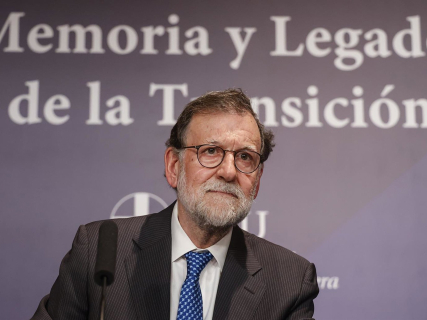
Rajoy has also reappeared in recent events and statements in which he has again expressed his opinion on the Spanish political situation. In an intervention in the Balearic Islands, the former president warned of the “democratic deficit” that, in his opinion, Spain is experiencing and spoke of a particularly intense polarization since the Transition. His diagnosis fits with the current discourse of the PP: the problem would not only be the management of the Government, but a way of exercising power that would have weakened the institutions and strained coexistence.
Such messages reinforce his role as a voice of experience within the conservative space. Rajoy no longer competes for leadership, does not set the daily agenda of the PP, and is not in the party's direction, but he retains symbolic authority for a part of the popular electorate, especially when he speaks of stability, management, Constitution, and institutional resistance.
An easy and uncomfortable figure for the PP
Rajoy is, at the same time, a useful and uncomfortable figure for the Partido Popular. Useful because he represents a stage of government, economic experience, absolute majority, and territorial power. For many PP voters, he remains the president who managed the exit from the financial crisis, halted the independence challenge of 2017 with the application of Article 155, and maintained an idea of politics based on prudence, the BOE, and the administration of power.
But he is also uncomfortable because his stage was marked by the corruption cases that affected the party and by a way of responding to those crises that his adversaries continue to use against the popular party. Every time the PP tries to present itself as a force of regeneration, Rajoy's name comes back as a reminder that the battle against corruption is not fought in the abstract, but over biographies, archives, and past responsibilities.
The phrase about the “plot against the PP”
One of the reasons why Rajoy is circulating again is the recovery of his phrase about the Gürtel: “It is not a plot of the PP, it is a plot against the PP.” That defense, pronounced at a moment of maximum judicial and political pressure, has become over the years one of the most used quotes by the rivals of the Partido Popular to question its moral authority when it speaks of corruption.
The phrase now functions as a weapon of comparison. When the PP accuses Sánchez's Government of hiding behind the argument of "lawfare" or of denouncing judicial persecutions to avoid taking responsibility, the left responds that Rajoy also resorted to a defensive explanation when the courts were closing in on his party. The debate is not only legal but also narrative: who can present themselves as a victim, who must take responsibility, and who has the legitimacy to demand institutional cleanliness.
Rajoy and the battle for moderation
Rajoy's figure also returns because it contrasts with the current tone of Spanish politics. Against a public conversation that is much more accelerated, polarized, and dominated by social media, the former president maintains an image of a slow, ironic, institutional leader who is not prone to dramatic effects. This image may be attractive to a part of the electorate that looks with fatigue at the permanent confrontation, but it may also seem insufficient to those who believe that the moment demands a much tougher opposition.
Feijóo tries to navigate precisely between those two registers: inheriting the idea of solvency and management associated with Rajoy, but without getting trapped in his judicial past or in an image of excessive caution. That is why the reappearance of the former president is politically delicate. He can bring authority, but he also reopens debates that the PP would prefer to keep closed.
From 155 to the institutional debate
Rajoy's political role is still linked to two major elements: economic management after the crisis and the response to the procés. For the PP, his presidency culminated with the application of the article 155 in Catalonia, a decision that the party continues to claim as an example of defending the State against the independence challenge. For his critics, however, that stage was also marked by a lack of political response to the Catalan conflict and by corruption that ended up eroding the Government until the motion of censure in 2018.
This double reading explains why Rajoy is not a neutral figure. His name activates different memories depending on the political block: for some, stability and Constitution; for others, Gürtel, cuts, and institutional wear. And in a stage where the PP wants to turn the upcoming elections into a trial of "sanchismo," Rajoy returns because he was also the last popular president in La Moncloa and because his legacy continues to condition Feijóo's narrative.
Why it is trending again now
Rajoy is trending again because Spanish politics has entered a new phase of comparison between the pasts. The PP wants the debate to focus on Sánchez, on the cases affecting the PSOE, and on the need for institutional reconstruction. His adversaries, on the other hand, try to steer the conversation towards the memory of the popular governments and remind that the party that today demands cleanliness also carries its own history.
To this, his latest public appearances and his ability to generate headlines even from the second line are added. Rajoy does not need to hold a position to return to the debate: it is enough for the PP to talk about corruption, for the PSOE to respond with Gürtel, or for the former president to make an intervention on the political situation for his name to start moving again on social media.
The former president who still weighs on current politics
Mariano Rajoy no longer leads the PP, but he continues to be part of the central dispute of Spanish politics. His figure weighs because it connects Feijóo's present with the party's past, because it serves the left to question the popular offensive against Sánchez, and because he retains a distinct voice within the conservative space.
His reappearance shows that the political battle is not only fought over the cases currently open, but also over how the cases of yesterday are remembered. Rajoy is trending again because Spain is once again discussing corruption, institutions, and power, and in that debate, the last popular president remains an unavoidable reference.