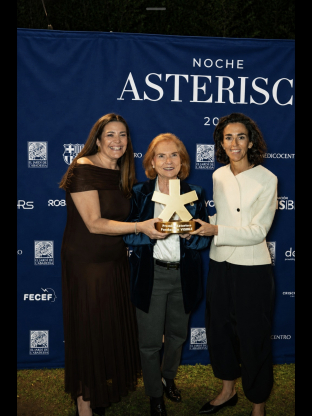

Elena Ruiz de la Torre, chief executive officer of the European Migraine & Headache Alliance (EMHA), and Dr. Patricia Pozo-Rosich, head of the Neurology Service at Vall d’Hebron University Hospital and director of the Migraine Adaptive Brain Center in Barcelona, have received in a personal capacity a Asterisco Award. It is the recognition with which the VISIBLE Foundation, through its MamaTieneMigraña project, honors those who manage to ensure that what cannot be seen stops
going unnoticed. It was presented at La Noche Asterisco, the first solidarity dinner of the VISIBLE Foundation, held on November 5, which brought together healthcare professionals, companies, institutions, and university professors.
The Asterisco Award recognizes work carried out consistently for years, from science and from patient associations, so that migraine is recognized as the neurological disease that it is.
Patricia Ripoll, chair of the VISIBLE Foundation, explained during the ceremony that with this recognition they want “to make a special mention of the people who have been fighting for a long time to make this disease visible, who support it from science and from associations, and who help other patients not feel like they are alone. Patients have this ability to accompany each other, but we need to come together and be strong: the more we are, the better”.
“It is a recognition of work carried out consistently for many years, without pause, truly believing in patients and in what we suffer, and above all believing that migraine is a neurological disease that has to be on the agenda, has to be a priority, and has to be recognized for what it is: a highly disabling disease that affects not only the patient, but the entire family and all those around them,” added Ripoll.
The Asterisco Award represents what needs explanation: realities that rarely appear in the data, in the clinic, or in public conversation, but that profoundly shape people’s lives. Migraine is one of them. Most of those who suffer from it continue working, caring for others, and studying while facing crises that others do not see.
Years of work in the European Parliament
Years of continued work have already produced a first result: on 16 September 2026, the European Parliament explicitly recognized migraine in its resolution on gender inequalities in health (2025/2074(INI)). The text places migraine among the diseases that affect mainly women and receive far less research funding, and includes an EMHA figure: migraine causes in the EU estimated production losses of 111,000 million euros per year in indirect costs.
The next objective is already underway. In the own-initiative report on future European Strategy for Neurological Health (2026/2053(INI), EMHA works with the Members of the European Parliament involved in the report so that migraine has explicit recognition and is translated into concrete measures.
The Asterisco Prize arrives at a key moment, when the future European Strategy for Neurological Health is being defined: it reinforces the scientific, social and political visibility needed so that migraine occupies the place it deserves in it.
An agenda advancing «meeting by meeting»
In her address, Patricia Pozo-Rosich, who leads the Migraine Adaptive Brain Center in Barcelona, put the focus on the joint work with the alliance: «The most important thing is what we are doing now with EMHA». In addition, she also referred to EMHA’s work so that migraine is included in the future European Strategy for Neurological Health, which will guide policies on neurological diseases in the coming years, and to the goal of having the World Health Organization (WHO) recognize it, which has led to several meetings in Geneva.
«Meeting by meeting we are moving forward. We hope that next year we can have a European policy that allows legislation and action in education on neurological diseases, to have equitable care pathways and to receive research aid from Horizon programmes with an eye on migraine and, in general, on all neurological diseases», concluded Pozo-Rosich.
Elena Ruiz de la Torre took stock of the road traveled: «We have advanced a lot. For twenty years we have had to explain that the brain has two types of diseases, mental and neurological, and that migraine is a neurological disease, proven and scientifically studied. Even so, for much of society it still is only a headache that is a bit stronger. But the fact that something is not seen does not mean that it is not felt, and migraine has an enormous burden in our lives».
Regarding the impact that this political recognition may have, Ruiz de la Torre emphasized that «it could have many cascading benefits: in research, in the response to patients’ needs, in education and in more study».