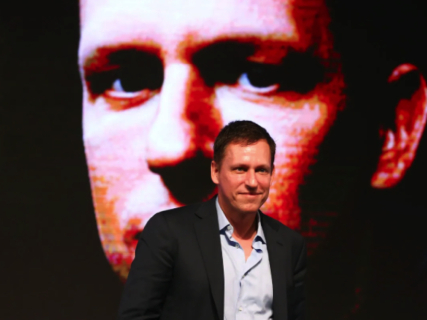

Peter Thiel (Frankfurt, 1967) is one of the most influential - and controversial - names in current technological capitalism.
Co-founder of PayPal and the data analysis company Palantir Technologies, first major external investor in Facebook, and partner at the Founders Fund, his figure blends technological innovation, financial power, and conservative political activism.
His role as chairman of the board of Palantir, a key company in defense and surveillance contracts with governments worldwide, has placed him at the center of the debate on privacy, security, and democracy.
A German Emigrant
Peter Andreas Thiel was born on October 11, 1967, in Frankfurt (West Germany) and emigrated with his family to the United States as a child.
He studied at Stanford, where he obtained a degree in Philosophy and later a doctorate in Law (JD), taking his first steps in the legal and financial world before fully entering technology.
Over time, he has accumulated triple citizenship (German, American, and New Zealander) and a fortune exceeding 10 billion dollars, according to Forbes.
PayPal, Facebook, and the "Mafia" That Changed the Internet
Thiel rose to technological prominence as co-founder of PayPal in the late 1990s. He was its first CEO and led the company's IPO before its sale to eBay.
After PayPal, he became a sort of "banker for the first generation of Internet 2.0": He was the first major external investor in Facebook when the social network was still a university project.
Through various investment vehicles, he participated in the early rounds of companies like LinkedIn, Yelp, SpaceX, and Airbnb, often founded or led by former PayPal colleagues, which gave rise to the term "PayPal Mafia" to refer to that circle of founders and investors.
In parallel, Thiel consolidated his financial influence with:
- Clarium Capital (macro fund).
- Founders Fund, one of Silicon Valley's best-known venture capital funds, where he is a partner.
Palantir: Data, Security, and Controversy
In 2003, Thiel drove the creation of Palantir Technologies, a big data analysis software company initially conceived to fight fraud and, later, terrorism.
He himself has explained that the idea arose from extending PayPal's anti-fraud techniques to contexts such as national security after the 9/11 attacks.
Thiel is today the chairman of the board of directors of Palantir, a company that:
Has obtained multi-million dollar contracts with the Pentagon, the U.S. Department of Homeland Security, the immigration agency ICE, and the British National Health Service (NHS), among other institutions.
Develops platforms such as Gotham, used by security forces to integrate and analyze enormous volumes of data and detect patterns related to organized crime, terrorism, or fraud.
This activity has made Palantir – and by extension Thiel – a central player in the debate on mass surveillance and civil rights: digital rights organizations and collectives such as the Chaos Computer Club in Germany have denounced the risk of "massive data interconnection" and possible violation of fundamental rights.
In 2025, a citizen petition in the regional parliament of Baden-Württemberg (Germany) called for a halt to the use of Palantir by the police, expressly pointing to Thiel's political positions and warning of a "dependence" on a U.S. provider for critical infrastructure.
Palantir, for its part, maintains that it only processes data provided by its clients and that its technology is limited to helping connect information already gathered by governments and companies.
Investor in AI and technologies that will define the future of humanity
In addition to Palantir, Thiel has been one of the first major financiers of artificial intelligence and participated in early rounds of artificial intelligence projects such as OpenAI or DeepMind.
Through Founders Fund, he has financed dozens of startups in AI, defense, biotechnology, and energy, and in recent years has invested in open and decentralized AI projects with the ambition of competing with the large closed models of Google, Meta, or OpenAI.
In 2025, in a series of conferences in the United States, he made headlines for linking the fear of AI to apocalyptic and religious discourses, even warning that excessive regulation of artificial intelligence could lead, in his opinion, to forms of totalitarian authoritarianism.
Political activism: from Silicon Valley to Trump
Far from limiting himself to the role of businessman or venture capitalist, Peter Thiel has consolidated himself as a weighty political figure in the United States.
For years, he has openly declared himself a conservative and has supported various Republican Party candidates, including Donald Trump, whom he supported in 2016 with millionaire donations and public presence at his convention.
Furthermore, he has financed think tanks and libertarian-leaning projects, such as the seasteading movement, which promotes the creation of floating cities outside state control, or the Thiel Fellowship scholarships, which invite young people to drop out of university to start businesses, questioning the value of the traditional academic system, according to EBSCO.
His influence also extends to exclusive global power spaces such as the Bilderberg Group, where he is part of the steering committee, and the Dialog forum, focused on the technological and geopolitical agenda.
This combination of money, ideology, and technology has fueled an ambiguous image: for some, Thiel is the "intellectual architect" of the new Silicon Valley; for others, a power in the shadows.
Thiel, the "Dark Enlightenment" and authoritarianism
Peter Thiel's thinking is often linked to the current known as the "Dark Enlightenment," an intellectual movement that questions liberal democratic principles and advocates for technocratic or authoritarian governance models.
Although Thiel does not formally declare himself a follower of this current, he has expressed ideas compatible with its critique of democracy. In his essay "The Education of a Liberal" (2009), he wrote that "I no longer believe that freedom and democracy are compatible," a phrase that has become an essential reference for understanding his stance.

Some of his collaborators - such as Curtis Yarvin (Mencius Moldbug), a central ideologue of the Dark Enlightenment - have orbited around his investment funds and technological projects, especially within Palantir and Founders Fund.
This intellectual affinity has led analysts to see Thiel as a bridge figure between Silicon Valley and neo-reactionary thought, where technology is conceived not only as a market tool but also as an instrument of control and political power.