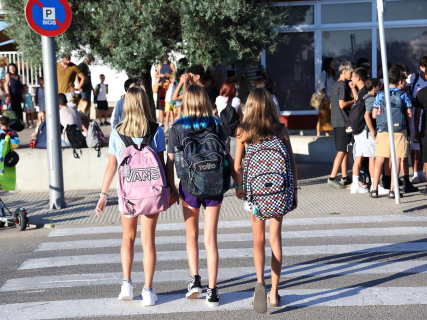

The general strike convened for Wednesday, November 11, 2026 raises numerous doubts among Spanish families, especially among those who need to take their children to school, to daycare, or to use dining-room and school transport services. The call, driven by CCOO, UGT, CGT and other trade union organizations, will last 24 hours and will affect both the public and private sectors, including education. However, November 11 is not a public holiday or a general non-instructional day, so educational centers will not automatically close their doors.
The main difference will be in how each school operates. Teachers, early childhood educators, and workers in supplementary services may take part in the strike, while the regional administrations have established or are finalizing minimum services to ensure care and safety for students. This means that a school can remain open and receive students without all classes being carried out normally. In addition, some centers have already announced the suspension of their dining rooms, which forces families to check the specific conditions before the day of the work stoppage.
Is there school on Wednesday, November 11, or are classes suspended?
Yes, Wednesday, November 11 is, in general terms, a teaching day in Spain. The strike call does not imply that all schools, institutes, and Vocational Education and Training centers suspend their activity. Students will be able to attend class, although the organization of the day will depend on the number of teachers who decide to take part in the stoppages.
Educational staff have the right to take part in the strike and are not required to communicate their decision in advance to the school’s management. For this reason, many schools will not be able to confirm until the actual Wednesday how many teachers will be available, nor whether all the scheduled subjects can be taught.
The minimum services established by the education administrations make it possible to keep responsible staff for opening, supervision, and care of students, but they do not amount to guaranteeing the ordinary teaching day. If a teacher takes part in the strike, their classes may be disrupted and students could be cared for by other teachers or by the personnel designated to cover essential services.
The situation also affects private and state-subsidized centers, whose workers can exercise the right to strike. Accordingly, the recommendation for families is to review the communications sent by each school and not assume that the day’s schedule will run as usual.
What happens with nurseries and early childhood schools on 11N
The nurseries and early childhood schools from zero to three years old are one of the services that most worries families, especially those who need to reconcile their working hours with the care of their children. These centers are also included in the general strike call, although the administrations have established minimum staffing levels to guarantee the safety of minors.
In the Community of Madrid, the minimum services provide for the presence of an infant teacher or educator for every 12 children under one year old, one for every 18 children who are two years old, and one for every 24 children who are three years old, or the corresponding fraction. In public early childhood schools under direct management, the management of the center must also remain, as well as certain kitchen, cleaning, and healthcare staff when applicable.
In Catalonia, the Generalitat has established that early childhood schools maintain at least the 33% of their usual staff, a proportion intended to guarantee basic care during the strike day. In Galicia, meanwhile, the Xunta has set a minimum allocation of two professionals for direct care to ensure the opening and closing of early childhood schools, with additional staff depending on the units that remain open.
These minimum services do not mean that all nurseries can accommodate exactly the same number of children as any other Wednesday. The capacity of each center will depend on its staff, on the workers who take part in the strike, and on the conditions set by the competent administration.
Will school cafeterias operate during the general strike?
The school cafeteria is not guaranteed in all schools on Wednesday, November 11. Its operation will depend on the minimum services established in each autonomous community, on the available staff, and on the capacity of the companies responsible for preparing and distributing the menus.
The difference is important because the dining room staff may depend on an external company and exercise their right to strike even if the teachers continue teaching classes. In addition, the workers responsible for preparing the food, transporting it, and attending to the students during service may belong to different companies.
In Madrid, the minimum services approved for dining rooms managed by companies guarantee care for minors from zero to three years old and students in Special Education. This does not imply that all dining rooms for Preschool, Primary, and Secondary will close, but rather that ordinary provision to the rest of the student body is not guaranteed by those minimums.
In Catalonia, the Generalitat has set a minimum presence of 33% of dining room staff and complementary activities staff to guarantee the safety of minors during these activities. However, this staffing level also does not ensure that all centers can maintain their usual menus and schedules.
In Galicia, the regional resolution includes minimum staff in school cafeterias of direct and indirect management, with specific provisions for Special Education centers.
The first schools that have already announced the suspension of the dining room on November 11
Some educational centers have begun to communicate specific changes to families for Wednesday. This is the case of CEIP Padre Collado, in the Canary Islands, which published a notice on November 6 informing that the school dining room will be suspended during the strike day.
As the center’s management explains, the catering company has communicated that it cannot guarantee the preparation and distribution of the menus or the usual care of the students. The school also warns of possible disruptions to school transport and instructional activities, since it cannot know in advance how many teachers will take part in the stoppages.
A similar situation occurs in the CEIP Policarpo Báez, also in the Canary Islands, which has announced that there will be no school dining room on November 11 because the supplying company cannot guarantee the service and the center will not have sufficient staff for the complementary activities.
These communications show that opening the school does not guarantee that students can stay to eat. However, these are decisions communicated by specific establishments and not a general suspension of the service in the Canary Islands or elsewhere in Spain.
Minimum services in Madrid, Catalonia and other autonomous communities
The regional administrations have established different criteria to maintain educational support during the strike. For example, Madrid approved on November 4 its minimum services, which include the presence of the headteacher and the head of studies, with the replacements provided for by law, as well as additional teaching staff in certain levels.
In second-cycle Infant and Primary schools in Madrid, there must remain a teacher for every 50 students or fraction, while in centers with Compulsory Secondary Education or Basic Vocational Training a further teacher is required for every 90 students or fraction. Specific Special Education centers must have one teacher for every 15 students, in addition to the corresponding support staff.
In Catalonia, the minimum services include a member of the management team per center, one teacher for every six school units in Infant and Primary and the 50% of the workforce in Special Education. Provision has also been established for nursery schools, canteens and complementary activities.
In Andalusia, the general strike will coincide with a specific educational mobilization called by USTEA and the Asamblea Andaluza por la Educación Pública. The unions are calling for improvements in the working conditions of teachers, a reduction in class sizes, more resources to cater for diversity and less bureaucratic burden. This sector-specific call may increase disruptions to classroom activity, although its definitive scope will depend on how the walkouts are followed.
In Castilla-La Mancha, minimum services have also been published for centers funded with public funds, while Galicia has established provision for schools, institutes, nursery schools and canteens. Therefore, there is not a single percentage of minimum staff that applies to all Spanish schools.
Will there be school transport and extracurricular activities on Wednesday?
The strike can also affect the school transport, early-morning services, after-school activities and other work-life balance programs. As happens with cafeterias, its operation will depend on the companies or administrations responsible and on the applicable minimum services.
In Catalonia, for example, it has been planned to maintain the usual school transport to access schools for Early Childhood and Primary when there is no alternative of public transport. In Galicia, services have been established for certain mandatory school trips and for students in Special Education.
However, in other centers, families have already received notices about possible interruptions. The CEIP Padre Collado, for example, has stated that it cannot guarantee the usual school transport during the school day.
After-school activities may experience similar difficulties if the monitors or the responsible staff support the strike. For this reason, it is advisable to check separately classes, the cafeteria, school routes and activities in the first hours of the morning or in the afternoon, since each service may have different conditions.
Can students go on strike and miss class on November 11?
Spanish regulations contemplate students’ right to adopt collective decisions to be absent from class from third year of Compulsory Secondary Education (3rd of ESO).
Article 8 of the Organic Law regulating the Right to Education establishes that these decisions will not be considered misconduct nor can they be sanctioned when they are the result of exercising the right of assembly, are adopted in accordance with the applicable requirements, and are communicated in advance to the school’s management.
The Supreme Court has also established that students from third year of ESO can exercise this collective right without needing to have prior authorization from their parents.
However, this legal protection does not automatically apply to students in Primary or in first and second year of ESO. It also does not mean that any individual absence is justified merely because a general strike is held.
How to know if your school is open and whether there will be a cafeteria on 11N
The most reliable way to check how the strike will affect the school is to consult its official communications. Many schools use educational platforms, messaging apps, emails, or circulars to inform families about the expected changes.
It is recommended to check the communications on Tuesday, 10 November, and again first thing on Wednesday, 11, since some centers will not be able to know the real follow-up of the strike until the day’s activities begin.
The official pages of the Education departments of each autonomous community may also be consulted, where resolutions on minimum services are published. In any case, families must distinguish between three issues: whether the school will remain open, whether there will be normal teaching activity, and whether the additional services will operate.
For now, the general situation is that on 11 November there will be school, but it is not guaranteed that all classes, nurseries, and canteens will operate normally. The minimum services make it possible to maintain essential care, while the effective availability of teachers and of canteen and transport workers will determine the specific changes at each center.