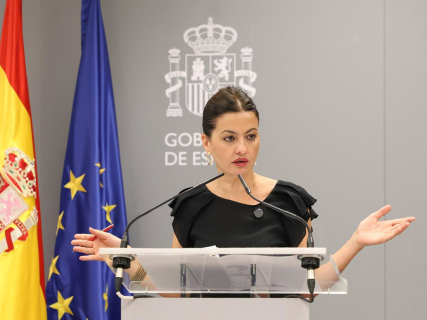

The Ministry of Youth and Childhood has sent a written report to the General State Prosecutor’s Office to request its intervention in the dissemination of child sexual abuse material on TikTok and the possible shortcomings of the platform to detect, remove, and prevent the circulation of this content. The initiative, confirmed this Monday, 9 November, by sources from the department led by Sira Rego, comes after an investigation by Maldita.es identified more than one thousand posts with images and videos of sexual abuse of minors that had accumulated millions of views on the social network.
The seriousness of the events has led the ministry to raise even the possibility of paralyzing TikTok services in Spain, provided that the competent authorities consider it appropriate and there are legal grounds to adopt a measure of this kind. The department has passed the information to the Prosecutor’s Office so that it investigates the events and determines the actions necessary to protect the children and adolescents who may be affected. At the same time, the minister Sira Rego has requested an urgent meeting with representatives of TikTok in Spain to demand explanations about the content moderation mechanisms and to find out what immediate actions the company plans to take.
The decision comes after the publication of the results of a journalistic investigation that calls into question the effectiveness of the social network’s security controls. According to Maldita.es, TikTok only removed five of the 50 videos with child sexual abuse material that were expressly reported to it, despite the fact that the content had reached millions of views. For the Ministry of Youth and Childhood, these events are of “extreme gravity” and require a coordinated response from both the Spanish authorities and European institutions.
What Maldita.es has discovered about sexual abuse of minors on TikTok
The investigation published this Monday by Maldita.es documents the presence of user networks that use TikTok to disseminate, promote, and exchange child sexual abuse material. Over 35 days, between 11 September and 15 October 2026, the research team identified 231 profiles and 1,183 posts with explicit content of sexual abuse of minors, which together accumulated approximately 48 million views.
The researchers located accounts that used the social media network as a showcase to promote illegal material and to establish contact with people interested in acquiring it or exchanging it. In some cases, users directed to other messaging platforms, such as Telegram or Zangi, where the purchase and sale of these files was allegedly organized. The investigation also detected posts that remained available for months and profiles that continued to be active despite having shared content with these characteristics.
One of the most relevant data points is that 136 of the 231 profiles analyzed, 59%, were still active on October 15, the reference date of that check. Maldita.es also reported the facts to the Prosecutor’s Office for Computer Crime and delivered documentation intended to preserve the evidence gathered during its investigation.
The organization believes that the deficiencies identified are not limited to the presence of illegal material, but also affect TikTok’s ability to prevent its dissemination and detect the users who participate in these activities. The data correspond to the content found during the investigation period and do not allow determining the total amount of child sexual abuse material that may currently exist on the platform.
TikTok only removed 10% of the videos reported for child sexual abuse
One of the findings that has driven the Government’s reaction is TikTok’s response when it received specific reports about these contents. To verify the effectiveness of the moderation mechanisms, Maldita.es selected a sample of 50 videos and reported them through the platform’s official tools, identifying them as illegal material related to child sexual exploitation.
After submitting the reports and appealing the initial moderation decisions, the result communicated by the platform was the following: five videos completely removed, 13 blocked only in Spain, 29 considered non-infringing, and three pending review or without a response. This means that TikTok only confirmed the removal of 10% of the reported content and restricted territorial access to another 26%.
The 50 sample videos accumulated 8.8 million views and more than 148,000 "likes", figures that reflect the reach of the posts before some of the moderation measures were adopted.
The investigation also found that some of the accounts responsible for disseminating the content remained operational even after certain videos had been removed or blocked. After 72 hours had passed since the first reports, 18 of the 47 accounts related to the reported videos remained accessible.
It is important to differentiate the decisions communicated by TikTok from the actual status of the content. Although the platform had considered that 29 posts did not violate its rules, Maldita.es found that some videos were removed later. This circumstance highlights discrepancies between the responses provided to those who reported and the measures finally applied.
Why TikTok’s recommendation algorithm is worrying
The Ministry of Youth and Childhood also focuses on how TikTok’s recommendation system works, especially on the possibility that it could help extend the dissemination of material related to sexual abuse of minors.
The social network uses an algorithm that selects the videos that appear in the “For you” section based on different activity and interaction signals. This system allows a post to reach numerous users even if they do not follow the account that has disseminated it.
According to Maldita.es’s investigation, the accounts responsible for the 50 reported videos had around 70,000 followers, while their posts totaled 8.8 million views and had been shared fewer than 14,000 times. These data lead the researchers to consider that the platform’s recommendations may have played a relevant role in the dissemination of the material.
However, the volume of plays does not make it possible to demonstrate on its own what proportion of the views comes directly from the algorithm. Determining the specific responsibility of the recommendation system would require knowing internal information about how those contents work and are distributed.
The ministry considers that the facts could reveal serious deficiencies in the detection, moderation, and recommendation systems, which should be analyzed by the competent authorities to check whether there has been a violation of children’s rights.
Can the Government shut down TikTok in Spain because of these events?
One of the most relevant issues in the action announced by the Ministry of Youth and Childhood is the possibility of temporarily suspending the operation of TikTok in Spain. The department has raised this alternative with the Public Prosecutor’s Office, but this does not mean that there is a closure decision or that the ministry can unilaterally block the platform immediately.
Suspending a digital service is an exceptional measure that requires legal grounds, intervention by the competent authorities, and guarantees of necessity and proportionality. In the European context, the Digital Services Regulation, known as the DSA by its English-language acronym, sets out mechanisms to investigate major platforms when there are indications that they have failed to comply with their obligations.
The regulations allow the European Commission to require corrective measures and impose sanctions when infringements are proven. In particularly serious circumstances, and as a last resort, it includes procedures for requesting temporary restrictions on access to a service, subject to strict requirements and judicial intervention.
Therefore, the request from Youth and Childhood opens the door to studying possible measures against TikTok, but it does not imply an automatic suspension of its activity in Spain. The Public Prosecutor’s Office will have to determine what actions are appropriate within its powers, while any possible administrative or judicial intervention would have to be adjusted to the corresponding procedures.
Directing a move to the Public Prosecutor’s Office also does not equate to a formal criminal accusation against the company, nor does it by itself demonstrate that TikTok has committed a crime. This is an action intended for the authorities to examine the facts and determine whether there are any responsibilities.
What is child sexual abuse material and why it is illegal to disseminate it
The concept of child sexual abuse material, also known by its acronym MASI, is used to identify images, videos, and other files that represent situations of exploitation or child sexual abuse. It is a term that puts the focus on the violence suffered by the victims and avoids presenting this content as if it were sexual material produced in a consensual manner.
In Spain, Article 189 of the Criminal Code punishes different conduct related to the production, distribution, display, offering, and dissemination of child pornography, as well as other behavior provided for in the same provision. The penalties depend on the specific conduct and on the circumstances of the offense.
Prosecuting this content is not limited to those who directly commit the abuses. It may also involve people who produce, distribute, commercialize, or facilitate its circulation in the situations established by law.
In the digital sphere, protecting the victims also requires preventing the images from continuing to circulate. Each new dissemination can prolong the victimization of the affected minors, even when the original abuses were committed some time ago.
Therefore, removing the material and identifying the people involved are two complementary actions: one seeks to stop its spread and the other makes it possible to investigate possible offenses and protect the victims.
What obligations does TikTok have under the European Union’s Digital Services Act
The European Union’s Digital Services Act (DSA) sets obligations for platforms operating in the Community territory, especially for those considered of very large size due to the number of users.
Among its requirements is to have accessible mechanisms to report illegal content, process notifications diligently, and provide information about moderation decisions. Platforms must also adopt proportionate measures to reduce the risks associated with their services, with special attention to protecting minors.
In the case of large platforms, the regulations require assessing and mitigating systemic risks, including those related to the dissemination of illegal content, fundamental rights, and the safety of children and adolescents.
The European Commission may open investigations and require information from companies to determine whether they comply with these obligations. When an infringement is established, the regulation provides fines of up to 6% of the company’s worldwide annual turnover, in addition to measures to correct noncompliance.
However, the presence of illegal content on a platform does not automatically determine its legal liability in all cases. It is necessary to analyze what knowledge it had of the material, how it responded to the reports, and whether it complied with the obligations that apply to it in accordance with the regulations.
Brussels is already investigating the risks of TikTok’s algorithm for minors
The actions of the Ministry of Youth and Childhood coincide with a time of increasing regulatory pressure on TikTok in the European Union.
Last November 6, the European Commission released its preliminary findings on possible breaches of the Digital Services Regulation related to the recommendation system “For you”. Brussels considers that certain characteristics of the algorithm may favor a phenomenon known as the “rabbit hole effect,” in which users repeatedly receive similar content that can harm their psychological well-being.
The European investigation focuses, among other issues, on the risks that this continued exposure may represent to the mental health of vulnerable users, especially minors. This is a different procedure from the facts now reported by Maldita.es, although both place the operation of the algorithm and the protection of children among the main issues under supervision.
In addition, in July the Commission had already communicated other preliminary findings on the safety of minors’ accounts, by considering certain privacy settings and the possibilities for recommending their posts to be insufficient.
These investigations do not yet constitute definitive resolutions of non-compliance, but they reflect the growing attention of European authorities to the mechanisms for protecting the youngest users.
Sira Rego demands an urgent meeting with TikTok to learn about protection measures
In addition to the communication sent to the Public Prosecutor’s Office, Youth and Childhood minister Sira Rego has requested an urgent meeting with TikTok’s representatives in Spain. The aim is to learn the company’s explanations regarding the documented events, the existing security mechanisms, and the immediate measures planned to prevent the spread of material of child sexual abuse.
According to ministerial sources, the department considers that Maldita.es’s findings require a coordinated response between Spanish administrations and European institutions. The Government wants to clarify whether moderation systems make it possible to detect this content with sufficient speed and what responsibility the platform may have when complaints do not lead to its removal.
For its part, Maldita.es points out that, as of the publication date of its investigation, TikTok had requested additional information, but had not responded in any substantive way to its questions about moderation failures and measures to protect minors. This circumstance does not make it possible to anticipate what explanation the company will provide to the ministry.
The matter now rests with the competent authorities, which will have to examine both the possible offences related to the dissemination of the material and compliance with the obligations that affect the platform.
The suspension of the service in Spain is, for the moment, a possibility raised by Juventud e Infancia and not a measure approved, while the Government calls for actions to be taken to ensure the protection of minors and prevent the child sexual abuse material from continuing to circulate through the social network.