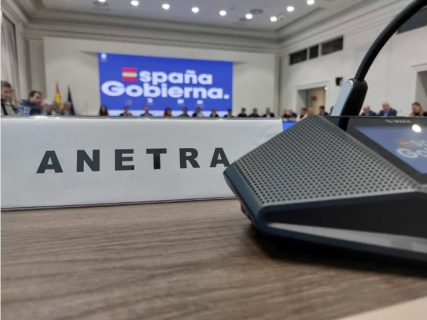

The National Association of Bus and Coach Transport Companies (Anetra) has asked the new president of Renfe, Inmaculada Gutiérrez Carrizo, to reassess the project of establishing a company backed by shareholders in the bus sector and to promote the withdrawal from the current alternative road transport tender.
The employers’ association argues that the need to launch this new public operator has not been demonstrated and warns that its creation could cause distortions in competition within a market in which numerous private companies already operate.
The association believes that the change in the Presidency of Renfe opens an opportunity to review a plan that would involve the entry of a public rail company into a field where a wide range of private operators already exists.
According to Anetra, the coach sector has accumulated decades of experience in providing alternative transport services for Renfe in the event of incidents, emergencies and scheduled interruptions, and has a fleet, personnel and organizational structure sufficient to cover these needs.
Along these lines, the employers’ association warns about the possible competitive advantages of a public company over private operators and questions whether it is necessary to set up a new corporate structure to offer services that, in its view, the sector is already in a position to take on.
Criticism of the tender model
Anetra also opines that the new procurement terms have not adequately remedied the shortcomings of the previous procedure, which was challenged before the Central Administrative Tribunal for Contractual Resources (Tacrc).
One of the points it questions the most is the configuration of the service lots: while Renfe has split emergency services into twelve lots, scheduled services remain grouped into two macrolots. According to the association, this structure makes it difficult for small and medium-sized companies to enter.
The employers’ association argues that scheduled services allow travel routes, dates and vehicle and driver needs to be planned in advance, so, in its view, they could be segmented territorially to favor the participation of companies of smaller size.
However, Anetra interprets that the chosen model benefits a limited group of operators and restricts the participation of SMEs with experience and sufficient capacity to take on these assignments.
Request for a meeting with the new president
The association has passed these concerns on to Inmaculada Gutiérrez Carrizo, whom it has congratulated on her appointment and has asked to meet in order to analyze possible formulas for collaboration. Anetra hopes that her track record in economic regulation and the defense of competition will help to rethink the initiative.
The organization emphasizes that it does not dispute the obligation to ensure transport for rail travelers, but rather the opportunity to create a new public operator and to maintain contract terms that, in its opinion, limit the participation of SMEs.
For this reason, it calls for Renfe to withdraw the current tender and backs a collaboration scheme that makes use of the resources and experience of the private companies that already exist, with the aim of guaranteeing service quality, free competition, and the presence of small and medium-sized enterprises.