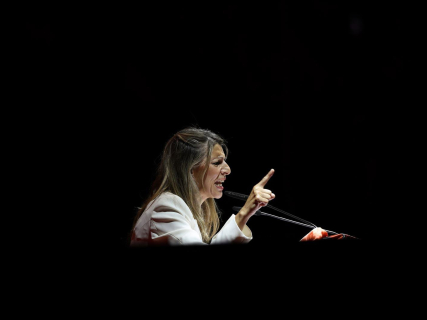

Yolanda Díaz, the Second Deputy Prime Minister and Minister of Labour, has urged this Friday the workforces and works councils of companies throughout the country to join the general strike called by trade union organizations for next 11 November. She has encouraged people to turn that day of protest into a “tide of hope” with the aim of achieving progress in labour rights, decent wages, and affordable housing prices.
During the closing of some UGT events—an event she has described as probably her “last act” with the union before the general elections on 29 November—Díaz defended without ambiguity that the strike has a political component. “What is a strike if it isn’t political? Of course it is political, it’s that if not, what would be the point of doing them?”. At the same time, she has branded the criticisms and the doubts raised in talk shows about its legality or its constitutional fit as “delusional”.
“Long live the general strike called by the unions of my country!”, the head of the Ministry of Labour has exclaimed, underscoring that “when a worker takes a risk by going on strike and stops receiving that wage, they do it for the hope of improving their living conditions”.
In a more relaxed tone, she commented that her team has barred her from attending as a picket—“they told me not even joking”—although she has made clear that she will back and continue the call.
Reproaches to employers and to the Ibex 35
Díaz based the need for mobilization on the historical benefits of the business fabric, pointing out that the 35 Ibex 35 companies closed the first half of 2026 with an aggregate profit of 36,473 million euros, double that of the large European corporations.
Relying also on a recent report from the Bank of Spain, she has indicated that the margins of microenterprises with fewer than ten employees are even higher than those of firms in the select index.
“With these benefits, it is not right that they refuse to negotiate and raise wages in a country that today has an CPI at 4.9%”, Díaz reproached the CEOE, which she accused of blocking the signing of a new Agreement for Employment and Collective Bargaining (AENC).
In the face of the stance of employers, she has assured that the Government will raise the interprofessional minimum wage (SMI) again before the end of the year.
In contrast with the policies of the Executive, it has announced that employers believe in a future PP Government to freeze the minimum wage, to again link pensions to 0.25%, or to impose more overtime hours, recalling that in Spain "2.5 million hours are worked without pay each week".
Call to vote on 29N "so that barbarism does not reach Moncloa"
With an eye on the elections on 29 November, the vice president has appealed to citizens and, in particular, to the working class to turn out in large numbers at the polls "with joy and conviction." She has drawn parallels with Lula da Silva’s recent re-election in Brazil and with the "spectacular defeat at the polls of Donald Trump in the United States".
The minister has been proud of the evolution of employment compared with earlier stages, highlighting that Spain is close to 23 million people employed and has 10.7 million women working, compared with the 18.4 million workers it had when she took over the Ministry of Labour.
To conclude, she has acknowledged that it weighs on her to leave the Ministry with reforms still pending—such as the review of dismissal or the new regulation of the part-time contract—but she has promised that she will continue to be involved "from wherever and however it is necessary so that barbarism does not reach Moncloa" and that the rights won in recent years will be maintained.