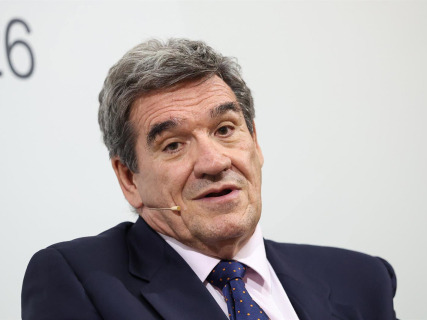

The governor of the Bank of Spain, José Luis Escrivá, has identified the elimination of the fragmentation of the European financial market as the essential priority for banking to be able to operate truly at a Community scale and strengthen the financing required by the continent’s economy.
Along these lines, Escrivá has insisted that, in a system as heavily banked as the European one, competition must focus on the ability of entities to provide services efficiently, rather than on direct comparison with other regions.
"What really matters to us is that our banking system is very well prepared to support growth and back all the investment that needs to be carried out," he asserted during a conversation within the framework of the 2026 International Banking Conference, organized by Santander, in which Héctor Grisi, chief executive of the Cantabrian entity, also participated.
The governor has spoken very positively of the mandate of the European institutions to undertake structural reforms with a horizon in 2027. "It is very timely and absolutely necessary that the Commission and the Council have decided that in 2027 we will have these major changes, and I believe we have to do it well," he emphasized, calling for the areas in which to act to be chosen "intelligently".
Fragmentation, simplification and regulatory framework
When questioned about which factor he considers decisive for reactivating credit, Escrivá has placed fragmentation at the center of the debate: "If I had to choose one, I would say it is fragmentation. There are so many elements in the European financial system that give rise to national borders that limit the possibility of providing banking services at a European scale; this is, for me, the most important element".
He has also compared the European reality with that of the United States, where entities of similar size operate under a single regulatory framework and with homogeneous rules. "When you compare it with Europe, the difference is enormous", he warned, calling for an "enormous simplification" for the Community sector and the design from the outset of a common European regulatory framework.
In parallel, the head of the Bank of Spain has warned that, despite the Community debate, he fears that national jurisdictions "because they are waiting for European reforms, do not look inward and do not really examine what reforms can be carried out without waiting for a European framework".
He has defended that there are multiple areas, not only financial ones, in which there are already examples within Europe that, with the current framework, things can be done "much better".
"When you look at the financial sphere, at capital markets, in Scandinavia, with the same framework, they have managed to develop a very favorable environment to support 'scale-ups', to support innovative companies", Escrivá has pointed out as a model to take into account in the rest of the continent.
Europe and the first wave of AI
In this context of lack of harmonization, the head of the Bank of Spain has underlined that "it is an established fact" that in the first wave of innovation in artificial intelligence (AI), Europe "has not been present".
The former Minister for Digital Transformation and the Civil Service has explained that the AI revolution is based on a combination of "rapid" innovation, based on cutting-edge discoveries and research, and on the adaptation of models and tools. "That is basically the process we are in. And in Europe we are not very good at that, and that is the reason why, in essence, we have been absent from this first wave", he stressed.
Facing this situation, he claimed that in the European bloc there are "very good researchers" and that many of the most outstanding experts in AI "come from European research centers". Nevertheless, he lamented that these professionals "have left Europe" and criticized that in the 'Old Continent' "success is not rewarded enough".
"There is a need for continuous innovation, which can be quickly transformed into something that is productive. And for that, one has to be much more agile, but also be prepared to support innovative people more. Capital comes later. So, for me, I think that if we really recognize and understand this deficiency in Europe, we will probably be able to make the leap to the next wave", he predicted.
Regarding the role of the financial sector, the governor defended that entities can be "very relevant in many ways", by also channeling the investments that numerous economic agents will have to undertake in the coming years.
In regulatory matters, and leaving aside certain high-risk models linked to human rights, he has pointed out that it is up to "you [the banks] to self-regulate and also examine the 'pros' and the 'cons' of using the models more intensively to obtain efficiency gains".
Digital payments, 'stablecoins' and the role of the ECB
In the field of payments, Escrivá has explained that "there are two sides": one that defends that the innovations linked to digital money and, in part, to tokenization, remain in the hands of the private sector, as happens in the United States; and another in which the monetary authorities assume an active role, a position in which Europe is situated and which he has described as the "correct" one.
"It is perfectly feasible to adopt all this distributed ledger innovation, smart contracts... that is really going to bring a lot of efficiency, agility, reduction of transaction costs in payments and new opportunities, and, at the same time, combine this with something that has been very important throughout the most recent history, which is trust in money", he concluded, in reference to the backing of the European Central Bank.
At the same time, he has considered a system based entirely on 'stablecoins' issued by private entities "very problematic", due to the impact it would have on the ability of central banks to provide liquidity to the system.
"When there are liquidity tensions --and there have been a good number of episodes of that kind in the last 25 years--, we [the central banks] have the responsibility, ultimately, to provide more liquidity to smooth the functioning of the market that provides financial stability. But this could not be done in a world completely dominated by cryptocurrencies", Escrivá objected.