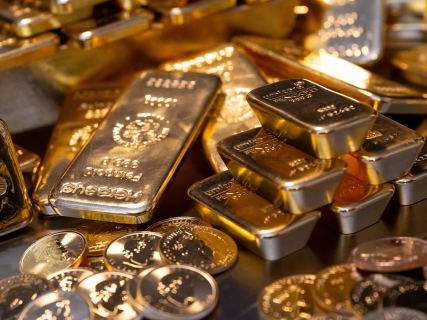

Gold and bitcoin have once again come into the spotlight during the last week, driven by the depreciation of the dollar and by the turbulence in U.S. debt yields. The rebound of both assets in the markets has reactivated the interest of investment managers, who, after reviewing their forecasts on the precious metal at the beginning of the war in the Middle East due to the rise in inflation expectations, have now resumed their bets on this safe-haven asset.
In mid-July, gold fell below 4,000 dollars an ounce. Just a month later, the traditionally considered safe-haven asset, which since the outbreak of the conflict between the U.S. and Iran had not been fulfilling that role and recorded sharp declines, has returned to around 4,650 dollars. Since August 5, when it was around 4,050 dollars, the accumulated advance is approaching 15%.
This vigorous rebound is explained by a combination of elements that have restored the appeal of the metal. Investment firms highlight, in particular, the actions of the U.S. Treasury and its interventionist measures to curb the increase in long-term debt yields.
Specifically, on August 19, the institution announced its plan to double the operations of repurchasing government bonds, exceeding 4 billion dollars, between September 9 and November 4.
After this announcement, long-term U.S. debt interest rates, as well as the dollar, turned downward. In parallel, and like a mirror effect, gold and bitcoin recorded sharp increases. The connection is clear: a lower yield on Treasury bonds reduces their relative appeal and opens space for alternatives like gold.
"The market increasingly perceives that the U.S. Treasury is unofficially moving away from its previously proclaimed strong dollar policy. If this policy manages to reduce long-term yields in the U.S., the obvious escape valve would be a weaker U.S. dollar," argues the head of commodities at Vontobel, Kerstin Hottner.
The depreciation of the greenback has become, precisely, one of the great supports of gold. "Gold is traded in U.S. dollars, so its price tends to rise when the dollar loses strength. A weaker dollar makes gold more attractive to those investing from other currencies, and vice versa," remind analysts from Allianz Global Investors (GI) in a recent report.
However, the fragility of the dollar is not the only element that fund managers consider positive for the metal. The high public debt of major economies, especially the U.S., reinforces its role as a hedge against the risk of currency value loss.
"For some time now, we have maintained that concerns about the sustainability of debt should favor gold. As a real asset that does not depend on fiat currency, it can benefit when financial repression fuels fears of a loss of value of currencies," point out experts from UBS.
Physical demand and central bank purchases
Alongside the macroeconomic context, a second factor supports prices: the physical demand for gold. Fund managers detect an increase in purchases on an international scale, especially by central banks of emerging markets. According to the World Gold Council (WGC), so far this year Poland leads acquisitions with 82 tons, followed by Uzbekistan and China. The latter added 20 tons just in July, its largest monthly increase since October 2023.
Moreover, the 2026 Central Bank Gold Reserves Survey by the WGC, conducted between February and May 2026, reveals that 89% of the consulted monetary authorities expect global official gold reserves to increase in the next 12 months, and 45%, a historic high, expect to also increase their own institution's reserves.
Regarding the seasonal component, analysts from Allianz GI remind that gold tends to show strength between the end of summer and the beginning of autumn, driven by demand linked to the festival and wedding season in India and by purchases in China as the year comes to a close.
The Fed introduces more uncertainty
In parallel, expectations of new interest rate hikes by the Federal Reserve (Fed) have cooled after the decision of the Federal Open Market Committee (FOMC) to maintain rates at its July meeting and after the employment and inflation (CPI) data from the US for that month came in below expectations. "This has favored a partial recovery of the net speculative position in COMEX, as well as the demand for gold ETFs," emphasizes the head of commodities at Vontobel.
For his part, the currency strategist at J. Safra Sarasin Sustainable AM, Claudio Wewel, highlights that during the press conference following the monetary decision, the first with Kevin Warsh at the helm of the Fed, the president offered few clues about the future trajectory of rates, chose not to include his own projection in the 'dot plot' and announced a broader review of the framework for monetary policy action.
Thus, more than a specific rate scenario, it is the greater uncertainty about how the Fed will react going forward that, according to the managers, could play in favor of gold. "Essentially, he prefers that markets deduce the monetary policy outlook from the data that will be published," Wewel emphasizes.
In the expert's opinion, this shift in the central bank's communication style will likely benefit the metal. "A less predictable reaction function could increase the volatility of asset prices and, with it, the demand for the precious metal as a hedge against uncertainty," adds the strategist.
Bitcoin soars to 79,000 dollars
The same backdrop that drives gold has also served as a catalyst for bitcoin, to which factors from the crypto universe are added. The main cryptocurrency, which at the end of June fell to the area of 58,000 dollars, is now trading around 79,000 dollars, representing a revaluation of over 35% in just two months.
Among the reasons for this surge, the senior market analyst at eToro, Javier Molina, mentions, in addition to the intervention of the US Treasury, the improvement of regulatory expectations regarding the 'Clarity Act' and a "huge cleanup of short positions" with nearly 4 billion dollars in liquidations in 48-72 hours.
"Its strong recovery while the dollar weakens is interesting and if that relationship continues while doubts about debt and currency increase, the movement would start to tell a story much more important than a simple crypto rebound," values Molina.
The geopolitical front and the risk of Iran
Despite the renewed appetite for these assets, the outlook remains exposed to risk hotspots. A new escalation of the conflict in the Middle East could thwart the improvement in the markets. "Investors believe that possible disruptions to trade, for example through the closure of the Strait of Hormuz, could drive inflation, making it difficult for the Federal Reserve to adopt a more expansive monetary policy," conclude the analysts from Allianz GI.