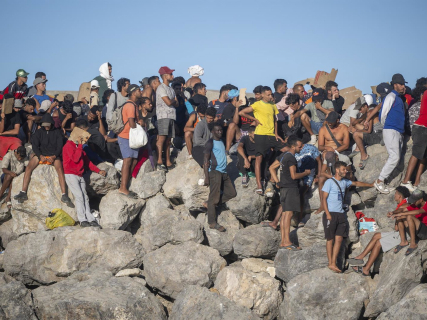

The hacker group Jabaroot has disseminated data of members of the security services of Morocco and claims to have a database with information on about 70,000 agents. The organization links the leak to the migration crisis in Ceuta and accuses those responsible in the Moroccan security leadership of having participated in the planning of the massive entry recorded on July 30.
The information was published this Monday by El Confidencial, which claims to have verified part of the documentation with former members of Moroccan Intelligence. The hackers present the operation as "the great gift to Europe, and especially to Spain, from Jabaroot."
Among the compromised information would be names and personal data of members of the General Directorate of Territorial Supervision (DGST), the Moroccan internal intelligence service, and of the General Directorate of National Security (DGSN), the country's police.
The exact dimension of the leak, however, requires caution. Other information published this Monday indicates that Jabaroot has so far disclosed names and birth dates of about twenty members of the DGST and claims to have in its possession another database with around 70,000 records. There is currently no independent official confirmation that these 70,000 records correspond entirely to intelligence agents or police.
Jabaroot points to Hammouchi and the king's main advisor
The most relevant accusation from Jabaroot goes beyond the theft of information. The group directly points to Abdellatif Hammouchi, head of the DGST and the DGSN, and to Fouad Ali el Himma, one of the main advisors to King Mohamed VI, for their supposed role in the events in Ceuta.
According to messages attributed to the group and collected by El Confidencial, both would have participated in the planning of the operation that led to the massive entry of migrants into the autonomous city.
"They are the ones who planned the attack to put Spain in a difficult situation," states Jabaroot, which adds that everything would have occurred with the knowledge of "a big country and another fictitious state." The hackers allude in this way, according to the interpretation published by the newspaper, to the United States and Israel, two strategic allies of Morocco.
These accusations come from the very group responsible for the leak and have not been independently verified.
The hackers promise to reveal who "orchestrated" the plan of Ceuta
Jabaroot claims that it still has documentation that it has not made public. The group threatens to disclose the names of those who, according to its version, "orchestrated and coordinated the plan of Ceuta".
It also claims to have orders directed to agents who traveled to Fnideq, the Moroccan town of Castillejos located next to the Ceuta border, before and during the events of July 30.
The massive entry left unprecedented figures. Around 72,000 people crossed the border between July 30 and 31, according to figures from the Spanish government later collected by international media. Most returned to Morocco afterwards.
So far, there is no official conclusion attributing the crisis to an operation organized by the Moroccan authorities. The explanations considered since then include the dissemination of messages and videos on social media, the actions of networks dedicated to organizing crossings, and the behavior of the authorities at the border.
A group that had already struck the Moroccan State
Jabaroot does not appear for the first time in this crisis. The group has been leaking information against Moroccan institutions for months and had already claimed large-scale attacks against the country's agencies.
In one of those previous operations, documents related to the Moroccan National Social Security Fund were disseminated. The country's authorities then questioned part of the leaked material and claimed that some documents were inaccurate, incomplete, or misleading.
The origin and connections of Jabaroot are also not clarified. From Morocco, the group has been linked to Algeria, Rabat's main regional rival, while other accusations have related it to Spanish services. None of those connections have been publicly substantiated.
The new leak comes amid tension over Ceuta and while the mystery remains open about what exactly caused tens of thousands of people to reach the autonomous city in just a few hours.