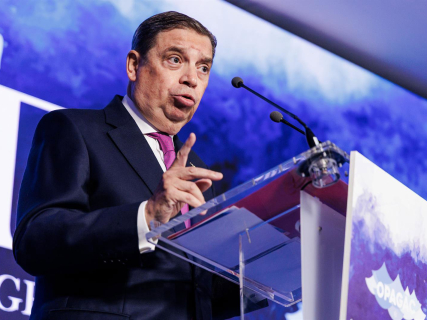

The Minister of Agriculture, Fisheries and Food, Luis Planas, has backed this Saturday the Government’s decision to take 12% of the olive oil production from the current campaign out of the market, an action that he has described as “absolutely necessary, timely and based on European law”.
Planas has insisted that this intervention is intended “to ensure that the entire sector is profitable” and to safeguard the primary producer, so that he can maintain profit margins in a year of high production. As he has recalled, the harvest forecasts are at 1.6 million tonnes and are added to stocks of 357,000 tonnes from the previous campaign, which places the total volume close to two million tonnes, as the Delegation of the Government noted in a statement.
The head of Agriculture has focused on traditional olive groves, “so important for many towns,” which bear production costs that are notably higher than those of the intensive and super-intensive model. “The measure is intended to give stability to the market and to support those who need it most,” he stressed, underlining that the initiative responds to a request put forward by farming organizations and agro-food cooperatives.
During the traditional festival of the first oil in Úbeda (Jaén), the minister highlighted that the resolution of the Directorate General for Agricultural Production and Markets, published yesterday in the Official State Gazette, is the result of “rigorous work, carried out over months, in which the olive oil campaigns of the last 20 years have been analyzed, and which is based on European and national law”.
The procedure for withdrawing part of the production from the market when there is a surplus is set out in the regulation that governs the functioning of the Common Organisation of Markets of the European Union. Planas has also stressed that this decision will not affect the prices paid by the end consumer and, in this context, he has asked that “no one take advantage of this opportunity to speculate” and has warned that the Government “will be behind it to prevent it”.
The minister has also highlighted the wide margin for growth of Spanish olive oil in foreign trade, where last year something more than one million tonnes were sold. He has cited, among other favorable factors, the next reduction in tariffs in China, from 10% to 5%, as well as the agreements that the European Union has concluded with Mercosur and India, which open up new opportunities for the sector.