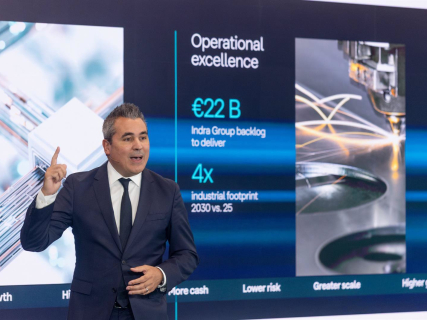

The CEO of Indra, Josep Maria Recasens, has reiterated that the company maintains full confidence in Minsait and in its ability to continue generating added value within the group.
"Minsait has always been there and will be, since it is the only one capable of translating consumers’ needs into technology," he said this Wednesday during the presentation of Indra’s new strategic plan, specifying that from now on the priority will be the value of each initiative and "not in the quantity, in order to generate added value."
With these words, Recasens responded to the doubts that the market has been showing about the subsidiary, also highlighting that Minsait will also be "a boost of talent."
Deep transformation of Minsait with the Forward 2030 plan
Along this line, the executive stressed that value creation is the central goal and the main commitment of the new plan. "It is much more than a strategic plan, it is taking the company to the next level," he said, emphasizing that it represents "the beginning of what is to come, since Indra "is prepared to accelerate its growth in this unique opportunity in life, driven by technology at full speed."
Under the Forward 2030 plan, Minsait will face a "deep" transformation and will continue to modify its business 'mix' toward higher added-value proposals supported by artificial intelligence (AI), data, proprietary solutions and strategic services. The aim is for its AI-based offering to move from around 40% in 2025 to 70% in 2030.
With this shift, Indra wants Minsait to consolidate its role as "strategic partner and orchestrator of technology solutions in the transformations of its clients," from AI to future technology waves; that it provides technological capabilities and commercial access to the rest of the group; and that it is configured as a magnet for technology professionals, supported by a workforce strengthened with AI and 're-skilling' processes. In addition, the activity is intended to be geographically reoriented toward businesses with higher value and lower exposure to risk.
On the financial front, the company expects that this evolution will make it possible to raise Minsait’s Ebit margin from approximately 6.4% in 2025 to 8% in 2030.
IndraMind, a cross-cutting axis and a commitment to sovereign AI
Parallely, IndraMind becomes a “cross-cutting strategic piece” that knits together the group by linking the critical military, security and civilian domains, and by providing a sovereign AI, command and control and systems integration capability. Beyond its role in internal transformation, the ambition for 2030 is for IndraMind to become the Spanish benchmark for sovereign AI, with the leading AI platform and a catalog of next-generation solutions that will subsequently be internationalized.
Currently, IndraMind has a portfolio valued at 400 million euros, has developed 15 solutions and has closed contracts for eight of them, supported by a team of more than 3,000 AI specialists. The plan includes scaling up to 1.2 billion euros in revenue by 2030, with a balanced 50/50 split between defense solutions and civil applications.
Compared with other market players, its proposal for security and defense covers the entire AI value chain, from cognitive superiority and autonomous operation to command and control and greater cyber resilience. In this way, defense and space, together with IndraMind, are configured as key growth and profitability levers, combining the execution of the current portfolio with its own differentiated product in order to gain a presence in Europe.
Objective: to consolidate as a European “prime” in defense
In the defense business, Indra aims to secure itself as a European “prime”, relying on a portfolio close to 11.4 billion euros, a new generation of ground vehicles and its command and control solutions, electronic warfare, radars, communications, autonomous systems, drones and next-generation technologies. Among the most notable initiatives is Land Next Gen, a modular, hybrid-electric, manned or unmanned ground platform and defined by “software”, designed for seven types of mission.
The company plans to allocate around 20 million euros of its own resources to its development, with the goal of having it available between 2028 and 2029. The new LAB-X production model will make it possible to accelerate the development cycle to make it three times faster, while IndraMind will be responsible for transforming the data generated into useful knowledge.
In parallel, the group underlines that the space area enters a new phase after the purchase of Hispasat and Hisdesat, driven by the European program IRIS2, endowed with 1.9 billion euros, and by the Spainsat-NG and PAZ II projects. The goal for 2030 is to become the European reference integrator for 'end-to-end' missions and a leading technological actor in dual-use space applications.
In this way, the space strategy is considered not only as a path for commercial expansion, but also as an element directly linked to defense, European sovereignty, and strategic autonomy.