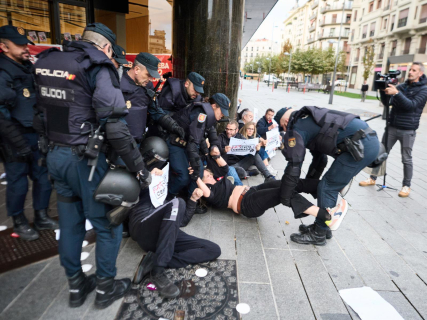
So goes the general strike: the unions demand monitoring and the employers lower it between stop-and-searches and police charges

CCOO and UGT place the participation of the first shifts between 41% and 75%, depending on the territory, while CEOE and Cepyme talk about a low incidence in most sectors. The pickets and police interventions mark the start of the day for housing and wages

fotonoticia 20261111121046 1920

fotonoticia 20261111121046 1920

Add DEMÓCRATA to Google

Ask FREN

Published

Last updated

3 minutes

Most read

Elecciones 29N · Encuestas

La media de las encuestas

Media a 10 de noviembre de 2026 · 15 institutos

  • PP31,5 %
  • PSOE26,8 %
  • Vox19,1 %
  • Frente Amplio6,2 %
  • ERC2,5 %
01020304050ene 2024jul 2024ene 2025jul 2025ene 2026jul 2026

Media del último estudio de cada instituto en 30 días y su evolución semanal desde el 23J. Partidos con al menos un 2 %.

Todas las encuestas

Elecciones generales del 29 de noviembre · Demócrata

This Wednesday’s general strike, November 11, is moving ahead with mixed figures regarding its follow-up, and with incidents in the early hours of the morning at wholesale markets, vehicle depots, and access routes to workplaces. The unions highlight participation in the first industrial shifts, while business organizations maintain that activity continues with limited impact in much of the productive sector. These are provisional assessments, with differences between sectors and territories.

What the unions say about the strike’s follow-up

CCOO and UGT place the follow-up between 41% in Extremadura and Castilla-La Mancha and 75% in Andalusia and Aragon, according to data compiled up to seven in the morning. This information corresponds mainly to the night shift and the start of morning activity. Later, CCOO provided data at 11:30 a.m. of the morning, with varying follow-up depending on sectors.

Union representatives acknowledge unequal participation, with greater presence in coastal areas and less impact in part of the interior. Both unions have also reported a 10% reduction in energy consumption in this first assessment. The regional range does not constitute an overall participation percentage in Spain.

What the employers’ association argues: low follow-up and minimum services

CEOE and Cepyme describe low monitoring in most sectors and territories, although they acknowledge that it is higher in areas with greater union presence. Their assessment comes from information provided by regional organizations, sector associations, and companies linked to employer organizations.

Business organizations point out that, in the early hours, minimum services were being complied with. They also use electricity demand as a reference: they place its decline at around 10% after eight in the morning and compare it with reductions greater than 14% in previous strikes.

Pickets, traffic stoppages, and police charges

The first hours have left cut-offs on the AP-7, the A-2 and the Barcelona Coastal Ring Road, in addition to a blockade of the Madrid M-30 near Legazpi. At Mercabarna, tire burnings were recorded, and at Mercamadrid, police charges and the use of pepper spray. RTVE reports at least thirteen people treated by medical services and one detainee at this latter venue.

Tension situations have also occurred in the bus depots of Madrid and Málaga and in the municipal cleaning facilities of Valladolid, where attempts were made to prevent the departure of trucks that were providing minimum services.

Unions question the police action and companies denounce blockades

For their part, CCOO and UGT report injuries among members of the pickets and consider the use of pepper spray to repress them to be disproportionate. Their legal services will analyze the images of the interventions at Mercamadrid and Fuencarral. They have also reported hit-and-runs involving members of pickets in Galicia and Burgos, without serious injuries according to their version, and the detention of a union delegate in Zamudio.

For their part, CEOE and Cepyme report difficulties accessing industrial estates, in Barcelona, Valencia and Sevilla and to the port of Algeciras due to the actions of pickets. They demand that the right to work be guaranteed and separately condemn the vandal acts against real estate agencies and the office takeovers recorded in the previous days.

Housing and wages, the demands of the day

Access to housing and purchasing power are at the center of the call. At the start of the mobilization, UGT’s general secretary, Pepe Álvarez, summarized the reason for the stoppage: "There is no wage that can withstand the price of housing in our country". The union directs its demands both to the central Government and to the autonomous communities and town councils.

More key points, information and questions with FREN

AI-GENERATED CONTENT

What parliamentary or legal procedures would be necessary for demands regarding housing and wages to translate into concrete measures?

For demands regarding housing and wages to become concrete measures, they must be translated into a decision by the competent body and follow the corresponding procedure. Not everything requires passing a new law: some actions require a legal reform; others, a regulation, public funding, an autonomous or municipal decision, or an agreement between unions and companies.

1. Specify the demand and who can address it

The first step is to define what is intended to be changed. Regulating rents, building public housing, granting aid, raising the minimum wage, or improving the salaries of a sector are different objectives and require different instruments.

  • Housing: the State, autonomous communities, and municipalities may intervene, depending on whether it concerns contracts, housing policies, urban planning, land, or permits.
  • Wages: labor legislation corresponds to the State, but many wage improvements are agreed upon through collective agreements between worker and company representatives.

Mobilizations, petitions, and meetings can promote these decisions, but they do not themselves change the existing rules.

2. If a law is needed: Congress and Senate

When the measure changes a matter regulated by law, the usual route is a legal reform. The Government can promote a bill, after preparing the text and the required procedures and reports. Parliamentary groups can present a private member's bill; there are also other initiative routes, subject to their own requirements.

Amendments are presented in Congress, that is, proposals to modify the text. Usually, a committee studies it and a commission drafts the report. Approval corresponds to the Plenary or, when appropriate, to a commission with full legislative competence. Private member's bills normally require prior consideration: a vote to decide whether their processing begins.

Then the Senate intervenes, which can approve the text, introduce modifications, or issue a veto. If there are changes or a veto, Congress decides on them according to the required majorities. Finally, the law is sanctioned, promulgated, and published.

3. If urgent: decree-law

The Government can approve a decree-law when there is an extraordinary and urgent need, respecting its constitutional limits. It can take effect before completing ordinary parliamentary processing but must be submitted to Congress within thirty days for validation or repeal: deciding whether to maintain or reject it.

It can also be processed afterward as a bill, allowing amendments to be introduced. Urgency does not eliminate the obligation to justify the measure nor allow this instrument to be used for any matter.

4. Regulations, agreements, and budgets

If the legislation already allows action, a regulation or administrative decision may suffice. For example, setting the minimum wage follows a governmental route with consultation of social interlocutors; improving the wage tables of an agreement requires collective bargaining, not necessarily a parliamentary law.

Rent subsidies, promotion of public housing, or certain public wage improvements also require funding. It may be necessary to approve budgets or modify existing credits. Approving money and recognizing a right are not the same: a budget item does not automatically replace the necessary regulation.

5. When the change is noticed

The measure becomes enforceable when it comes into force and its conditions are met. Some rules have immediate application; others require regulatory development, aid calls, administrative agreements, or autonomous and municipal actions. Therefore, monitoring must check not only approval but also funding, deadlines, beneficiaries, and mechanisms to claim compliance.

What are the legal competencies of the general secretaries of UGT and CCOO in calling general strikes?

The general secretaries of UGT and CCOO do not have, by virtue of their position, an exclusive legal power to call a general strike. It is necessary to distinguish between the union's legitimacy to promote it, the competencies their statutes assign to each body, and the representative function of their general secretary. Announcing a strike, signing its communication, and adopting the call agreement are different actions.

Legitimacy corresponds to the union

The right to strike belongs to the workers. Unions can promote and call strikes within their scope of action, but that does not make their top leaders personal holders of that right nor allow them to automatically replace the collective decisions required by their organization.

In a general strike, the capacity of UGT and CCOO to act derives from their status as trade union organizations and their presence in the affected area. There is no prior administrative authorization that their general secretaries can grant or request for the right to arise. Nor does the union call individually oblige each worker to support it.

What the general secretaries can do

Their intervention may include the following functions, always within statutory attributions or validly adopted agreements:

  • Promote the proposal: propose the call and submit it to the competent bodies.
  • Coordinate union action: negotiate with other organizations a joint call, its date, objectives, and scope.
  • Represent the union: publicly communicate the decision and act as interlocutors before the Government, business organizations, and other actors.
  • Execute the agreement: sign communications or carry out actions for which they have sufficient representation or authorization.

These functions do not necessarily equate to competence to decide unilaterally. The general secretary's signature may reflect a prior union agreement; by itself, it does not prove that he was the one attributed the decision.

Who adopts the agreement in UGT and CCOO

The specific answer requires separately examining the current statutes of each confederation, their operating rules, and, when appropriate, delegations of competencies. It should not be assumed that both organizations distribute their powers in the same way.

It has not been verified here which specific body currently holds that competence in each union. Therefore, it would not be rigorous to attribute it to an executive committee, a committee, a council, or the general secretary himself without checking their respective rules. Being the top representative is not enough to deduce a personal power of call.

What limits their action

Union representation does not exempt from complying with the legal requirements of the strike: call agreement, prior communication, determination of its objectives and scope, and constitution of the strike committee when appropriate. It should also be distinguished between who represents the organization and who makes up that committee: they are not necessarily the same people.

The general secretaries also cannot, through a public statement, eliminate obligations related to essential services nor impose participation on all workers. The legality of a strike depends on its purpose, procedure, and development, not on the rank of the leader who announces it.

In short, their role can be politically and organizationally decisive, but the legal competence must be proven through internal rules and the call agreement. To assess a specific call, the determining documents are the applicable statutes, the agreement of the body that decided it, and the formal communication that executed it.

What results did the main parties obtain in the last union elections in the industrial sectors?

If you are referring to Spain, it is important to distinguish political parties and unions: the results of union elections correspond to labor representation candidacies, not parties. The information consulted places CCOO as the leading organization nationwide at the end of 2025, but does not provide a complete and comparable breakdown of the latest elections in all industrial sectors.

Therefore, it would not be correct to present those general data as if they were the specific result for metal, automotive, chemical, agri-food, or energy. Nor should the representatives obtained by a union be attributed to a political party.

General results: reference, not industrial result
  • CCOO: closed 2025 with 116,068 representatives and 34.67% of the national union representation, according to Servimedia. This is the most recent general data found, but it covers different labor areas and not exclusively industrial companies.
  • UGT: appears as the second largest national organization, although the sources consulted do not provide a national figure for the end of 2025 that allows direct comparison with the previous one. As background, CCOO reported that both organizations together held 67.01% of the representation in the process concluded in December 2023. That percentage should not be transferred to 2025 nor to industry: it corresponds to another date and scope (2023 balance).
What specific industrial results have been found
  • Agri-food: ElPozo Alimentación. In the elections held on October 1, 2026, CCOO obtained 16 of the 33 representatives on the works council. Four candidacies participated, the census amounted to 5,915 workers, and participation exceeded 50%. The available information does not detail the distribution of the other 17 seats, so it does not allow completing the comparison between unions. It is a company result, not of the entire Spanish agri-food sector (ElPozo results).
  • Industry, construction, and agriculture in Ciudad Real. UGT FICA reported winning the union elections of 2025 in that provincial scope. The news found does not provide a complete distribution of representatives by organization. Also, it groups several activities: it does not prove a UGT victory in all Spanish industry nor allow separating the result of each sector (UGT FICA provincial balance).
Territorial dimension also matters

For Euskadi there is an official reference of general representativeness: with elections held until June 30, 2025 and minutes registered until July 31, ELA reached 40.46%, LAB 20.53%, and CCOO 17.62%. These figures were published to renew the Labor Relations Council, not percentages exclusive to industrial sectors. They serve to show why the national result does not necessarily describe each territory (official Basque publication).

What can be concluded

The supported conclusion is limited but clear: CCOO leads the general national representation; there are specific industrial victories of CCOO and UGT; and ELA and LAB have a territorial weight that requires separate analysis. For metal, automotive, chemical, and energy no recent and complete national scrutiny by union has been found. There are also no homogeneous industrial figures to compare USO, CSIF, or CIG with the previous organizations.

To respond with a precise distribution of winners, percentages, and delegates, it would be most useful to specify sector, territory, or company. This would avoid mixing results from different dates and scopes.

Play

Test your knowledge with FREN!

How much do you know about this topic? Answer the following 3 questions.

What main reason did the UGT general secretary, Pepe Álvarez, highlight at the start of the general strike?

Question 1 of 3

What incidents were recorded at Mercamadrid during the general strike?

Question 2 of 3

What percentage reduction in energy consumption was reported during the general strike?

Question 3 of 3