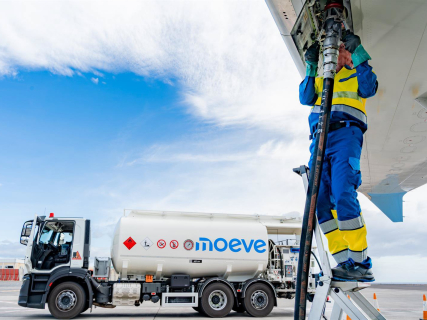

Spain will consolidate in 2025 as the second country in the European Union by volume of SAF supplied, after surpassing 152,000 tons. This figure will represent 2.59% of the total fuel loaded at Spanish airports, which implies exceeding by around 30% the minimum 2% target set by Community regulations.
These forecasts are set out in the “Guide for the implementation of the ReFuelEU Aviation Regulation in Spain,” presented yesterday by the Alliance for the Sustainability of Air Transport (AST) during the annual meeting of its governing board.
The document, in addition to reviewing the situation from the last fiscal year, details the main challenges for expanding the use of SAF, emphasizing the urgency of strengthening economic incentives in order to close the price gap with conventional kerosene, boost production capacity, and encourage new investments.
In this regard, the guide proposes to direct back to aviation the revenues that airlines contribute to the European Emissions Trading Scheme (EU ETS), using them to accelerate decarbonization in the sector. The included data show that in 2024 Spain allocated 48% of those funds to climate and energy transition policies, while other Member States channel practically all of the money raised toward this kind of action.
The analysis also underscores that none of the initiatives funded in Spain was specifically aimed at promoting SAF.
Against this backdrop, the AST argues that the support for SAF included in the EU ETS review is “absolutely insufficient,” since aviation has stopped receiving free emission allowances and only between 10% and 12% of the current contributions by air operators to the EU ETS returns to the sector in the form of SAF “allowances” (free allocation of emission rights).
The Alliance proposes that the reform of the system significantly increase the volume of SAF “allowances,” consistent with the weight of aviation in the EU ETS toward 2040, and ensure a level of support capable of covering the existing extra cost between SAF and traditional fossil fuel.
Likewise, the organization stresses that Spain must make the most of its competitive advantages and its industrial base to multiply SAF production, with special attention to synthetic SAF. To do so, it proposes mobilizing European funds and national budgetary resources in order to create market mechanisms adapted to the level of maturity and the particularities of each technology, which "give certainty to producers and buyers and unlock new investments".
In the words of its chairwoman, Margarita de Gregorio, it is key "to foster cooperation among all the agents involved to encourage the development of sustainable fuels and to move forward in the defossilization of air transport, which requires a joint and coordinated response".
The guide, prepared by the SAF Working Group of the Alliance, also puts the focus on regulatory and administrative obstacles, such as the complexity of certification and reporting schemes, the desirability of furthering the digitization of traceability, and discrepancies between the criteria that ReFuelEU Aviation and the EU ETS apply when recognizing the use of sustainable fuels.
These differences can increase operating costs and penalize more efficient logistical options. For this reason, the document calls for harmonizing both regulatory frameworks and simplifying procedures, so that the expansion of SAF is facilitated without putting at risk either its traceability or the associated environmental benefits.