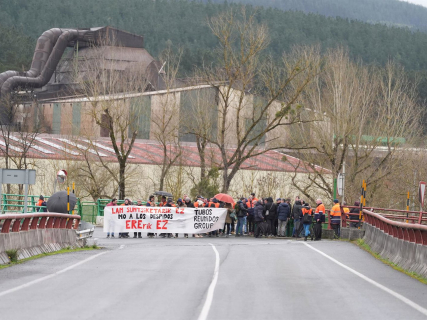

The situation of Tubos Reunidos does not respond to a specific event, but to a

that has accelerated in recent months. The company, specializing in the manufacture of seamless tubes for sectors such as energy or petrochemical, has gone from registering profits to closing the last fiscal year with millionaire losses, in a context of high debt and liquidity difficulties.
This deterioration has been directly reflected in the market. Throughout 2026, the company's stock has accumulated drops of more than 50%, with episodes of daily plunges close to 40% in the sessions prior to the communication of the proceedings. The stock market performance has gone hand in hand with the loss of investor confidence in the face of worsening accounts and the lack of financial solutions.
The process has culminated with the suspension of trading after the communication of the creditors' meeting, which leaves the company temporarily out of the stock market and without a price reference.
From profits to losses and doubts about continuity
The turn in the results has been one of the determining factors in the company's recent evolution. After closing 2024 with profits, Tubos Reunidos registered losses close to 118 million euros in 2025, a significant change that reflects the accumulated impact of different operational and financial factors.
To this situation is added the level of indebtedness. The company maintains a debt that is situated in a range close to 263-298 million euros, with the Sociedad Estatal de Participaciones Industriales (SEPI) as the main creditor, concentrating around 150 million. This volume of debt has conditioned the refinancing options and has limited the room for maneuver.
The company's auditor has also pointed out the existence of significant doubts about the company's ability to continue as a going concern, an element that has increased pressure on the listed company and influenced market perception.
Lack of liquidity, industrial tension, and drop in activity
Treasury tensions have been another of the central elements in recent developments. The company has acknowledged difficulties in meeting its financial obligations, in a context marked by a lack of liquidity and the need for new sources of financing that have ultimately not materialized.
In parallel, industrial activity has also been affected. The shutdown of the Amurrio plant and the labor dispute, with an employment regulation file affecting several hundred workers and an indefinite strike, have contributed to reducing operational capacity at a key moment.
To these internal factors have been added external elements that have directly impacted the business, such as the imposition of tariffs in the United States —one of the company's main markets—, the evolution of the dollar, and the increase in competition in the European arena.
Failed refinancing attempts and stock market suspension
Before the entry into administration, the company explored different avenues to avoid this situation. Among them, a refinancing plan and the search for new investors or alliances that would allow for the reinforcement of the financial structure. However, these attempts did not translate into the entry of sufficient resources to guarantee operational continuity.
The lack of agreements in this area has been decisive in the outcome. Without a solution that ensured liquidity, the company has ended up resorting to bankruptcy proceedings as a way to order its financial situation.
On the stock market, the immediate consequence has been the suspension of trading by the CNMV after the official communication. This measure interrupts the negotiation of shares and reflects the situation of uncertainty surrounding the company's future.
The recent evolution of Tubos Reunidos thus shows a continued process of deterioration in results, balance sheet, and market, which has led to the current situation after months of stock market declines, financial tensions, and lack of financing solutions.