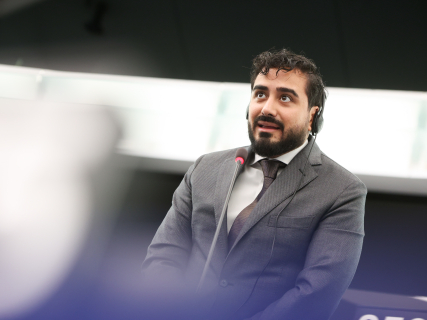

The majority of the European Parliament has supported the request to withdraw the judicial protection of MEP Alvise Pérez within the framework of the case in which the Supreme Court is investigating the alleged illegal financing of Se Acabó la Fiesta (SALF). The decision represents a new judicial and political setback for the Spanish leader, who already has several proceedings open both in the Spanish jurisdiction and at the European parliamentary level.
The European Parliament considers that there are sufficient elements to allow the judicial investigation to continue into events that, according to parliamentary sources, are not related to the political activity carried out by the MEP in the exercise of his parliamentary duties. The procedure is part of the ordinary mechanism for lifting immunity provided for in the Rules of Procedure of the European Parliament and managed through the Committee on Legal Affairs (JURI) and can be appealed by the leader.
Suspicions of irregular financing
The European Parliament maintains that the MEP allegedly maintained ties with businessman Álvaro Romillo, known as “CryptoSpain”, who supposedly acted on behalf of individuals and legal entities with the aim of obtaining economic benefits through tax optimization schemes. According to the documentation analyzed by MEPs, the purpose would have been to create a "portfolio" to raise funds to finance the electoral campaign of Se Acabó la Fiesta for the European elections.
According to the Supreme Court, Romillo may have advanced a sum close to 100,000 euros to the political circle of the Spanish leader. In the opinion of the High Court, the facts could constitute possible crimes of illegal financing, as well as other offenses related to the irregular collection and management of funds before Alvise Pérez obtained his MEP seat.
The investigation focuses on the use of alternative political financing mechanisms, especially those linked to the cryptocurrency ecosystem and digital resource mobilization structures.
Parliamentary immunity, under scrutiny
In the report approved by the European Parliament, Parliament recalls that parliamentary immunity does not constitute a personal privilege of the MEP, but an institutional guarantee intended to protect the independence of Parliament and the free exercise of the representative mandate.
“Considering that the alleged offenses do not constitute an opinion expressed or a vote cast by him in the exercise of his duties,” states the text promoted by MEP Pascale Piera. The document further underlines that Members of the European Parliament enjoy immunity solely with respect to opinions expressed or votes cast in the performance of their parliamentary responsibilities.
The interpretation is particularly relevant from a legal point of view, as it delimits the material scope of parliamentary immunity. Community doctrine differentiates between actions directly related to the political exercise of the office and private conduct or conduct prior to the acquisition of the parliamentary mandate.
In this case, both the European Parliament and the Supreme Court consider that the facts under investigation would have occurred before Alvise Pérez obtained his European seat. This element considerably reduces the chances of immunity acting as a procedural barrier against judicial investigation.
No indication of political persecution
Following the processing of the request in the Committee on Legal Affairs, the European Parliament also concluded that there is no indication that the judicial proceedings have been initiated with the intention of harming the political activity of the Spanish leader.
This point is key in the procedures for lifting immunity within the European Parliament. The European legal analysis does not assess the guilt or innocence of the MEP under investigation, but rather focuses on determining whether there is a possible case of fumus persecutionis, that is, whether the judicial case could be a disguised political persecution.
According to the conclusions of the parliamentary committee, no elements have been found to support the claim that the actions of the Spanish Supreme Court aim to obstruct the political work of Alvise Pérez as an MEP.
The decision also reinforces the line historically maintained by the European Parliament, which usually agrees to lift immunity when the facts under investigation fall outside the direct exercise of parliamentary activity and there is no evidence of political instrumentalization of justice.
The second request against the leader
This is the second waiver request processed against Alvise Pérez in the European Parliament. The first was approved in relation to the case linked to the alleged harassment against the delegated prosecutor for hate crimes in Valencia, Susana Gisbert, through messages disseminated on his Telegram channel.
That investigation also referred to events prior to obtaining the MEP's mandate. Justice is analyzing whether the dissemination of certain content and personal data could have led to a coordinated harassment campaign against the Valencian prosecutor.
However, the legal problems of the founder of SALF do not end there. The leader also faces another case related to the dissemination of a false PCR attributed to the former Minister of Health and current president of the Generalitat de Cataluña, Salvador Illa.
Added to this is a more recent procedure linked to the alleged harassment against two MEPs initially elected under the acronym of SALF and subsequently disassociated from the formation.
The complaints of Diego Solier and Nora Junco
In this last case, the Supreme Court already interrogated the founder of Se Acabó la Fiesta last January, after magistrate Manuel Marchena agreed to summon him after he expressed his willingness to appear voluntarily.
MEPs Diego Solier and Nora Junco —currently integrated into the European Conservatives and Reformists (ECR) group, led by Italian Prime Minister Giorgia Meloni— reported having suffered a “continuous harassment campaign” on social media after various messages disseminated by Alvise Pérez both in a podcast and on his Telegram channel.
According to what they reported before the High Court, the situation reached the point of fearing for their physical integrity after data related to their location and movements were revealed. Both maintain that, after the dissemination of their email addresses, phone numbers, and social media profiles, they began to receive an “enormous” quantity of offensive and threatening messages.
The complainants assure that this situation generated a “continuous feeling of insecurity” and forced them to modify personal habits and daily routines, affecting not only their parliamentary activity, but also their family life.
The Supreme Court came to appreciate “a voluntary and conscious intention to compromise, in a significant way, the normal development of the daily lives of its victims”, in reference to the possible impact that public calls made from digital channels linked to the political leader could generate.