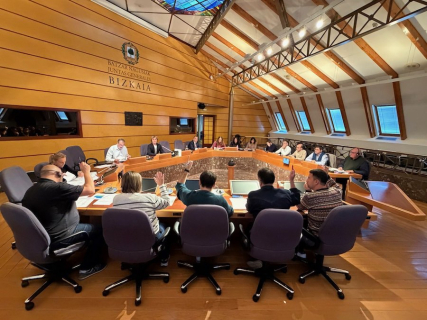

The Finance and Treasury Commission of the General Assemblies of Bizkaia gave its approval this Tuesday, with certain modifications, to the Draft Foral Norm that regulates the implementation of new fees for authorizations for works and installations on the foral road network and on the territory’s bicycle routes.
As the Bizkaia chamber has indicated, the opinion, which must be submitted to the plenary for its definitive approval, has gone forward with the support of Basque Nationalists and Basque Socialists and the abstention of the opposition groups. The text incorporates three changes resulting from an agreement between the parties that support the foral Government and the Popular Vizcaíno group.
The agreement between PNV, PSE and PP has been formalized through two transitory amendments and the acceptance of a specific amendment from the populars, with the aim of strengthening legal certainty and eliminating procedures or charges considered unnecessary.
With the first of the transitory amendments approved, sections 2 and 3 of article 5 of the initial text are eliminated. The groups agreed that this modification clears up "possible interpretive doubts" about the determination of who must bear the payment and the liability regime in the event that there are several beneficiaries.
The second transitory amendment agreed eliminates section 2 of article 7, on the understanding that applicants should not be required to pay the fee before obtaining the corresponding administrative authorization.
In addition, PNV and PSE have supported an amendment by the Partido Popular (1873) to eliminate tariff 12 from the annex to the norm. Given that special transport authorizations are the competence of the Basque Government and the Provincial Council is limited to issuing technical reports that do not generate a fee, it has been concluded that keeping this concept was confusing and lacked usefulness.
The regulatory project, which must be ratified in the plenary in order to come into force, updates a tax framework in force since 1990, which contemplated 12 types of tariffs and made it difficult to set specific fees for numerous actions.
With the new wording, the classification now includes 19 groups of actions, after one was eliminated in Tuesday’s session, and expressly incorporates the protection zones of the bicycle routes, absent from the previous regulations.
The new fees have been established based on the nature of the action, the proximity to the infrastructure and the relevance by volume or cost, parameters that directly influence the time needed for administrative processing.