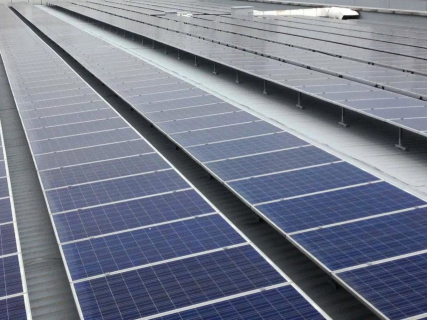

Households in the Basque Country can now apply for the new aid from the Eguzki Hotz program, an initiative of the Basque Government to promote energy self-consumption and sustainable air conditioning. The call for applications, managed by the Basque Energy Entity (EVE), opened last November 5 and provides for grants to install solar panels, add storage batteries, and replace heating or hot water systems with renewable technologies.
The Basque Government announced a total investment of 120 million euros for this program, although the call for applications published by the EVE initially has funding of 80 million: 60 million for installations for generating renewable electricity and 20 million for electrifying thermal uses.
In the residential sector, the regional Executive has announced aid of up to 55% of the cost of photovoltaic installations. However, the regulatory bases establish that the amount is calculated by modules per installed power and that the grant may not exceed 65% of the eligible cost. Therefore, the final percentage will depend on the characteristics and the eligible expenses of each project.
Who can apply for the grants to install solar panels
The program is aimed at individuals, businesses, public administrations, and homeowners’ communities, among other beneficiaries. In the case of households, individuals may apply who do not carry out an economic activity through which they offer goods or services on the market.
Residential homeowners’ communities and renewable or citizen energy communities that meet the requirements set out in the bases may also apply for the grants.
The installations must be located in Euskadi and the generated and stored energy must be consumed in the territory. In addition, for grid-connected self-consumption installations, it is required that the associated annual consumption reaches, at minimum, 80% of the energy generated. This requirement does not apply to isolated installations.
Which installations and actions are eligible for grants
Eguzki Hotz includes two main lines of action, with different aid conditions and calculations.
1. Electricity generation for self-consumption
This line includes:
-
New photovoltaic facilities to produce electricity for self-consumption.
-
Extensions of renewable generation facilities that are already in operation.
-
Incorporation of batteries to store the energy produced by new or existing facilities.
-
Wind generation facilities that meet the requirements of the call.
In the case of batteries, they must be associated with a renewable generation facility and located in the internal grid. The maximum subsidizable capacity is limited to four kilowatt-hours for each peak kilowatt of installed photovoltaic power.
For individuals who do not carry out economic activity, photovoltaic aid is calculated by means of modules of 600 euros per kWp for installations up to 10 kWp, 450 euros per kWp for powers greater than 10 and up to 100 kWp, and amounts lower for installations of larger size. The subsidy may not exceed the eligible cost or the maximum limit of 65%.
2. Electrification of thermal consumption
The second line finances the replacement or installation of renewable systems for space heating and the production of domestic hot water (DHW). The technologies covered include:
-
Air source heat pumps (aerothermal energy).
-
Geothermal energy.
-
Hydrothermal energy.
-
Certain air-to-air heat pump systems and rooftop units.
In private homes, the aid is calculated according to the installed power and has maximum limits per home. For example, air-to-air heat pumps can receive up to 500 euros per kW installed, with a maximum of 3,000 euros per home. For closed-loop vertical circuit geothermal, the limit reaches 13,500 euros.
There is an important difference between technologies: air-to-water heat pump systems, geothermal energy, and hydrothermal energy do not have to be linked to a dedicated photovoltaic installation in order to access these grants. In contrast, certain air-to-air heating and cooling units must be associated with a source of renewable generation, such as solar panels. In addition, not all air-to-air systems are included: the conditions vary depending on the type of unit and the beneficiary.
Can the grants be requested if the solar panels have already been installed?
Yes, but it depends on who applies for the subsidy and when the project was carried out.
For individuals and entities that do not carry out an economic activity, the bases allow admitting firm implementation commitments, accepted budgets, orders, contracts, invoices, and payment supporting documents dated from January 1, 2026, inclusive. This means that a private individual who has contracted or installed solar panels before the opening of the call could apply for the aid if they meet the conditions and can substantiate the dates and expenses.
On the other hand, people or entities that carry out an economic activity, such as companies and self-employed workers, must submit the application before starting the action or assume firm commitments to carry it out. They will not be able to apply for the subsidy if they have started the project or assumed that commitment prior to the application.
What documentation must be submitted and how to apply for it
The application is processed through the electronic headquarters of the Basque Government, from the Eguzki Hotz program file on the website of the Ente Vasco de la Energía.
Before starting the procedure, it is necessary to have a means of electronic identification and to prepare the documentation in digital format. The specific documents depend on the type of installation and on the applicant’s situation, but among the planned models and supporting documents are:
-
Identifying documentation of the applicant and, where applicable, of their representation.
-
Data of the electrical supply point (CUPS).
-
Responsible statements about the consumption and monitoring of the installation.
-
Technical documentation of the action and of the installed equipment.
-
Documentation relating to storage, when batteries are incorporated.
-
Budgets, contracts, invoices, and payment supporting documents, according to the project phase and the type of beneficiary.
Once the file has been prepared, the applicant must complete the form, attach the documents, sign, and submit the application. The system generates a receipt confirmation and later allows consulting the status of the file through «My folder».
Until when can the grants be requested
The deadline began on November 5, 2026, and will remain open until the available budget is exhausted. In any case, the set deadline is the September 29, 2028.
Requests are examined in order of submission, as long as they meet the required requirements and there is budgetary credit. Therefore, even if the period extends for almost two years, the call may close earlier if the funds are exhausted.
Once the grant has been awarded, beneficiaries have a maximum of 18 months from the notification of the resolution to carry out, invoice, and pay for the action, with a general deadline of 31 October 2029.