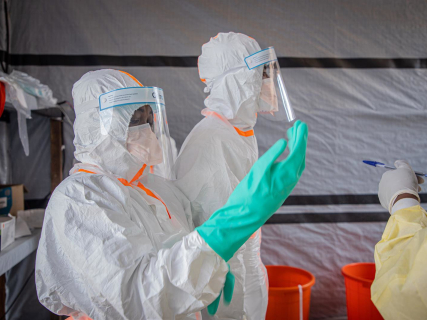

Authorities in the Democratic Republic of the Congo (DRC) have reported that the Ebola outbreak declared approximately six months ago in the east of the country has surpassed the threshold of 10,500 cases, in a context of expansion that keeps international alarm burning, especially after the detection of related infections in other African states.
In its latest bulletin, the National Institute of Public Health (INSP) details that so far 10,532 infections and 5,126 deaths have been recorded, with 65 new cases and 23 deaths in the last day, which places the overall case fatality rate at 48.7%.
The report also specifies that there are currently 961 people admitted or in isolation—almost two dozen fewer than the previous day—while 2,834 patients have overcome the disease and have been discharged. In addition, the percentage of located and controlled contacts stands at 84%.
The health agency details that eight provinces are affected by the outbreak—Ituri, North Kivu, South Kivu, Upper Uélé, Lower Uélé, Tshopo, North Ubangi, and South Ubangi—. Ituri continues to be the main focus, concentrating 70.6% of total infections, although this percentage has fallen slightly in recent weeks due to an increase in cases in other areas of the country.
Meanwhile, the United Nations Children’s Fund (UNICEF) delivered on Tuesday 50 tons of supplies to South Sudan in order to reinforce preparedness efforts against Ebola, including personal protective equipment and materials intended for infection control.
UNICEF emphasizes that, as part of its intervention, it is intensifying preparedness by improving infection prevention protocols in health facilities and communities, as well as through information and training actions aimed at both health personnel and the population, with the objective of facilitating early detection of symptoms and fostering barrier practices that slow transmission.
"The evidence from previous Ebola outbreaks shows that preparedness is essential to keep outbreaks under control," said UNICEF’s representative in South Sudan, Noala Skinner, who highlighted that "national investment in social services, including the payment of salaries, is, at this moment, of the utmost importance to reinforce preparedness and support any response".
The current outbreak in the DRC has already become the deadliest that the country has experienced, surpassing the one recorded between 2018 and 2020. The projections indicate that it could even exceed the West Africa outbreak from 2014 to 2016, which left 28,616 cases and 11,325 deaths in Guinea, Liberia and Sierra Leone, according to data from the World Health Organization (WHO).
In the past few weeks, infections have also been verified in Kenya and Nigeria —the latter declared free of the virus after evacuating to Switzerland the only patient— related to the outbreak in the DRC. All of this occurs after Uganda announced on July 28 that it was free of the virus, after counting two deaths and 20 cases.