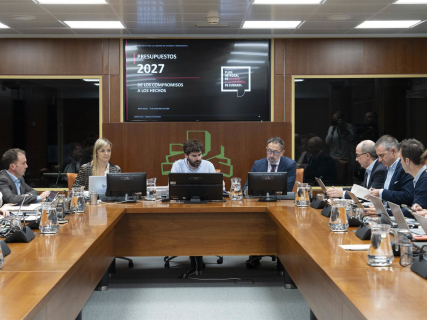

The Department of Housing and Urban Agenda of the Basque Government has proposed a budget of 504.1 million euros, 19.4% more than this year, which will be financed entirely with its own resources after the end of the MRR funds and which, according to its projections, "will make it possible to reach and exceed the commitment of 7,000 protected rental homes" before the end of the term.
That is what the minister of Housing and Urban Agenda, Denis Itxaso, has stated during his appearance this Tuesday before a parliamentary commission, in which he detailed the accounts of his department for the 2027 financial year.
Itxaso has emphasized that Euskadi "redoubles its commitment with its own resources" to address the housing access problem, "a crisis that affects both the most vulnerable people and young people with jobs, working families and the middle classes". The plan concentrates resources to expand the stock of protected and affordable rental housing, activate vacant housing, strengthen aid and rehabilitate the existing housing stock, along with three specific reforms of the Basque Housing Law to expand the capacity for public intervention over land and protected housing.
The 'Housing Program' will have 493.1 million euros, 60.8 million more than at present, which represents an increase of 14.06%. Of that amount, 413.1 million are reserved for the 'Rental Program', which groups 83.8% of the total.
For 2027, the start of construction of 1,840 public-protection housing units and housing for specific end uses/apartment units is expected: 279 directly driven by the Department and 1,561 by Visesa. "These starts correspond to the effective awarding of the works, a more advanced phase than the provisional approval or the administrative start of the developments," the minister has clarified.
The direct development adds 3,655 homes and apartment units, integrating the 1,840 that is intended to be launched in 2027 and the 1,815 coming from previous years. In addition, 95 homes from the program to promote affordable rental housing are added, with funding of 40.3 million euros, of which 610 will be delivered in 2027.
In total, both lines bring together 4,607 homes and apartment units in different stages of development, a figure that rises to 5,174 if the 510 homes of Benta Berri (100 million) and the 57 acquired from Kutxabank (5.7 million) are included.
New homes by territory
In Álava, 683 new homes will be launched: 29 VPO in Llodio, 58 in Agurain, 23 in Oyón, and several developments in the Vitoria neighborhoods of Salburua (167 VPO and 130 social homes) and Zabalgana (276 VPO). In addition, 465 more currently under construction in Vitoria-Gasteiz, Llodio and Elciego are added to them, reaching 1,148 homes for direct development.
During 2027, 522 homes from the affordable rental program are expected to be delivered and another 173 will be put into execution, all in Vitoria-Gasteiz, so that the total number of homes underway in Álava will reach 1,843.
In Bizkaia, it is planned to start 187 homes: 75 VPO in Muskiz, 40 in Abanto-Zierbena and 72 in Zorrotzaurre, while 847 are already in the construction phase in Bilbao, Ortuella and other areas. Taken together, they total 1,034 homes for direct development, to which 257 homes from the affordable rental program in Bilbao, Derio and Barakaldo are added, for a total of 1,291 homes underway.
Gipuzkoa will concentrate 970 new construction starts: 472 VPO in Irún, 44 in Zumarraga, 190 in Ordizia, 80 in Andoain, 71 in Azkoitia, 16 in Azpeitia, 30 in Soraluze, 27 in Errenteria and 40 subsidized apartments in Eibar. These developments are added to the 503 homes already being built in Tolosa, Donostia, Zumarraga, Lezo, Ordizia and Beizama, reaching a total of 1,473 homes.
Housing Social Fund and legal changes
The minister has detailed that the first legal reform will allow the direct allocation of land to the 'Housing Social Fund'. Associated with the strategic land reserve, this figure seeks to promote, through public-private collaboration and under public planning, 10,000 new affordable rental homes aimed mainly at working and middle classes.
In this context, he has defended the importance of anticipating the availability of land, given that "without land there is no affordable rent at large scale".
The second modification proposes extending the temporary qualification of protected homes prior to 2003 located in tense areas and that could lose their protection starting in 2027, with the aim of "preventing this housing stock from moving to the free market precisely where pressure on prices is greatest".
The third tool will be a public real estate agency for protected housing to "put its secondary market in order". With it, it will be determined who must acquire the homes that are transferred between private individuals, based on the people registered in Etxebide as purchasers seeking housing, and taking into account criteria such as the needs of the living unit, the length of time on the register, and the rent.
Itxaso has reminded that each year around one thousand privately protected homes are sold in Euskadi, so this measure aims to guarantee "transparent allocations and combat concealed overpricing", including those demanded through mandatory purchases of furniture, so that "protected housing cannot become a space for private abuse built on a public advantage".
In addition to these three legal reforms linked to the budgets, the minister has advanced that the Basque Government will promote an amendment to the proposal for a law on simplification and streamlining for sustainable economic activity, currently in parliamentary processing, so that Higher Projects of Public Interest may also incorporate residential actions intended for public protected housing.
Public management and rental programs
Visesa will have a budget of 166.3 million euros and Alokabide will have 187.1 million. The accounts set aside 35.1 million for the Visesa program contracts between 2022 and 2027 and 80.4 million so that Alokabide acquires rental developments, including the 711 homes that Visesa will deliver to it in 2027.
Bizigune will have 55.4 million euros, 10% more, with the goal of reaching 8,500 homes, while the new intake, the transfers from the Department, and the purchases from Visesa will make it possible to move toward a total housing stock of 19,000 homes managed by Alokabide.
Alokaplus will have 2 million to compensate for rental non-payment. 500,000 euros of support for town councils for applying the levy to vacant housing is maintained, and another 2 million euros is allocated for drafting municipal housing plans and streamlining urban planning plans.
The budget sets aside 83 million euros for the economic benefits linked to the Subjective Right to Housing, 18 million more than in 2026, with the expectation of closing 2027 with 34,000 families holding this right.
Gaztelagun increases its endowment to 30 million euros, with the aim of reaching 11,000 beneficiary persons, and the 50% reserve of affordable rental housing for people under 36 years of age is maintained.
The Directorate for Rehabilitation and Neighborhood Regeneration will have 81.49 million euros. Assistance to improve habitability, accessibility, and energy efficiency totals 56.8 million, including both 2027 financing and commitments for later years, while the specific neighborhood regeneration program will have 23.9 million.