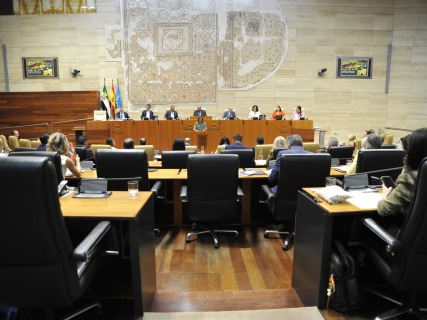

The parliamentary groups of PP and Vox have advanced that they will vote against the partial amendments registered by the PSOE --40-- and Unidas por Extremadura --50-- to the General Budgets of Extremadura (PGEx) for 2026 in the area of Health and Dependency Care, understanding that the accounts already prioritize healthcare and consolidate the system.
The socialist proposals, organized into two blocks, have been defended by deputies Soraya Vega and Judit Olivares. In her speech, Vega insisted that the SES does not suffer from a funding problem but from a management issue, with a model change that, in her opinion, "does not consist of strengthening public health, but of deteriorating it little by little" to legitimize referrals to private healthcare and favor private insurance.
With their amendments, the PSOE aims to "recover the course" through a shock plan to "rescue" Primary Care, in addition to demanding more resources for mental health, a modernization plan for local clinics, and the recovery of a "true agenda of health investments."
Judit Olivares emphasized that the amendments on disability and dependency "are not opposition for opposition's sake" but a "clear and committed" alternative to the well-being of the Extremaduran citizens and against the outsourcing of services and resources.
Among their proposals, she has suggested strengthening and expanding the network of Disability Care Centers in Extremadura (Cadex), with the creation of a new one in Plasencia, as well as enhancing social agreements, early care, functional habilitation places, and residential places for people with disabilities.
In the position-setting turn, the deputy of Unidas por Extremadura José Antonio González Frutos has appealed for parliamentarians to be "mature," to assume the real situation of the healthcare system, and to recognize that the measures applied so far "are not sufficient."
From Vox, deputy María Jesús Salvatierra has maintained that the PSOE's amendments do not constitute a true healthcare plan, but rather a "propaganda operation paid with the money that heals the sick," and has reproached that financing actions is proposed "by emptying operating rooms and pharmacological treatments."
In the same line, the PP deputy Margarita Núñez has demanded that the PSOE stop "lying," denying the figures that the opposition attributes to health referrals and detailing the increases in multiple items of the Health and Dependency Care section, something that the 'popular' Isabel Sánchez Torremocha has also highlighted.
The 50 amendments of Unidas por Extremadura
On behalf of Unidas por Extremadura, José Antonio González Frutos has defended the 50 amendments registered by his group, of which 24 refer to dependency care and consumption, and the rest to the health sector.
Regarding the health system, he has denounced that the model "fatten" in budgetary terms without this meaning a real improvement, and has criticized the "imbalances" in the distribution of the increase, since, he said, referrals to the private sector, variable productivity, daily wages, and pharmaceutical spending grow more than the structural and planned reinforcement of the public system.
As for the dependency care system, he has warned that it is at a crossroads that requires making decisions and carrying out an "adequate diagnosis" to move towards a model of "more quality," "more dignity," and with "greater home care."
In the subsequent debate, the Vox deputy María Jesús Salvatierra has described the package of proposals from Unidas as a "letter to the Magi." "A residence in every town, a health center in each one, an ambulance on every corner. All at once, everything and now," she has ironized.
She has also opined that many of those measures represent a "camouflaged cut" to public health via medications and has emphasized that a good part of the demands are already included in the governance agreement, which is beginning to be executed with a "realistic and rigorous" budget that allocates a "historic amount" to health and dependency care.
On behalf of the PSOE, Soraya Vega has confirmed her group's support for the amendments from Unidas as they aim to strengthen the public system, and has emphasized the agreement on the urgency of strengthening Primary Care.
"What is urgent is that Extremadura needs more public health, more professionals, and more own capacity. Because I have to remind you that the competencies are ours, of the autonomous community. Shifting the blame is almost ridiculous," she has pointed out.
Likewise, the socialist Judit Olivares has emphasized that they share a good part of the content of these amendments and that they contribute to improving the lives of the population. "Behind every residential square there is a family that is waiting for a solution," she has stated.
From the PP, Margarita Núñez has asked González Frutos to abandon the "narrative of cuts" and has defended that the "reality" is that the accounts guarantee the well-being of the citizens and strengthen public services.
For this reason, she has justified the rejection of the 'popular' to the amendments for considering them irresponsible from a budgetary point of view, as they intend to finance new measures by weakening pharmaceutical provision or reducing funds for surgical interventions, diagnostic tests, or hospital medications. In the same vein, the 'popular' Nélida Martín Hernández has emphasized that the budgets for 2026 are the "most substantial" and the "most social".
Debate on subsidies and social dialogue
In the section of Finance, Public Administration, and Social Dialogue, the deputy of Unidas por Extremadura Juan Alessandro Schirinzi has defended the 10 amendments of his group, focusing his intervention on those that affect the institutional participation of trade union organizations, whose subsidies are reduced in these accounts, although he has specified that most of the proposals are of a technical nature.
In the turn of positions, the deputy of Vox Eva García Alegre has assured that, when analyzing the figures in detail, the "true reality" of the budget is revealed, which, in her opinion, is a "profound distortion" of priorities by prioritizing the financing of structures related to the "real improvement" of public services.
On behalf of the PP, Susana Rodríguez Sánchez has announced that her group will reject the ten amendments from Unidas and has listed the improvements achieved by public employees since María Guardiola took office as President of the Junta, such as the payment of salary arrears or the implementation of level 3 and level 4 of the professional career, among others.
Regarding the ten amendments from the PSOE, deputy Julio César Rodríguez has reproached that social dialogue has been elevated to the rank of ministry and that "at the first opportunity, valid interlocutors are left with barely any budget," after cutting subsidies by 50 percent "dragged by their inhumane agreement with the far-right."
Again, Eva García Alegre (Vox) has censured that the PSOE presents what she considers the "perfect catalog of wrong priorities and ideological confusion" with which the left intends to manage public resources, for which she has announced "with absolute firmness" the vote against the socialist amendments.
Finally, the 'popular' Olivia Labrador has responded to the PSOE that, in terms of social dialogue, the Junta recognizes the constitutional and legal role of the most representative organizations, but has emphasized that their funding must be adjusted to criteria of "legality, review, and budget adequacy."