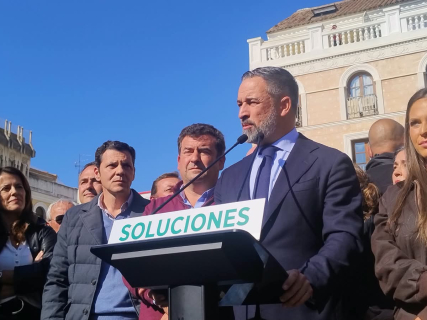
Abascal points to Sánchez following the resignation of Puente: "Body is only one more fuse"

The leader of Vox holds the President of the Government responsible for the deterioration of public services during a press conference in Ciudad Real that has ended up turning into a rally. Tonight, he will meet with Javier Milei in Madrid.

WhatsApp Image 2026 11 04 at 13.19.07 (1)

WhatsApp Image 2026 11 04 at 13.19.07 (1)

Add DEMÓCRATA to Google

Ask FREN

Published

Last updated

2 minutes

Most read

Elecciones 29N · Encuestas

La media de las encuestas

Media a 4 de noviembre de 2026 · 15 institutos

  • PP31,0 %
  • PSOE26,3 %
  • Vox19,5 %
  • Frente Amplio6,5 %
  • ERC2,5 %
  • Podemos2,2 %
  • SALF2,2 %
01020304050ene 2024jul 2024ene 2025jul 2025ene 2026jul 2026

Media del último estudio de cada instituto en 30 días y su evolución semanal desde el 23J. Partidos con al menos un 2 %.

Todas las encuestas

Elecciones generales del 29 de noviembre · Demócrata

Ciudad Real. Vox’s pre-campaign has taken the party president, Santiago Abascal, to the main square of Ciudad Real. What was initially planned as a media-attention event has ended up turning into a rally overflowing the organization.

In his speech, Abascal has launched into Pedro Sánchez following the resignation of Óscar Puente after the Urda (Toledo) rail accident and the announcement that Carlos Cuerpo will take over the Transport portfolio. "It’s just one more body that gets in the way between Pedro Sánchez and the dock, just one more fuse," he said about the new minister.

The Vox leader has insisted that the political responsibility for what happened lies with the president of the Government. "We said it before Puente’s resignation. Everything that has happened in Spain during the last few years has an X. The X of all those crimes, betrayals and lies is Pedro Sánchez," he stated.

Abascal has accused the head of the Executive of using his associates to evade responsibilities, citing his wife, Begoña Gómez, his brother, David Sánchez, and the former Transport minister. "Pedro Sánchez always has a fuse to disconnect, but he is hiding behind all his henchmen", he assured.

According to Abascal, Sánchez is the "main person responsible for the destruction of the rail network, the power grid, the energy network and the hospital network." He also denounced what he considers a "tax heist" against the middle classes, the self-employed, SMEs and workers.

"More taxes are paid than ever and public services are worse than ever and more dangerous than ever," he said, before hardening his message: "The betrayal of this Government kills, the corruption of this Government kills and the ideological fanaticism of this Government kills".

On the route

Although it was a working Wednesday, not even a pin could fit in the city center. In the crowd, people of all ages, even children, who had been waiting for hours to hear the leader of the far-right formation, 24 days before the ballot boxes open.

This afternoon, Vox’s electoral activity continues in Cuenca, with an event, this time yes, planned for its supporters. Afterwards, late in the day, Abascal will head to Madrid. As it has become known this morning, the leader of the formation will meet with the president of Argentina, Javier Milei, who is in our country on the occasion of the Ibero-American summit.

"This time it won't be by video call, so they don't say that we emulate the film of Torrente. It will be in person", he said ironically in an interview. The quote will be Milei's only activity outside the official agenda of the summit and will allow both leaders to see each other in person after, during the Argentine president's most recent visit to Madrid, last October, they had to make do with a video call because Abascal was in pre-campaign in Ponferrada.
More key points, information and questions with FREN

AI-GENERATED CONTENT

What parliamentary procedures are necessary for the swearing-in of a new minister in Spain?

No parliamentary procedure is necessary for a new minister to be sworn in in Spain. Neither the Congress nor the Senate must approve their appointment, ratify it, or hold a prior hearing. Parliamentary involvement consists of overseeing their actions, not authorizing their incorporation into the Government.

Who decides the appointment

The fundamental rule is in Article 100 of the Constitution: "The other members of the Government shall be appointed and removed by the King, at the proposal of its President." Therefore, it is the Prime Minister's responsibility to choose the ministers and propose their appointment; the King formally carries it out.

This distribution does not grant the Cortes an individual confirmation power. The Constitutional Court explains this in Judgment 124/2018: the Constitution assigns the Congress the election of the candidate for the Presidency of the Government and the president the choice of the other members, for their appointment by the King. Article 64 frames royal acts within the system of countersignature, which assigns responsibility to the person who countersigns them.

Why there is no investiture of the minister

Investiture, that is, the vote by which the Congress grants its confidence to the candidate for president, does not extend to each member of the Government. Article 99 of the Constitution and Articles 170 to 172 of the Congress Rules regulate this procedure exclusively for the Presidency.

Consequently, replacing a minister does not require repeating the investiture, obtaining a parliamentary majority, or raising a vote of confidence. Nor does the Senate participate in a vote on the appointment. Parliamentary confidence in the president and the selection of their team are legally different decisions.

What parliamentary formalities are not required
  • There is no mandatory prior hearing before a committee to evaluate the candidate and authorize their access to the position.
  • There is no confirmation vote, neither in the Plenary nor in committee, before or after the appointment.
  • There is no parliamentary oath as a minister. Incorporation into the Government should not be confused with the requirements to acquire full status as a deputy.
  • There is no constitutive appearance: a session to explain the department's lines does not grant the position nor validate the appointment.

The designation procedures for certain authorities set out in Articles 204 to 206 of the Congress Rules do not apply to ministers. The existence of appointments that do require parliamentary participation does not allow transferring that requirement to members of the Government.

What control the Chambers can exercise

Once incorporated into the Government, the minister is subject to parliamentary control. Articles 109 to 111 of the Constitution allow the Chambers and their committees to request information, demand the presence of Government members, and formulate questions and interpellations, which are instruments to request explanations about their management.

In the Congress, Article 44.2 allows requesting their presence in committee. Article 202 regulates informative sessions at their own request or that of the committee, and Article 203 contemplates appearances before the Plenary or committees. The latter foresees that groups formulate questions and observations and that the minister answers "without further voting."

In short, appearing to be accountable does not equate to being confirmed in office. Article 108 establishes the Government's collective political responsibility before the Congress, but that responsibility does not turn each ministerial appointment into an individual investiture.

What are the competencies of the Ministry of Transport and Sustainable Mobility according to Spanish legislation?

The Ministry of Transport and Sustainable Mobility proposes and executes the Government's policy on infrastructures and transport services of state competence, and promotes safe, sustainable, and socially just mobility. Its competencies also include the regulatory organization of postal services and state services of astronomy, geodesy, geophysics, and cartography.

The main reference is Royal Decree 253/2024, of March 12, especially its Articles 1 and 2. It should be read with the amendment introduced by Royal Decree 690/2025, of July 29, on crisis coordination and other functions.

1. Transport infrastructures and services

The Ministry gathers functions of planning, investment, regulatory drafting, and administrative organization. Its main areas are:

  • Roads: planning and programming of actions on state roads, projects and works, maintenance, operation, and technical regulations. It also promotes and supervises actions related to toll highway concessions.
  • Railway: planning and evaluation of the General Interest Railway Network, drafting regulations and feasibility studies, terminal planning, and coordination between infrastructure managers and operators. These functions respect the specific powers of the State Railway Safety Agency.
  • Road and rail transport: general organization and administrative regulation of services of state competence, integrating infrastructure policy with transport needs.
  • Air and maritime transport: definition and execution of the corresponding state policies, including their infrastructures. In the port area, it establishes planning and investment objectives in ports of general interest.
2. Sustainable mobility and logistics

Sustainability is a cross-cutting competence, not limited to building infrastructures. It includes the social, economic, and environmental dimensions of mobility, including active mobility, such as walking or cycling trips.

The Ministry promotes plans and strategies, energy-saving measures and emission reductions, technological innovation, and aid. It promotes intermodality, that is, the combination of different means of transport, and develops logistics actions for people and goods. It also cooperates with territorial administrations in sustainable urban mobility plans and in the urban integration of infrastructures of general interest.

3. Investments, funds, and international relations

It is responsible for programming investments and executing infrastructures, directly or through attached entities. The regulation prioritizes safety, maintenance, daily mobility, technological modernization, and intermodality.

It also coordinates European funds linked to transport, participates in trans-European networks and cross-border connections, and develops actions within its competence under the Recovery Plan. It coordinates its international relations, especially with the European Union, in collaboration with the Ministry of Foreign Affairs.

4. Organization, crisis, and other functions

The State Secretariat for Transport and Sustainable Mobility directs these policies through three general secretariats: Land Transport, Air and Maritime Transport, and Sustainable Mobility. It exercises strategic direction and result control over entities such as ADIF, Adif-High Speed, Renfe-Operator, Enaire, and State Ports.

The Undersecretariat groups common services, economic and budget programming, organization and inspection, and the National Geographic Institute. The department also assumes postal regulatory organization and the scientific and cartographic functions mentioned.

The 2025 reform strengthens crisis prevention and coordination, victim and family care, and relations with the independent accident investigation authority, without replacing the direct management of the competent bodies.

Finally, these powers are exercised at the state level and respecting the competencies of other administrations and ministries: they do not imply that the department manages all urban transport or all Spanish infrastructures.

What has been Carlos Cuerpo's political trajectory before assuming the Transport portfolio?

Carlos Cuerpo came to the responsibility of Transport with a trajectory mainly developed in the economic administration and European institutions, before moving to the Government's front line. His two major previous political milestones were his appointment as Minister of Economy, Commerce, and Business in December 2023, and his promotion to First Vice President in March 2026. He does not come from a career of elected positions nor from organic responsibilities in the PSOE.

Education and entry into the Administration

Born in Badajoz in 1980, he graduated in Economics from the University of Extremadura in 2003, completed a master's degree at the London School of Economics in 2004, and obtained a doctorate in Economics from the Autonomous University of Madrid in 2017. In 2008 he joined the Senior Corps of State Commercial Technicians and Economists, the starting point of his public career.

Between May 2008 and April 2011 he worked as an analyst in the Directorate General for Macroeconomic Analysis and International Economy. His specialization focused on forecasts, economic models, and evaluation of public policies. This first stage was technical, not political representation, according to the trajectory recorded by Demócrata.

European experience and passage through AIReF

From May 2011 to April 2014 he was an economic analyst in the Directorate General for Economic and Financial Affairs of the European Commission. That experience in Brussels preceded his incorporation into the Independent Authority for Fiscal Responsibility, AIReF, an agency dedicated to evaluating public finances.

At AIReF he held two successive responsibilities: Deputy Director General of Public Debt, between May 2014 and October 2016, and Director of the Economic Analysis Division, between November 2016 and January 2020. His work was linked to macroeconomic analysis, forecasts, and public debt sustainability. This stage took place during José Luis Escrivá's presidency.

Rise in Nadia Calviño's economic team

In February 2020 he returned to the Ministry of Economic Affairs and Digital Transformation as Director General of Macroeconomic Analysis. He remained until August 2021, during the COVID-19 crisis, participating in economic forecasts and analyses supporting the Executive's decisions.

In August 2021 he became Secretary General of the Treasury and International Financing. Until December 2023 he assumed responsibilities over public debt, State financing, and international financial relations. Alongside Nadia Calviño, he participated in negotiations on the reform of the European Union's fiscal rules. This was his last position before entering the Council of Ministers.

From Minister of Economy to First Vice President

On December 29, 2023, he was appointed Minister of Economy, Commerce, and Business, replacing Calviño after her designation to preside over the European Investment Bank. This appointment marked his transition from senior administration to direct political responsibility over the Government's economic policy.

The next promotion came in March 2026: Sánchez announced on the 26th that he would replace María Jesús Montero as First Vice President, maintaining Economy. Cuerpo took the oath of office on March 27, as recorded by La Moncloa.

Therefore, before the announcement of his temporary assumption of Transport on November 4, 2026, Cuerpo already had experience as a senior official, minister, and first vice president. According to Demócrata, he will assume that responsibility after Óscar Puente's resignation, until the formation of the new Government after the November 29 elections.

Play

Test your knowledge with FREN!

How much do you know about this topic? Answer the following 3 questions.

In which city did Santiago Abascal's rally take place where he criticized Óscar Puente's resignation?

Question 1 of 3

Who will take over the Transport portfolio following Óscar Puente's resignation as announced?

Question 2 of 3

Which foreign president will Santiago Abascal meet personally in Madrid?

Question 3 of 3