Abascal attacks Sánchez: "Not all of us are the same; we do not have our hands stained with blood"

From Cuenca, the leader of Vox again blames the Government for railway accidents and calls for electoral mobilization in a province where his party has never managed to achieve representation

WhatsApp Image 2026 11 04 at 20.38.24

WhatsApp Image 2026 11 04 at 20.38.24

Add DEMÓCRATA to Google

Ask FREN

Published

Last updated

2 minutes

Most read

Elecciones 29N · Encuestas

La media de las encuestas

Media a 4 de noviembre de 2026 · 15 institutos

  • PP31,0 %
  • PSOE26,3 %
  • Vox19,5 %
  • Frente Amplio6,5 %
  • ERC2,5 %
  • Podemos2,2 %
  • SALF2,2 %
01020304050ene 2024jul 2024ene 2025jul 2025ene 2026jul 2026

Media del último estudio de cada instituto en 30 días y su evolución semanal desde el 23J. Partidos con al menos un 2 %.

Todas las encuestas

Elecciones generales del 29 de noviembre · Demócrata

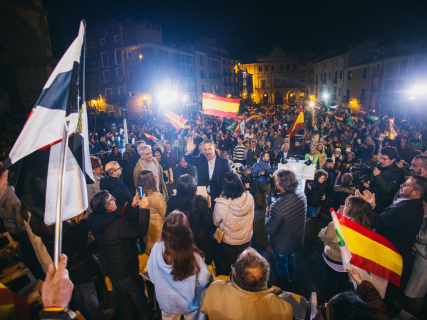
Cuenca. After the press conference offered in Ciudad Real, which has ended up turning into a rally before thousands of people, the president of Vox, Santiago Abascal, has continued this Wednesday his pre-election campaign in Cuenca.

"Something is happening all over Spain," he said during an event in the Plaza Mayor of the city, where he insisted that there is an opportunity for political change, although he warned that the result is not decided. "Let no one take for granted the change, let no one trust the polls," he asked.

"Hope is what has brought us here," Abascal said, who has defended the need to offer an alternative to the current Government. "Sánchez is not a sentence we have to put up with; it is something we can get rid of", he declared to his supporters.

"Everywhere I hear the same problems, there are no differences, in the north and in the south," he said, adding that is why his recipe is the same across Spain: national priority, deregulation, and remigration. In this sense, he has also advanced that his party will be announcing new proposals over the coming days. It is expected that Vox will reveal its electoral program once we enter the official campaign (next November 13).

Criticism of the Government over rail accidents

Abascal has once again leveled criticism at the Executive over the state of infrastructure and public services, with his mind on the Urda rail accident that claimed the lives of 69 people a week ago. "I do not dare to tell Spanish people to use the train," he said.

The leader has had words of remembrance for the accidents of Adamuz and Urda, the blackout, and the DANA. "We do not have our hands stained with blood," he emphasized.

On the other hand, Abascal has defended that Vox wants to offer a different way of doing politics. "We are here because we want something different. We need different politicians; we appeal to common sense," he said.

The leader of Vox closed the rally, insisting on the importance of electoral participation and that his supporters do not take for granted the sum of forces that aspire to "remove Sánchez from the Moncloa."

In search of a seat

He also took the floor Iván Vélez, number 1 on Vox's candidacy for the Congress for Cuenca. Vélez is an architect, writer, and director of the Denaes foundation; he already led the list of the far-right party in the two general elections of 2019 and in 2023.

The formation of Abascal has never managed representation in this province. Cuenca distributes three seats, which historically have been distributed between PP and PSOE.

In the 23J, the formation of Abascal obtained 17,700 votes, which translated into 15.55%, not enough to achieve parliamentary representation. With a view to the 29N, the polls place them ahead of 20 points; however, the seat here remains expensive. Presumably, PP and PSOE will achieve one deputy, and the third will swing between the popular and Vox.

More key points, information and questions with FREN

AI-GENERATED CONTENT

What is the parliamentary status of the proposals that Vox has announced it will present during the campaign?

There is no single package of Vox campaign proposals currently in parliamentary processing. As of November 4, 2026, it is useful to distinguish between electoral announcements, previously rejected initiatives, and proposals that expired with the dissolution of the Cortes. Some measures have parliamentary precedents, but that does not mean that the current announcements are newly registered texts.

The dissolution changes the status of the proposals

The Congress and the Senate were dissolved on October 6; elections will be held on November 29 and the official campaign will run from November 13 to 27. Therefore, the October announcements correspond to the pre-campaign and the Vox bills that were still pending expired: they do not automatically continue into the next legislature. (Electoral call)

Immigration and national priority
  • Restriction of legal residency: the organic bill to restrict this regularization route was rejected on September 16, 2025, when the Congress voted on whether to start processing it. Its course ended then; it is not pending approval. (Published rejection)
  • Expulsion of convicted foreigners and loss of acquired nationality: Vox presented a reform of the Penal Code on July 2, 2026, published on July 17. It had been admitted for processing but expired on October 6 without becoming law. (Text of the proposal)
  • Preference in aid and housing: there are precedents, including a motion debated in June. The sources consulted document its parliamentary defense but do not allow attributing a definitive result here; nor do they prove a new state law registered during the pre-campaign. (June debate)
  • National health priority: it has a separate regional trajectory. Initiatives have been registered in Navarra, La Rioja, Castilla-La Mancha, and the Valencian Community; in Aragón, PP and Vox jointly processed a non-binding proposal. The Valencian one was rejected. These regional procedures are not canceled by the dissolution of the Cortes Generales. (Regional situation)
Taxes, housing, and pensions

The IRPF reform — minimum exemption of 22,000 euros and rates of 15% and 25% —, tax advantages for buying a first home, and the mixed pension model appear as electoral proposals. There is no record in the sources consulted of a new state bill that gathers these measures and remains open. Their announcements should not be confused with an already approved reform. (Economic proposals)

There is a specific precedent on energy taxation: the proposal to eliminate taxes on electric and nuclear production could not continue its processing; its non-admission was published on May 30, 2025. That text does not equate to the entire energy reduction announced now. (Published agreement)

Deregulation: different program and precedents

The deregulation program presented on June 27 is a political document, not a law by itself. The initiative to eliminate the obligation of low emission zones and the waste tax was indeed presented and admitted, but expired on October 6. (Program presentation; Presented proposal)

In short, the announcements do not constitute a common file: their precedents are rejected, expired, or follow regional paths. To turn the expired state proposals into laws, it would be necessary to present them again in the new legislature.

What are the specific powers of the President of the Government of Spain according to the Constitution?

The President of the Government of Spain is the highest authority of the executive power and his position is mainly regulated in the 1978 Constitution, especially in articles 97, 98, 99, 100, 112, 115, and 116, among others. From these derive a series of specific powers and functions, distinct from those of other members of the Government.

1. Direction of Government action

The core competence of the president appears in article 98.2 of the Constitution: he directs the action of the Government and coordinates the functions of the other members, without prejudice to their direct competence and responsibility in their management. This means:

  • Setting the broad lines of government policy (internal, economic, social, external, etc.).
  • Establishing priorities, coordinating the ministries' actions, and resolving conflicts among them.
  • Acting as the political driving center of the executive, ensuring the Government's unity of criteria.

Although the Government is a collegiate body, the Constitution configures the president as its true political director, granting him a clearly preeminent position.

2. Relationship with the Cortes Generales

The Constitution assigns the president several key powers in the relationship between the Government and the Congress of Deputies:

  • Investiture (art. 99): the King proposes a candidate for president of the Government after consulting political party representatives. The person who undergoes the investiture session and presents their program before Congress is the future president. If they obtain confidence (required majority), they will be appointed by the King.
  • Motion of confidence (art. 112): the president can submit to Congress the confidence in his program or a general policy declaration. If not obtained, he must resign.
  • Dissolution of the Chambers (art. 115): the president can propose to the King the dissolution of the Congress, the Senate, or the Cortes Generales, opening the door to new elections. This power has limits (for example, it cannot be exercised while a motion of censure is underway).
  • Political responsibility: the Government as a whole is politically responsible before Congress, but the president is the central figure against whom the motion of censure (art. 113) is directed and who loses office if that motion succeeds.

3. Appointment and dismissal of ministers

Article 100 establishes that the King appoints and dismisses other Government members at the proposal of its president. In practice, this confers the president:

  • The power to select ministers and propose their appointment.
  • The ability to reorganize the Government (dismissals, portfolio changes, reshuffles) during the legislature.

Although the formal act is performed by the King, the political decision corresponds to the president, who designs the executive structure and his ministerial team.

4. Other relevant constitutional powers

Besides the above, the Constitution provides other specific functions of the President of the Government:

  • Calling consultative referendums (art. 92.2): consultative referendums on matters of special political importance are called by the King, but always at the proposal of the president of the Government, with prior authorization from Congress.
  • Endorsement of the King's acts (art. 64): many acts of the King must be endorsed by the president of the Government (or the competent minister). The endorsement makes the endorser politically responsible; thus, the president assumes political responsibility for decisions such as proposing a candidate for president, dissolving the Cortes, or calling a referendum.
  • Participation in states of crisis (art. 116): the Government, under the direction of its president, intervenes in the declaration and management of states of alarm, exception, and siege, always subject to the framework and controls established by the Constitution and the organic law regulating them.
  • Representation of the Government: although the Constitution does not phrase it in a single sentence, it can be deduced that the president is the highest representation of the Government internally (before the Cortes and other institutions) and externally (in relations with other States and international organizations, without prejudice to the King's intervention as Head of State).

5. Summary

In summary, the specific powers of the President of the Government according to the Spanish Constitution focus on: directing and coordinating government action; articulating the political relationship between the Government and Congress (investiture, confidence, dissolution, responsibility); proposing the appointment and dismissal of ministers; promoting consultative referendums; endorsing the King's acts; and leading the executive's action in ordinary and crisis situations. All this configures a position of clear predominance within the executive power, although always subject to parliamentary control and the framework of the Constitution.

What has been Santiago Abascal's political trajectory before leading Vox?

Before leading Vox, Santiago Abascal developed his career mainly in the People's Party of the Basque Country: he was a councilor in Llodio, leader of New Generations, representative in the General Assemblies of Álava, and regional deputy. Later he held positions in bodies linked to the Community of Madrid and presided over the Foundation for the Defense of the Spanish Nation. His break with the PP in 2013 preceded the creation of Vox and his election as president in September 2014.

Beginnings in the Basque PP

Abascal, born in Bilbao in 1976, joined the PP during his youth. The biographies consulted differ on the exact year of affiliation, placing it between 1994 and 1996. His first elected office came in 1999, when, at 23 years old, he was elected councilor of the Llodio City Council, in Álava. He remained in the municipal corporation until 2007, during two terms. (Profile in El Español)

Between 2000 and 2005 he presided over New Generations of the Basque PP, the party's youth organization. That responsibility allowed him to move from municipal politics to territorial leadership tasks. He also was part of the PP's governing bodies and, in 2005, assumed the Education Secretariat of the party in Euskadi. (Trajectory in El Correo)

Representation in Basque institutions

Between 2003 and 2004 he was a procurator in the General Assemblies of Álava, the representative institution of the territory. In January 2004 he entered the Basque Parliament to replace Carlos Urquijo, appointed Government delegate in the Basque Country. He did not win a seat in the 2005 elections but returned that same year through another replacement and remained in the Chamber until January 2009. (Parliamentary stage)

His activity in Euskadi took place in a context of ETA threats against political representatives, which also affected him personally. During those years he gained notoriety for his opposition to Basque nationalism and the Ibarretxe Plan. In 2008 he made a public gesture by tearing up a ballot of the consultation promoted by the lehendakari. (Profile and political episodes)

DENAES and positions in Madrid

In parallel, since 2006 he promoted and presided over the Foundation for the Defense of the Spanish Nation, known as DENAES. This organization defended the unity of Spain and opposed independence projects. It provided him with a platform for public activity beyond his institutional responsibilities and the PP structure. (Profile in El Periódico)

After his Basque parliamentary stage, he took on appointed positions in Madrid, supported by Esperanza Aguirre. He directed the Data Protection Agency of the Community of Madrid and, between 2012 and 2013, the Foundation for Patronage and Social Sponsorship. These were not positions obtained by popular election but responsibilities in bodies linked to the regional administration. (Positions before Vox)

The break with the PP and arrival at Vox

On November 25, 2013 he left the PP by letter to Mariano Rajoy, after disagreements about terrorism, nationalism, and government orientation. He later participated in the launch of Vox, publicly presented in January 2014. He was provisional secretary general in March and elected president on September 20, 2014: thus culminating his transition from PP leader to founder and top leader of another party. (Break and political transition)

Play

Test your knowledge with FREN!

How much do you know about this topic? Answer the following 3 questions.

In which city did Santiago Abascal hold his rally during the mentioned pre-election campaign?

Question 1 of 3

What percentage of votes did Vox obtain in Cuenca in the general elections of 23J?

Question 2 of 3

Who is the number 1 candidate of Vox for the Congress from Cuenca?

Question 3 of 3