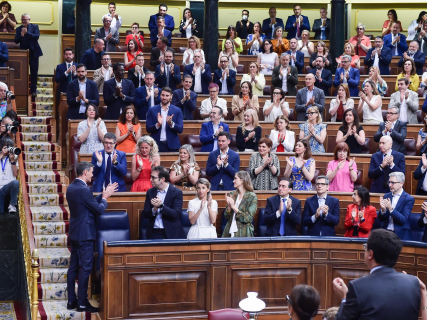

The general strike called for next November 11 also opens a debate about the activity of the Congress and the Senate. Members of the Chamber of Deputies and senators may publicly back the protest and even decide not to attend a parliamentary session, but they cannot exercise the right to strike under the same conditions as workers.
The explanation lies in their relationship with the Cortes Generales. Although they receive an allowance for their functions, parliamentarians are not employees of the Congress or the Senate. Their link to the chambers comes from their status as elected representatives and is regulated by the Constitution and parliamentary regulations, not by an employment contract.
Why deputies and senators do not have an employment relationship
Article 28.2 of the Constitution recognizes workers’ right to strike in order to defend their interests. This right allows the temporary interruption of the provision of services with the effects envisaged in labor legislation and, with its particularities, it can also be exercised in public employment.
The situation of parliamentarians is different. Their activity in the Cortes does not arise from an employment contract or from a relationship of public employment, but from the representative mandate they acquire after their election.
The Congress and the Senate pay them the corresponding allowances and establish their parliamentary obligations, but they do not act as employers with respect to their deputies and senators. That is why a decision not to attend the chamber to support a general strike does not legally equate to suspending an employment relationship.
What happens if a deputy does not attend the Congress during the strike
A parliamentarian’s absence to back the protest does not have the same effects as a worker’s strike. However, it also does not exempt them from the attendance obligations established in the regulations of their chamber.
In the Congress, the article 99 of the Rules allows the Board to deprive a deputy of certain rights when they stop voluntarily attending Plenary or committee sessions in a repeated or notorious manner. The application of this measure requires a reasoned agreement, so a one-off absence does not automatically imply a sanction.
In the Senate, article 20 expressly recognizes the right and duty of senators to attend plenary sessions and the committees of which they are members. Therefore, a member of the House of Representatives or a senator may express their political support for the 11N strike by being absent, but that decision will continue to be subject to the parliamentary attendance rules.
Do they dock their salary if they support the strike?
When a worker exercises the right to strike, they stop receiving the remuneration corresponding to the time during which they suspend their activity. This deduction does not automatically apply to deputies and senators who decide to be absent to support a call, because their allowances do not arise from an employment relationship with the chambers.
This does not mean that they are free from economic consequences for failing to meet their parliamentary obligations.
In the Congress, article 99 allows measures to be adopted that affect the economic rights of deputies in the situations provided for. In the Senate, article 23 contemplates the possibility of depriving them of their economic rights for one or more months from senators who repeatedly miss sessions without authorization from the Bureau, through the regulatory procedure.
In both cases, these are consequences linked to failure to comply with parliamentary duties, not salary deductions for exercising the right to strike.
Court workers can, in fact, exercise the right to strike
The difference is clear when comparing the situation of parliamentarians with that of staff who work in the Congress and the Senate.
Civil servants of the Cortes Generales do have the right to strike recognized. The article 46 of the Personnel Statute of the Cortes Generales, approved in November 2025, establishes that the exercise of this right will be adjusted to the criteria applicable to civil servants, with the corresponding adaptations to the parliamentary Administration. Contract staff may also exercise it in accordance with their legal regime.
Thus, in the face of the general strike on November 11, a worker of the Cortes can exercise the right to strike, while a member of the House of Representatives or a senator may support the call or be absent for political reasons, but without availing themselves of the same regime.
The difference does not depend on the place where they carry out their functions, but on the nature of their relationship with the institution.