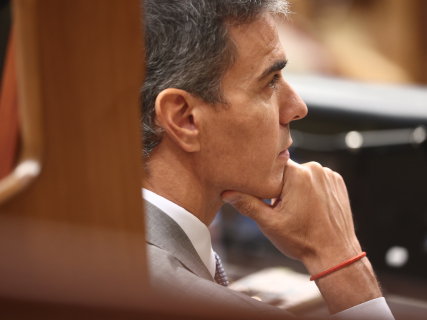

Pedro Sánchez has on the table a formula that would allow doing almost "everything at once": calling general elections, keeping the housing agenda alive, and submitting some of the defeated measures to a vote in which Junts would no longer hold the key by itself. The key lies in a parliamentary body that gains prominence when the Cortes are dissolved, the Diputación Permanente, responsible for maintaining certain functions of the Congress until the new Chamber is constituted.
The possibility expands the scenarios after the failure of the two royal decree laws on housing on Friday. Until now, the options seemed to lead to a dilemma between gaining time to renegotiate the measures or taking advantage of the mobilization in the streets to advance the elections. This third way would allow attempting both things: setting a date for the polls and approving a new decree before the electoral process ends.
A majority of 35 against 34 without needing Junts
The arithmetic of the Diputación Permanente is different from that of the Plenary. In the XV Legislature, it is made up of 68 deputies plus the president of the Congress, Francina Armengol, who also participates in the votes. The official distribution assigns 27 representatives to the PP, 24 to the PSOE, six to Vox, six to Sumar, and one to each of ERC, Junts, EH Bildu, PNV, and the Mixed Group. With Armengol, the socialist bloc practically adds up to 25 votes.
If PSOE, Sumar, ERC, EH Bildu, PNV, and the representative of the Mixed Group, Ione Belarra, voted together, they would reach 35 supports. PP, Vox, and Junts would total 34. The Executive could thus validate a new decree without needing the vote of Carles Puigdemont's party, which in the ordinary Congress has seven deputies and was decisive in overturning the rules from Friday.
| Parliamentary group | Members |
|---|---|
| PP | 27 |
| PSOE, including Francina Armengol | 25 |
| Vox | 6 |
| Sumar | 6 |
| ERC | 1 |
| Junts | 1 |
| EH Bildu | 1 |
| PNV | 1 |
| Mixed, represented by Ione Belarra | 1 |
| Total | 69 |
Source: Congress of Deputies . The 69 members include the president of the Chamber.
PSOE, Sumar, ERC, EH Bildu, PNV, and the representative of the Mixed Group would total 35 votes, against the 34 of PP, Vox, and Junts, if all voted in those blocks. It is a potential majority, not a confirmed support for a new decree.
That does not make the operation automatic. Most would be of one single vote and would force the Government to keep all its potential partners aligned. Just one abstention, one absence, or a change of position would alter the result, so the Permanent Deputation would reduce dependence on Junts but would not eliminate the need to negotiate.
The PNV demonstrates why the numbers are not enough
The main warning came precisely in the last vote. The PNV supported the main decree, but voted against the second text, which included the automatic renewal of certain rental contracts. The Basque nationalists questioned the balance of that measure and its impact on small property owners and the housing supply.
If that behavior were to be exactly transferred to the Permanent Deputation, the second decree would fall again: 34 votes in favor versus 35 against. PSOE, Sumar, ERC, EH Bildu, and Podemos would total 34, while PP, Vox, Junts, and PNV would reach 35. The new arithmetic would allow for dispensing with Junts only in those measures capable of also retaining the PNV.
Podemos would also be essential. That Ione Belarra occupies the position corresponding to the Mixed Group does not mean that her vote is guaranteed for any text presented by the Executive. The content would still be decisive, and the Government would have to negotiate again both with the purple formation and with the Basque nationalists.
Can Sánchez approve a decree after calling elections?
Yes. Calling elections and dissolving the Cortes does not automatically make the Government a caretaker Executive. The Government Law establishes that the Government ceases after the holding of general elections, not when the call decree is published. Until the day of the elections, it therefore retains its ordinary powers and can approve royal decree laws.
Once Congress is dissolved, the Permanent Deputation precisely assumes the function of deciding on those decrees. The Chamber's Regulations establish that the validation or repeal of a royal decree law corresponds to the Plenary or to the Permanent Deputation and must occur before 30 days have passed since its promulgation. There is even the possibility of processing those texts later as bills during the period between legislatures.
There are also precedents. The Permanent Deputation has validated decree laws with the dissolved Cortes on several occasions, including the electoral stage of 2019, when it pronounced on seven. The parliamentary route, therefore, exists and would not be a specific creation for this crisis.
November 29 fits into the calendar
The date that circulates most strongly in PSOE sectors is Sunday, November 29. To reach it, Sánchez would have to activate the dissolution in the coming days. The Organic Law of the General Electoral Regime establishes that, when the president uses his power of early dissolution, the elections are held on the 54th day after the call.
This allows for the electoral calendar to be compatible with a new initiative on housing. The president could announce the advance, approve a text different from the rejected ones, and then submit it to the Permanent Deputation within the constitutional deadline. The ballots and the decree would cease to be incompatible paths.
But the Executive cannot limit itself to exactly resurrecting a norm that has just been rejected as if the Congress vote had not occurred. Any new royal decree law would have to justify the "extraordinary and urgent necessity" again, respect the constitutional limits of this figure, and, politically, introduce sufficient modifications to rebuild a majority.
Experts consulted by DEMÓCRATA see the maneuver as "forced"
Here the main reservations appear. Experts consulted by DEMÓCRATA consider the use of the Permanent Deputation legally imaginable, but question the political convenience of designing a new norm thinking fundamentally about taking advantage of a more favorable vote distribution after dissolving the Cortes.
"I see it as forced and like a trickster," says one of the consulted experts. His alternative involves reducing the complexity of the movement: "It is better to approve it with some changes and take it back or approve the Budget project and include it there with all its processing and a decree on evictions only".
The first option would involve renegotiating the measures that may still gather a majority before dissolving the Chambers and presenting a new decree with modifications. The second would imply using a potential Budget Law to incorporate those policies that fit legally within it and reserving the urgent instrument for specific protection against evictions.
The problem of the Budgets if Sánchez calls
This second alternative, however, would only have a path if Sánchez decided to maintain the legislature. Once the elections are held, the Government becomes provisional and the Law of the Government expressly prohibits it from approving the General State Budget project and presenting bills to Congress.
That is why the two strategies respond to different political decisions. If Sánchez opts to buy time, he can try to rebuild the housing agreement within the current Congress, advance with the Budgets, and separate an urgent decree against certain evictions. If he opts for the elections on November 29, the Permanent Deputation becomes one of the few available windows to continue legislating through decrees before the polls.
The question is no longer merely whether the mechanism exists. It exists. The question is whether Sánchez wants to use it and whether he would find the votes for it to work.
From Junts' blockade to dependence on PNV and Podemos
The main advantage for Moncloa would be evident: in the Permanent Deputation, Junts goes from having seven votes in the Plenary to having one, just like ERC, EH Bildu, PNV, and the Mixed Group. The proportional design of the body completely changes the relative weight of the small parties and allows for the construction of a majority different from the one that just defeated the Government.
But Junts does not disappear from the equation to be replaced by a guaranteed majority. The Executive would exchange one dependence for another: it would need to keep PNV and Podemos together, two formations that have shown different positions on parts of housing policy. Hence, the figure of 35 against 34 serves to demonstrate that there is a path, but not to guarantee the outcome.
The first decree that fell on Friday could have more chances because PNV and Podemos supported it. The second would need significant modifications to attract the Basque nationalists or seek different support that is not currently present in the composition of the Deputation.
Sánchez's particular "Everything Everywhere All at Once"
The formula would allow Sánchez to try to close the legislature with an unusual image: announce elections and, simultaneously, keep open a new parliamentary pulse for housing. It would be his particular "Everything Everywhere All at Once": electoral campaign, a new decree, and a vote in a Congress reduced to 69 members.
Politically, the operation would allow the PSOE to go to the polls trying to demonstrate that the defeat on Friday has not meant abandoning housing measures and would force the parties to reposition themselves. But it would also expose the Government to a second defeat immediately before a campaign if PNV, Podemos, or any of its partners do not accept the new text.
For now, Sánchez has not announced either the electoral advance or a new decree. The scenario of November 29 has gained weight among members of the Government and socialist leaders, but the decision remains in the hands of the president. The Permanent Deputation offers a legal door to combine both movements. Whether Moncloa decides to cross it, and whether those 35 votes are really on the other side, is another question.