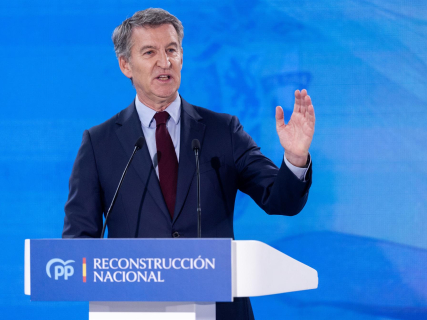
Feijóo asks Sánchez "where is the money of the Spanish people" and denounces the deterioration of public services

The leader of the PP opens the 29N campaign accusing the Government of collecting more taxes, accumulating more debt and receiving more European funds than ever while, in his judgment, infrastructure, security and public services worsen

fotonoticia 20261112170921 1920

fotonoticia 20261112170921 1920

Add DEMÓCRATA to Google

Ask FREN

Published

Last updated

4 minutes

Most read

Elecciones 29N · Encuestas

La media de las encuestas

Media a 12 de noviembre de 2026 · 15 institutos

  • PP31,5 %
  • PSOE26,8 %
  • Vox19,1 %
  • Frente Amplio6,2 %
  • ERC2,5 %
01020304050ene 2024jul 2024ene 2025jul 2025ene 2026jul 2026

Media del último estudio de cada instituto en 30 días y su evolución semanal desde el 23J. Partidos con al menos un 2 %.

Todas las encuestas

Elecciones generales del 29 de noviembre · Demócrata

Alberto Núñez Feijóo has opened this Thursday the campaign of the Partido Popular for the general elections of November 29 with an offensive against the economic management of the Government of Pedro Sánchez. The PP president has questioned the destination of public resources after assuring that Spain collects more taxes than ever, accumulates a record debt and has received a historical amount of European funds, while citizens, as he has denounced, suffer deterioration of services and infrastructure.

"Spain charges Spaniards more taxes than ever. And also simultaneously Spain accumulates more public debt than ever. And also simultaneously Spain has received more European funds than ever," he said during his first election rally, held in Badalona (Barcelona).

After listing those three elements, Feijóo has launched a question directly at the Executive: "Where is the money of the Spaniards?".

The popular candidate has turned that criticism into one of the central arguments of his intervention, by denouncing that the increase in the available resources has not translated, in his view, into better living conditions for citizens.

Feijóo denounces the deterioration of infrastructure and security

The PP leader has linked his economic criticism with the state of the roads, the operation of public services, the illegal occupation of homes and immigration, matters that he has used to question the priorities of the Executive.

"The worst highways, the worst security, [...] the greatest occupation, uncontrolled immigration and the worst feeling of all: that it seems like no one cares," he has denounced.

Given that situation, he has promised that his Government would pay attention to citizens’ everyday problems. "Well, to me it matters and I do want to change it, I do want to change and solve the problems of our country," he has assured.

His words are framed within the speech of "national reconstruction" with which the PP is contesting the elections of 29N, after a legislature marked by the Government’s parliamentary difficulties and the political controversy surrounding its management.

At the rally, Feijóo has set against the availability of public resources the shortfalls he attributes to the Executive. Although he has presented tax revenues, debt, and European funds as records, in the excerpt of his speech he has not provided specific figures that would make it possible to compare those magnitudes with the evolution of public spending or the quality of services.

Housing and trains, among the main criticisms of the Government

The situation of housing and the functioning of the rail infrastructure have also occupied a prominent place in the discourse of the popular candidate.

Feijóo has denounced citizens’ difficulties in accessing affordable housing and has blamed the Executive for the lack of solutions to transportation problems, especially in Catalonia.

"You’ve been waiting for too long for the infrastructures that correspond to you and for the trains to work. You’ve been waiting for a home you can’t afford," he said.

In his view, in recent years the political debate has displaced concerns related to everyday life. In the case of Catalonia, he has held the prominence of the independence process responsible for relegating the needs of hospitals, schools, roads, and railways.

"The procés in the morning, the procés in the afternoon, and the procés at night. And meanwhile, everything else was neglected: hospitals, schools, roads, trains," he reproached.

With that argument, he has defended that the political change he proposes must recover attention on public services, security, and access to housing.

Feijóo calls for a decisive Catalonia for the change of Government

The choice of Badalona as the setting for the first rally has also served to assert Catalonia’s role in his national political project.

"I don’t want a Catalonia that is watching or alien to change. I want a Catalonia that is a protagonist, protagonist in the reconstruction of Spain," he proclaimed.

Feijóo has defended that the community should recover the economic weight it had for decades and should again play a central role in the country as a whole.

"Spain wants an open, prosperous and strong Catalonia," he said, before calling for it to again be "the main engine of the Spanish nation."

The popular president has explained that he chose Catalonia to kick off the campaign both in recognition of those who have defended the PP in that community and because of his conviction that it must take an active part in a possible change of Government.

"Catalonia has to be decisive in Spain’s change," he has insisted.

The PP launches the campaign with its sights set on 29N

Feijóo shared the event in Badalona with the city mayor and PP candidate for Congress for Barcelona, Xavier García Albiol, whom he praised for his municipal management.

During his remarks, he reiterated that he wants to count on Albiol to push through a law against the illegal occupation of homes, an initiative that he had already announced previously.

"I want Xavi to be the presenter of the anti-occupation law so that what works in Badalona can work throughout Spain," he said.

The rally inaugurates the PP’s campaign for the general elections on 29 November, which begins officially at midnight. Feijóo will continue his electoral schedule this Friday in Madrid alongside Isabel Díaz Ayuso, and on Saturday he will take part in an event in Santiago de Compostela with the president of the Xunta, Alfonso Rueda.

The campaign will end on Friday 27 November, before the day of reflection and the voting on Sunday 29.

More key points, information and questions with FREN

AI-GENERATED CONTENT

What is the parliamentary procedure required to pass a law against illegal occupation of housing in Spain?

A state law against illegal occupation of housing would follow the legislative procedure of the Cortes Generales: initiative, debate and approval in the Congress, examination by the Senate, and official publication. There is no special procedure for occupation; the majorities and some guarantees depend on the specific content of the reform.

1. Determine whether it would be ordinary or organic

The term "against occupation" does not determine its rank. It must be examined whether its measures belong to matters reserved for a organic law. The Board of the Congress makes that classification, after hearing the Board of Spokespersons, according to article 130 of the Congress Regulations.

The difference is decisive: an ordinary law is approved, as a general rule, by a simple majority — more favorable votes than opposing votes. An organic law requires an absolute majority of the members of the Congress in a final vote on the whole. To adopt agreements, the majority of the members of the corresponding body must be present.

2. Present the initiative
  • Government bill: it arrives at the Congress accompanied by a statement of reasons and background. The Board orders its publication, opens the amendment period, and refers it to the competent committee.
  • Bill proposal: it can be promoted by a parliamentary group or a deputy with fourteen other signatures. There are also initiatives from the Senate, autonomous assemblies, and citizens, subject to their requirements and limits.

Proposals presented in the Congress normally require a consideration: the Plenary decides whether to start its processing. They are first sent to the Government to know its opinion and, when appropriate, its budgetary conformity. Those coming from the Senate that have already passed this procedure do not repeat it.

3. Debate and approve in the Congress

The ordinary period to submit amendments to a bill is fifteen working days, subject to modification. Amendments can propose specific changes or challenge the entire text. If an amendment requesting to return the bill to the Government succeeds, it is rejected.

Then, a committee — a team of parliamentarians — studies the text and amendments and drafts a report. The committee debates the articles and approves an opinion. The Plenary subsequently examines the opinion and the amendments that the groups maintain.

In constitutionally delegable ordinary laws, the committee can approve the text with full legislative competence, without a final Plenary vote. Organic laws must pass the plenary vote on the whole with an absolute majority.

4. Senate examination and final decision

The text goes to the Senate, which ordinarily has two months to examine it. It can leave it unchanged, introduce amendments, or approve a veto by absolute majority.

  • Unchanged: no new vote in the Congress is needed.
  • With amendments: the Congress decides to accept or reject them by simple majority.
  • With veto: the Congress can override it by absolute majority or, after two months from its imposition, by simple majority.

In an organic law, overriding the veto always requires an absolute majority. If Senate amendments are accepted, the resulting text must also pass a vote on the whole with that majority.

5. Urgency, publication, and guarantees

The Board can agree on urgency at the request of the Government, two groups, or one fifth of the Congress: deadlines are halved. The single reading allows concentrating the debate when the nature or simplicity of the text justifies it, but no modality eliminates the required majorities.

After final approval come sanction, promulgation, and official publication; application begins according to its entry into force. Constitutional control does not constitute an additional parliamentary approval: both content and relevant procedural violations can be reviewed.

What are the competencies and political trajectory of Alberto Núñez Feijóo as president of the Partido Popular?

Alberto Núñez Feijóo has been national president of the Partido Popular since April 2, 2022, when he succeeded Pablo Casado. His role consists of directing and representing the party, coordinating its strategy, and organizing its teams; it does not equate to exercising the powers of the Government of Spain. His trajectory combines state administrative responsibilities, thirteen years leading the Xunta de Galicia, and national leadership of the PP.

Competencies as PP president

His powers come from the party statutes. They are internal management and political representation faculties, distinct from those corresponding to an autonomous president, a minister, or a deputy. Among his main responsibilities are:

  • Representation: exercising the political and legal representation of the PP before institutions, other organizations, and third parties.
  • Political direction: guiding the national action of the party and coordinating it with its territorial organizations and public officials.
  • National bodies: presiding over the National Board of Directors and the National Executive Committee, directing their meetings, and exercising the casting vote when appropriate.
  • Internal functioning: ensuring compliance with the statutes and agreements, authorizing official statements, and promoting appointments according to internal procedures.
  • Electoral and parliamentary strategy: setting priorities and coordinating teams and messages, respecting the powers of electoral bodies and group leaderships.

These powers do not allow him to replace the autonomous PP governments nor exercise their legal competencies. Nor does his presidency turn into the daily spokespersonship of all parliamentary groups: the party's political direction and parliamentary work are related but different responsibilities.

Trajectory before national leadership

A civil servant of the superior body of the Xunta, he first developed his career in the Galician Administration. Later he assumed state health responsibilities: he presided over Insalud between 1996 and 2000 and directed Correos between 2001 and 2003. Then he returned to Galicia, where he held territorial policy responsibilities and the vice presidency of the Xunta (PP biography).

In 2006 he became president of the PP of Galicia. He was president of the Xunta between 2009 and 2022, after obtaining four consecutive absolute majorities in the 2009, 2012, 2016, and 2020 elections. That autonomous experience preceded his arrival at national leadership (RTVE profile).

Stage as national president

He was elected at the extraordinary congress in Seville in April 2022 with 98.35% of the votes, after the internal crisis that ended Casado's leadership. In July 2025 he was re-elected with 99.24% of the support (Demócrata review).

In 2022 he entered the Senate by appointment of the Galician Parliament; in 2023 he obtained a seat in the Congress. After the July general elections that year, in which the PP obtained 137 deputies, he tried to form a Government, but his September investiture did not gather the necessary support (Congress of Deputies).

Since then he has acted as the main opposition leader. That denomination describes his political role, not a constitutional office with its own executive powers. In 2025 he reorganized his team, placing Miguel Tellado in the General Secretariat and Ester Muñoz as spokesperson in the Congress (leadership renewal).

As of November 12, 2026, he maintains the presidency of the PP and runs as a candidate for the Presidency of the Government in the November 29 elections (Demócrata information).

What legal requirements must a public accounts audit meet at the state level?

At the Spanish state level, a public accounts audit must be carried out by the competent body, with independence, according to public auditing standards and through a documented procedure that ends in a report. It is essential to distinguish between the internal control of the IGAE and the external audit of the Court of Auditors: their competencies and procedures are not interchangeable.

1. Competence and legal framework

Article 136 of the Spanish Constitution assigns the Court of Auditors the supreme audit of accounts and state economic management. Its actions are regulated by Organic Law 2/1982 and Law 7/1988.

Internal public auditing is framed in the Law 47/2003, General Budgetary Law. It is exercised by the General Intervention of the State Administration — IGAE — through its competent units; in Defense and Social Security their respective general interventions intervene, functionally dependent on it. Collaboration with private firms is foreseen but subject to public direction and supervision: it does not replace the legal control competencies.

2. Independence and technical quality

Article 5 of Organic Law 2/1982 requires the Court full independence and submission to the legal system. For internal control, the Resolution of September 20, 2017 specifically develops the principle of independence.

The work must follow applicable technical standards, not a methodology freely chosen by the auditor. The Resolution of July 30, 2015 regulates the execution, reports, and quality control of IGAE audits. To determine the applicable adapted international standards, the Resolution of May 22, 2023 must also be considered, which partially modifies the framework approved in 2019, effective from January 2024.

3. Planning and defined scope

In the IGAE, the action must be framed in the annual audit plan. This incorporates legally mandatory work and those selected through risk analysis, considering objectives, priorities, and available resources.

It must specify which entity, fiscal year, and operations are reviewed. Not all audits have the same scope: they can verify accounting reliability, legality compliance, or good financial management. Post audits should not be confused with prior audits of expenditure acts.

The accounting reference depends on the entity: articles 119 to 122 of the General Budgetary Law distinguish between public accounting, business accounting, and non-profit entities. The objective is to verify the true and fair view of assets, financial situation, results, and budget execution as appropriate.

4. Documentation and collaboration

Checks and conclusions must be documented according to technical standards. Audited entities must provide accounts, vouchers, background, and other required information. Article 7 of Organic Law 2/1982 allows the Court to demand collaboration even from private persons related to public funds. Requests must be attended within the indicated period; non-compliance may generate coercive measures and liabilities.

5. Report and accountability

The result must be reflected in the corresponding report, respecting the rules of preparation, content, presentation, and delivery. In the IGAE, modifications introduced by the Resolution of June 6, 2022 must be considered. The Court submits its annual report to the Cortes and communicates, when appropriate, infractions or responsibilities.

Finally, auditing does not replace the obligation to render accounts: state entities must render them to the Court through the IGAE according to their specific regime and deadlines.

Play

Test your knowledge with FREN!

How much do you know about this topic? Answer the following 3 questions.

In which Catalan city did Alberto Núñez Feijóo start the Popular Party's electoral campaign for November 29?

Question 1 of 3

What has Feijóo promised to review if he reaches La Moncloa?

Question 2 of 3

Who accompanied Feijóo at the campaign launch event in Badalona as the lead candidate for Barcelona?

Question 3 of 3