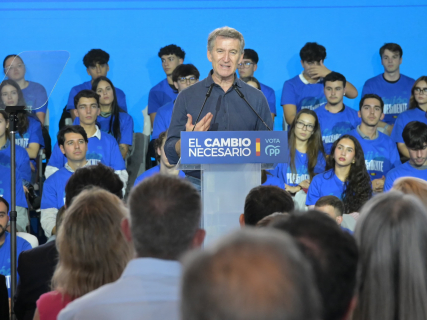
Feijóo claims his victory in the debate against Sánchez, but warns: "We have not yet won the elections"

The Popular candidate assures at a rally in Tenerife that the head-to-head allowed two projects to be confronted “with the same rules” and calls on people to mobilize until 29N. He also promises that, if he governs, “never” will he leave the Canary Islands alone in the face of a migration crisis.

EuropaPress 7930916 presidente pp candidato presidencia gobierno alberto nunez feijoo

EuropaPress 7930916 presidente pp candidato presidencia gobierno alberto nunez feijoo

Add DEMÓCRATA to Google

Ask FREN

Published

Last updated

2 minutes

Most read

Elecciones 29N · Encuestas

La media de las encuestas

Media a 20 de noviembre de 2026 · 19 institutos

  • PP30,8 %
  • PSOE27,9 %
  • Vox19,0 %
  • Frente Amplio6,3 %
  • ERC2,5 %
01020304050ene 2024jul 2024ene 2025jul 2025ene 2026jul 2026

Media del último estudio de cada instituto en 30 días y su evolución semanal desde el 23J. Partidos con al menos un 2 %.

Todas las encuestas

Elecciones generales del 29 de noviembre · Demócrata

Alberto Núñez Feijóo has asserted this Friday before PP militants in Tenerife his performance in the electoral face-off with Pedro Sánchez, although he has warned that the outcome of the debate does not guarantee victory at the ballot box. "We have won a debate, but we have not yet won the elections", he said during a rally at the Auditorio de Tenerife, where he asked the conservatives to maintain mobilization until November 29.

The popular candidate dedicated part of his speech to assessing Thursday’s televised confrontation, convinced that it allowed showing the differences between the two leaders. "Yesterday I only did the same thing that I have been doing for the last three years of this legislature: a narrative of the facts and of what Spain has suffered during this time," he defended, before assuring that he offered the political alternative he has been preparing in order to reach La Moncloa.

In his view, the main novelty was that both candidates were able to intervene "under the same rules, with the same time and without intermediaries". Feijóo believes that this equality of conditions allowed viewers to learn a different reality from the narrative that, in his words, the president of the Government intends to convey.

Feijóo contrasts his "firmness" with Sánchez's "silences"

During his speech, the PP leader recovered some of the criticisms he directed at the president in the debate, especially those related to corruption cases and the management of the Executive. "Yesterday we held Sánchez up to the mirror of his corruption, his poor management, and we offered a better Spain," he said.

He also set against "the lack of enthusiasm, the lie and the silences" that he attributes to Sánchez the "firmness" of the PP project, while defending that Spain is ready for a change of Government.

However, he insisted that the party cannot take its electoral objective as achieved. "Yesterday nothing ended. We have one week of campaigning in which we have to give it everything," he told the attendees, whom he encouraged to keep working "day by day, neighborhood by neighborhood, vote by vote".

To illustrate the importance of the coming days, he turned to a sports comparison: "Yesterday it was a match, the final is left", he said, recalling that the final decision corresponds to the voters on November 29.

He promises that he will "never" leave Canarias alone

The rally has also served for Feijóo to bring to Tenerife the impressions from his visit this morning to La Restinga, in El Hierro, where he met with representatives of the Police, the Guardia Civil, Salvamento Marítimo, and residents of the area in order to learn about the consequences of the recent migration emergency.

As he explained, the island’s public services were overwhelmed and its inhabitants felt abandoned by the central Executive. "If I am president of the Government I will never leave Canary Islands alone, never. Neither Canary Islands nor anywhere else in our country", he has promised.

The Popular Party candidate has linked that situation to the obligation of the Government to guarantee territorial integrity and Spanish sovereignty. In his address he also referred to Ceuta, after a fellow party member asked him not to abandon the autonomous city.

Feijóo has defended his commitment to the Spanishness of Ceuta and has insisted that protection of the territory must be one of the first responsibilities of any president of the Government.

Apologies for the cancellation of his visit to Gran Canaria

During the event, Feijóo also apologized to the citizens of Gran Canaria for the change to his electoral schedule. Initially he intended to travel to Las Palmas de Gran Canaria during the morning, but finally

More key points, information and questions with FREN

AI-GENERATED CONTENT

What is the current status of the electoral call scheduled for November 29?

The call for the general elections on November 29, 2026, is already formalized and in force: it is not pending approval or publication. As of November 20, the process is in full electoral campaign and final preparation for the vote. The pending matters are the following electoral milestones and, afterwards, the constitution of the new Cortes.

The call was completed on October 6

The legal instrument is Royal Decree 806/2026, of October 5, dissolving the Congress of Deputies and the Senate and calling elections. It was issued at the proposal of the President of the Government, after deliberation by the Council of Ministers on October 5, and was published in the BOE on the 6th, when it came into force.

Its article 2 expressly states: "Elections are called for both Chambers, which will be held on Sunday, November 29, 2026." Therefore, that date ceased to be a political forecast and became the official date. The decree also dissolved the Chambers elected in 2023, set the representatives corresponding to each constituency, and determined the duration of the campaign and the meeting of the new Chambers.

What phase are we in now

The electoral campaign began on November 13 and will end at 24:00 on Friday the 27th, according to article 4 of the decree. The proclaimed candidacies are already published. The initial deadlines to communicate coalitions and submit lists are behind us; these are not pending procedures of the call.

Measures have also been adopted to execute the process:

  • The Order HAC/1062/2026, of October 7, published on the 8th, set the subsidies and limits on electoral expenses.
  • A resolution of October 9, published on the 10th, determined the centers enabled to deposit ballot votes abroad.
  • The Council of Ministers approved the manual of the polling stations on October 27. Subsequent agreements, including those of November 17, address the supply and distribution of ballots, records, and electoral material.

These are organizational actions for elections already called, not additional authorizations to hold them.

What remains before and after November 29

The upcoming milestones are as follows, according to the calendar collected by Demócrata:

  • November 25: ordinary deadline to deposit postal votes. The application period ended on November 19, according to the Interior Ministry information.
  • November 27: end of the electoral campaign.
  • November 28: reflection day.
  • November 29: voting day, with polling stations open from 9:00 to 20:00, and subsequent counting at the tables.
  • December 2: start of the general scrutiny, the official review of results by the electoral boards, before the proclamation of the elected representatives.
  • December 23, at 10:00: constitutive sessions of the Congress and the Senate, date set by article 5 of the decree.

Until the constitution of the new Chambers, the Permanent Deputations maintain the powers corresponding to them during dissolution. Afterwards, the investiture procedure will open. In short, the call is completed; the electoral process is ongoing, with the vote as the next major milestone.

What are the powers attributed to the President of the Government according to the Spanish Constitution?

The Spanish Constitution regulates the powers of the President of the Government, mainly in articles 97, 98, and 99, and to a lesser extent in other provisions. From these, the figure of the president is outlined as the central piece of the executive power and the main director of the State's policy.

1. Direction of Government action

The core power appears in article 97 of the Constitution: the Government directs domestic and foreign policy, the civil and military administration, and the defense of the State, and exercises executive function and regulatory power. Within this framework, the president is the one who directs the Government's action and coordinates the functions of the other members.

This implies, in practice:

  • Setting the broad lines of the Government's general policy.
  • Marking legislative and administrative action priorities.
  • Resolving conflicts or disagreements between ministries.
  • Promoting, coordinating, and, if necessary, correcting the ministers' actions.

2. Representation of the Government and political leadership

The President of the Government is the highest authority of the executive power and its main political and institutional representative. He appears before the Congress and the Senate to explain the Government's action, participate in general debates (for example, on the state of the Nation, when held), and respond to parliamentarians' questions and requests for information.

Although the Constitution does not explicitly use the words "political leadership," de facto the president is configured as the Government's leader before the Cortes Generales, the other State powers, and internationally, representing the Spanish State at summits and high-level meetings, without prejudice to the King's role as head of State.

3. Appointment and dismissal of ministers

Article 100 of the Constitution establishes that the other Government members (vice presidents, ministers) are appointed and dismissed by the King at the proposal of the President of the Government. From this article derives an essential power:

  • Propose to the King the appointment of vice presidents and ministers.
  • Propose the dismissal of any of them at any time.

In practice, the Government's composition is a political decision of the president, who thus has a strong capacity to configure the ministerial team and reshape the Government during the legislature.

4. Relationship of confidence with the Congress

Although investiture is decided by the Congress (art. 99 CE), once invested the president assumes powers directly linked to that parliamentary confidence relationship:

  • Vote of confidence: article 112 allows the president to submit to Congress a vote of confidence on his program or a general policy declaration, thus forcing a ratification or withdrawal of the Chamber's confidence.
  • Political responsibility: a possible rejection of the vote of confidence (or approval of a motion of censure) obliges the president to resign and triggers a new investiture phase.

These faculties reinforce his role as the center of the relationship between Executive and Legislature.

5. Dissolution of the Cortes and calling elections

Article 115 of the Constitution assigns the president a decisive power: to propose to the King the dissolution of the Congress, the Senate, or the Cortes Generales and the calling of general elections, always under certain conditions (it cannot be proposed during a state of exception, siege, or war, nor when a motion of censure is in process, and certain temporal limits must be respected).

Although formally it is the King who dissolves and calls, the political initiative corresponds to the President of the Government, giving him a fundamental tool for managing political timing and early closure of the legislature.

6. Other relevant powers

Besides the above, the Constitution and the constitutional block place the President of the Government in other key functions:

  • Defense direction: in coordination with the rest of the Government, he leads defense policy and decisions on the use of the Armed Forces, always within legality.
  • Participation in the declaration of states of alarm, exception, and siege: the Government proposes and manages these extraordinary states (art. 116 CE), under parliamentary control, and the president is their main political responsible.
  • Relationship with autonomous communities: although the Constitution does not detail this, it corresponds to the president to lead the State Government's position in cooperation and coordination with autonomous governments, as well as in competence conflicts brought before the Constitutional Court.

7. Summary

Overall, the powers attributed to the President of the Government by the Spanish Constitution configure him as the apex of executive power: he directs Government action, chooses and dismisses his ministers, sets the political agenda, manages the confidence relationship with Congress, and has the initiative for the dissolution of the Cortes and electoral call. All this is exercised always within the framework of political responsibility before the Cortes Generales and subject to the Constitution and the rest of the legal system.

Could you detail exactly what the investiture procedure of the President of the Government consists of according to the Constitution? What differences are there between the functions of the President of the Government and those of the King as head of State? How is the motion of censure against the President of the Government regulated in the Constitution and what effects does it have?

What has been Alberto Núñez Feijóo's political and professional trajectory before leading the Popular Party?

Before assuming the national presidency of the Popular Party on April 2, 2022, Alberto Núñez Feijóo had developed a career focused on public administration: he was a civil servant, responsible for health management, executive of Correos, and member of the Galician Government. His political experience culminated with thirteen years leading the Xunta de Galicia and four consecutive absolute majorities.

Education and early positions in Galicia

Born in Ourense in 1961, Feijóo graduated in Law from the University of Santiago de Compostela. Although he initially considered the judiciary, in 1985 he entered by competitive examination into the Senior Corps of the General Administration of the Xunta. His professional starting point was, therefore, the autonomous public function, before assuming administrative management responsibilities (biographical profile from ABC).

In 1991 he was appointed technical secretary general of the Ministry of Agriculture, Livestock, and Forests. That same year he moved to the General Secretariat of the Ministry of Health and Social Services. Between 1992 and 1996 he also held responsibilities as vice president and secretary general of the Galician Health Service, Sergas. In this stage, he worked alongside José Manuel Romay Beccaría, an important figure in his early years of health management (trajectory in El Mundo).

State health and direction of Correos

In 1996 he moved to the State Administration during José María Aznar's Government. Until 2000 he was secretary general of Health Assistance at the Ministry of Health and Consumption and president of the National Health Institute, Insalud. This body managed state health assistance before the transfers to autonomous communities were completed. His experience thus went from Galician health management to national-level responsibilities (summary of positions).

He then directed Correos: between May 2000 and June 2001 he was CEO of the public business entity Correos y Telégrafos. From June 2001 until January 2003 he presided over the State Society Correos y Telégrafos. This stage added the management of a public company to his administrative and health experience (professional profile).

Return to the Xunta and succession of Fraga

In January 2003, Manuel Fraga incorporated him into his Government as Minister of Territorial Policy, Public Works, and Housing, with responsibilities over infrastructure, territory, and housing. In September 2004 he was promoted to first vice president of the Xunta, a position he held until the Government change in 2005 (trajectory in El Mundo).

In 2005 he was elected regional deputy for Pontevedra. After the PPdeG lost the Galician Government, he participated in Fraga's succession and was elected president of the party in Galicia on January 15, 2006. From that position, he led the opposition to the Government formed by PSdeG and BNG until the 2009 elections (succession explained by Demócrata).

Galician presidency and national leap

Feijóo recovered the Xunta for the PPdeG in 2009 and renewed the presidency in 2012, 2016, and 2020, always with an absolute majority. He remained at the head of the Galician Government until May 2022: four terms that constituted his main experience as a governor before leading the national party (biography and responsibilities).

The internal crisis that ended with Pablo Casado's departure opened his access to the PP presidency, formalized at the extraordinary congress in Seville in April 2022. He arrived, therefore, with a mainly executive and autonomous trajectory, built from public service to Galician presidency, not from a ministry or a prior seat in Congress (profile from Cadena SER).

Play

Test your knowledge with FREN!

How much do you know about this topic? Answer the following 3 questions.

What did Feijóo warn PP members after the debate with Sánchez?

Question 1 of 3

What situation did Feijóo link to the Government's obligation to guarantee territorial integrity?

Question 2 of 3

To which place did Feijóo apologize for canceling his electoral visit?

Question 3 of 3