

"Affirmative votes: 425, negative votes: 59, abstentions: 13". Torcuato Fernández-Miranda, president of the Cortes, announces the result of the vote and begins a long ovation. It is 21:35 on Thursday 18 November 1976. After three days of debate, Francoist Cortes have just approved the Law for Political Reform.
A few moments later, the session is adjourned. Seated beside the rostrum of speakers (the blue benches did not yet exist), the president of the Government, Adolfo Suárez, lets himself fall back against the backrest of his seat and breathes with relief. The television cameras capture the gesture that would go down in history as an emblematic image of the Transition.
That night, his Chief of Staff, Carmen Díez de Rivera, writes in her diary: "The yes of the girls". Two centuries earlier, Leandro Fernández de Moratín had premiered under that title one of the great neoclassical comedies of Spanish theatre, which denounced education based on obedience, silence, and acceptance of another person’s will.
Francoist procurators had just voted for the principle of the end of the regime to which their seats owed their existence. One year after Franco’s death, the Cortes had written their own ending. They had done the "harakiri".
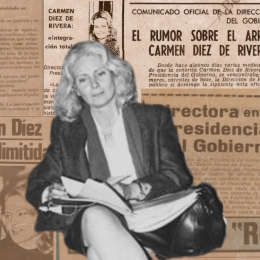
Featured story
"Disorder in Moncloa", Díez de Rivera's experience as Suárez's chief of staff
5 minutes
From Suárez to Suárez
The draft of the Law for Political Reform, the paternity of which Fernández-Miranda had renounced when he handed Suárez an initial draft months earlier, crystallized the governmental spirit of the time: from law to law through law. Using the rules of the regime to make its replacement possible, while avoiding an immediate legal rupture.
After the July 1976 amnesty, which covered the sentences imposed for acts of political intent or linked to the expression of opinions, this norm became the second step toward democratic elections.
So Suárez had expressed it in the televised speech in which he presented the law to all citizens: "Good evening, I present myself to you to call on the Spanish people to a task of leading and solidarity." As Lucía Méndez recalls in "Democracy in words", the president presented his reform to citizens before the Cortes and before the National Council—institutions that, he thought, no longer represented the reality of the street.
That Suárez should assume the electoral commitment himself and underscore the need for the Cortes to approve it was essential for his social backing.
But although the citizenry would eventually be invited to the party, the first step seemed the most complicated: convincing the majority of the procurators elected during Francoism that the time had come to step aside.
Suárez’s hard core took on the task. With a tactical vision and taking into account the different families of the regime and the section they came from, the negotiations were allocated among them. Each “yes” achieved was cheered like a goal, and little by little, the balance tipped in favor of the plans of the Executive and the Crown.
He played a prominent role in the process and also during the Plenary session of its ratification, Fernando Suárez. Minister of Labor in 1975 and vice president of the Government in the last cabinet of Franco, chaired by Carlos Arias Navarro, was one of the speakers of the reform and the person in charge of answering the amendments to the entirety.
His speech from the rostrum, which was also his parliamentary debut, is considered by the chroniclers of the Transition as one of the most symbolic of that stage. In a face-to-face with Blas Piñar, he replied to the immobilists that one could not be loyal to Franco by preventing the Spanish people from expressing their opinion.
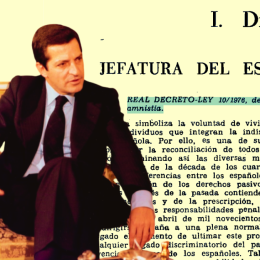
Featured story
The amnesty of 1976 marks half a century: the first great legal step of the Transition
4 minutes
Speak, people, speak
After his agonizing, but victorious, passage through the Cortes, the Law for Political Reform was left at the mercy of the citizenry. For the first time since the Civil War, the population would take part in a clean process, open and with guarantees.
The “yes” obtained around 94% of the votes cast, with turnout close to 77% of the census. An important part of the democratic opposition defended abstention because full freedom and political competition still did not exist, but it did not oppose it, aware that it was the only realistic path for the materialization of change in Spain.
Months later, on 15 June 1977, the desire expressed by the Government and the demands of the opposition converged in a historic election day that led to the formation of the Constituent Cortes.
In tension
In the winter of 1976, the shadow of terrorism was already beginning to try to destabilize the process of the Transition. During the processing and the campaign of the reform, the armed group GRAPO kidnapped Antonio María de Oriol y Urquijo, who at that moment was the President of the Council of State.
The terrorists did not achieve their objective, and the consultation took place normally. The conservative politician would be released in February 1977 after spending two months kidnapped.