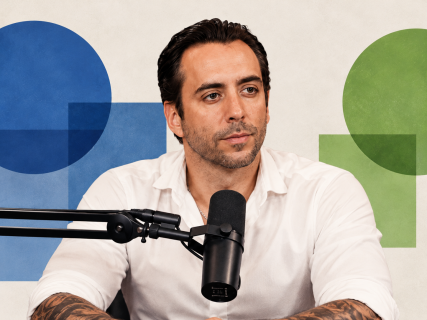
Jordi Wild, waiting for Sánchez: Feijóo, Abascal, and Colau accept their interviews for the 29N

The creator of The Wild Project is preparing a series of electoral interviews without agreed questions or editing cuts. The candidate from Frente Amplio has been the last to accept, while the president of the Government has not yet confirmed his participation.

Retrato editorial de podcast geométrico

Retrato editorial de podcast geométrico

Add DEMÓCRATA to Google

Ask FREN

Published

Last updated

3 minutes

Most read

Elecciones 29N · Encuestas

La media de las encuestas

Media a 20 de octubre de 2026 · 16 institutos

  • PP31,7 %
  • PSOE26,8 %
  • Vox18,7 %
  • Sumar6,3 %
  • Podemos3,1 %
  • ERC2,2 %
010203040ene 2024jul 2024ene 2025jul 2025ene 2026jul 2026

Media del último estudio de cada instituto en 30 días y su evolución semanal desde el 23J. Partidos con al menos un 2 %.

Todas las encuestas

Elecciones generales del 29 de noviembre · Demócrata

Jordi Wild has managed to get Alberto Núñez Feijóo, Santiago Abascal, and Ada Colau to agree to participate in a series of electoral interviews on his podcast, The Wild Project, ahead of the general elections on November 29. The president of the Government, Pedro Sánchez, is the only one of the four leaders initially invited who has not yet confirmed his attendance, despite the contacts that the content creator claims to have maintained with people close to his circle.

The latest addition has been Ada Colau, candidate of Frente Amplio, who has resumed her activity on X after five years to respond affirmatively to the invitation. Her decision completes the participation of the main representatives of the PP, Vox, and the alternative left, while Wild continues to await a response from the PSOE.

The project aims to transfer part of the electoral pre-campaign to YouTube through individual conversations, without pre-agreed questions and with a duration longer than usual in televised political interviews. The recordings are scheduled for publication during the second week of November, starting from the 9th, although the definitive dates have not yet been announced.

Feijóo, Abascal, and Colau accept the invitation

Jordi Wild's proposal began to take shape in early October when the content creator publicly invited the main candidates for the Presidency of the Government to participate in a special edition of The Wild Project dedicated to the general elections.

Alberto Núñez Feijóo was the first to accept, just a few hours after the call. Wild himself acknowledged his surprise at the speed of the response from the president of the PP, whom he initially considered one of the most difficult leaders to incorporate into the project.

Shortly after, the confirmation from Santiago Abascal arrived, who also agreed to participate in the format. With the two main candidates from the right willing to attend, attention turned to the pending responses from the PSOE and the political space to its left.

The situation of the latter was clarified this Tuesday with the affirmative response from Ada Colau. The former mayor of Barcelona, elected candidate of Frente Amplio for the 29N, has returned to publish on X after five years of inactivity to accept the interview.

The incorporation of Colau comes after several weeks of negotiations between leftist organizations to define their candidacies. The failure of the state agreement between Frente Amplio and Podemos had added uncertainty about who would represent that space in the program.

Pedro Sánchez, the only one who has not yet responded

The main unknown remains the participation of Pedro Sánchez. As Jordi Wild has explained, before making his proposal public, he had contacts with a person very close to the President of the Government to explore the possibility of interviewing him.

The creator assured that he conveyed from the beginning the conditions of the conversation, including his intention to ask questions about sensitive issues. The response received was that the proposal had to be studied internally with the campaign managers.

Since then, no definitive acceptance has been announced by Sánchez. Wild has insisted that he keeps the invitation open and that his goal is to have representatives from different political options before the elections.

Initially, the person in charge of The Wild Project had conditioned the holding of the interviews on the acceptance of the four invited guests. However, this Monday he modified that position and announced that he would interview the candidates who were willing to participate, even if some rejected the proposal.

The change allows conversations with Feijóo and Abascal, to which Colau is now added, to take place without depending on the decision of the President of the Government.

Interviews without pre-agreed questions or editing cuts

Wild intends for the interviews to be conducted under common conditions for all participants, although the content of each conversation may vary according to the candidate.

The interviews will last approximately between 50 and 90 minutes and will not necessarily be organized into rigid blocks on economy, housing, immigration, or foreign policy. The goal is to maintain open conversations, with questions adapted to each leader and some common issues that allow for comparing their positions.

The creator has also explained that the interviews will be recorded, but he commits to publishing them in full, without removing segments or modifying the responses. The candidates will also not be able to subsequently request the removal of any part of the conversation.

According to the announced conditions, the political teams will not receive the questions in advance. Wild intends to formalize these commitments before the recordings to avoid discrepancies regarding the editing and broadcasting of the programs.

The plan is to publish the conversations during the second week of November, although it still needs to decide whether to premiere them simultaneously or distribute the broadcasts over several days.

More key points, information and questions with FREN

AI-GENERATED CONTENT

What is the parliamentary status of the law regulating the holding of electoral debates or interviews on digital media in Spain?

The electoral reform related to electoral debates and interviews expired on October 6, 2026. Therefore, as of October 20, 2026, it is no longer under parliamentary processing nor has it become law. There is also an important clarification: the identified bill regulates electoral debates in the media, but it should not be described as a specific law on interviews or debates on digital media.

What initiative it is and its status

It is the Organic Bill modifying Organic Law 5/1985, of June 19, on the General Electoral Regime, promoted by the Government and processed in the Congress of Deputies.

Its text was published in the Official Bulletin of the Cortes on July 24, 2025. The publication agreement, dated July 22, opened a period of fifteen working days to submit amendments, which initially ended on September 17, 2025.

The parliamentary outcome was its expiration on October 6, 2026, linked to the dissolution of the Cortes. The official reference associated with that closure can be consulted in the Official State Gazette (BOE) of the dissolution. This means that its parliamentary course ended: it was not simply suspended or pending continuation in the next legislature. To resume that reform, a new initiative would be necessary.

What changes it proposed

The bill aimed to modify article 66 of the electoral legislation. Its main measures regarding debates were as follows:

  • Public media: they had to hold at least one debate among the competing political parties during the electoral campaign.
  • Attendance: it was proposed to be mandatory, except for justified cause assessed by the competent electoral board. Organizers had to inform about the unjustified nature of absences.
  • Participation: the organization had to especially consider the results of the last equivalent elections and the presence of significant political groups.
  • Private media: retained the decision to organize debates. If they held them, they had to respect the principles established by electoral legislation.

These measures were proposals of the bill, not new obligations that have come into force. Its parliamentary publication did not equate to its definitive approval.

The clarification about digital media

The published text distinguishes between public media, private broadcasters, and private televisions. In particular, it mentions the principles of proportionality and informational neutrality applicable to electoral debates and interviews organized by private televisions. It does not allow stating that any digital newspaper, streaming platform, or social media channel was subject, by that sole fact, to all those obligations.

It should also not be confused with the Bill modifying various legal provisions for the improvement of democratic governance in digital services and regulation of the media. This other bill also expired on October 6, 2026, but its name does not prove that it was the specific reform of electoral debates.

What framework remains relevant

The expiration does not eliminate existing electoral rules. The general reference remains the General Electoral Regime Law, along with the Instruction 4/2011 of the Central Electoral Board, modified by Instruction 1/2015. In short, the identified reform ended without approval; its content should not be used as if it were current legislation to organize a digital debate.

What are the competencies of the President of the Government of Spain regarding institutional communication during electoral campaigns?

The President of the Government can direct and coordinate the Executive's communication and explain its decisions during an electoral process, but cannot use institutional media to favor a candidacy. He does not have special authorization to do propaganda from his position: he must separate his institutional activity from his intervention as a political leader or candidate.

Direction competencies, not unlimited authorization

His directing role allows setting the general lines of government communication and coordinating ministries. However, the planning and execution of institutional campaigns are distributed among different bodies: the Advertising and Institutional Communication Commission prepares the annual plan based on ministerial proposals and the Council of Ministers approves it. Therefore, presidential direction should not be confused with a personal competence to authorize any campaign.

This distribution is stated in articles 11 and 12 of Law 29/2005. Inclusion of a campaign in the annual plan does not allow its dissemination if it violates electoral restrictions.

What communication can be maintained

The specific rule of article 10 of that law is to refrain from carrying out institutional campaigns during the electoral period, with two exceptions:

  • Legally provided electoral information: registration in the census and communications about the voting date, how to vote, and the requirements and procedures for postal voting. The authority corresponds to the competent public powers that have called the process, not personally to the president by the mere fact of being so.
  • Essential information: campaigns necessary to safeguard public interest or guarantee the functioning of public services, for example, health or safety notices. They must be limited to the necessary information, without presenting the action as an electoral merit of the Government.

Article 50.1 of the LOREG requires that information about voting does not influence the orientation of the vote and is disseminated in free spaces of public media. Instruction 2/2011 of the Central Electoral Board specifies that these campaigns also cannot aim to encourage participation.

What is prohibited

Restrictions apply from the publication of the call until the day of voting, not only during the fifteen days of the campaign. The president cannot:

  • Organize or finance, directly or indirectly, institutional acts that highlight governmental achievements or use images and expressions similar to those of a candidacy.
  • Hold inaugurations of works, public services, or their projects, regardless of the name of the act. The works and services can enter into operation.
  • Turn official appearances or institutional channels into instruments for vote solicitation, partisan promotion, or electoral disqualification of opponents.

Additionally, article 4 of Law 29/2005 prohibits campaigns aimed at highlighting management achievements also outside the electoral period.

Appearances and electoral control

The president can continue appearing and communicating government decisions. The obligation is to maintain neutrality: answering journalistic questions does not turn an official act into a space free of restrictions. His partisan participation must be carried out through separate channels, subject to campaign rules.

The competent electoral boards control these limits and can order the removal of content and initiate sanctioning procedures. They do not authorize each institutional act beforehand: they intervene through consultations, complaints, claims, and appeals. In short, the president retains the capacity to inform and coordinate, but not to transform State resources into electoral propaganda.

What legal requirements must a podcast meet to organize electoral interviews with candidates for the Presidency of the Government?

A podcast can organize electoral interviews, but not all are subject to the same obligations as a radio or television. The key is to distinguish its legal nature and keep journalistic information and electoral propaganda separate. In the consulted regulations, there is no general prior electoral authorization for a private podcast to interview candidates.

1. Determine what type of service it provides

The name "podcast" does not decide the legal regime. Its ownership, editorial responsibility, economic activity, and distribution matter: audio on demand, radio broadcasting, or video. The Audiovisual Law 13/2022 contemplates on-demand sound services, but not all personal content is automatically subject to all its obligations.

Audiovisual and electoral regulation are different matters: fitting into the former does not prove, by itself, that all television electoral rules must apply to the podcast. No specific doctrine has been found that indiscriminately equates any independent podcast with a broadcaster.

2. Pluralism, selection, and duration

Article 66 of the LOREG differentiates three situations during the electoral period, from the publication of the call until voting:

  • Public media: pluralism, equality, proportionality, and informational neutrality. They must present their coverage plans to the competent Electoral Board.
  • Private radios: pluralism and equality.
  • Private televisions: additionally, proportionality and neutrality in interviews, debates, and campaign information.

There is no general obligation to interview all candidacies or grant them identical minutes. For private televisions, Instruction 4/2011, whose consolidated text was published by Instruction 1/2015, requires particular attention to the results of the last equivalent elections. The obligation to compensate a debate restricted to the two most voted candidacies should not automatically be transferred to any individual podcast interview.

3. Avoid turning the interview into covert advertising

It is advisable to maintain editorial control over questions, editing, and publication. If a candidacy pays or conditions the episode, it must be analyzed as possible electoral advertising, not simply labeled as an interview. Article 60 prohibits contracting electoral advertising in public media and private televisions; identifying sponsorship does not remedy a prohibited contract.

Additionally, article 50.5 limits campaigning by legal entities other than electoral formations, safeguarding freedom of expression and information. It should also be avoided to use institutional financing or resources to electorally favor the interviewee, according to article 50.2.

4. Calendar, polls, and corrections
  • Propaganda: article 53 prohibits certain electoral insertions from the call until the start of the campaign, and propaganda once it has ended. A journalistic interview is not automatically propaganda; its content and conditions are decisive.
  • Polls: article 69 requires technical information and identification of those responsible and prohibits publishing, disseminating, or reproducing polls during the five days prior to voting.
  • Correction: article 68 allows candidates and leaders to claim it against harmful inaccurate facts.

The Internet is not an exception: Instruction 4/2007 extends campaign restrictions to electronic media.

5. Recommended protocol

Document criteria for selection, invitations, refusals, conditions, and promotion of each episode. These are preventive measures, not a universal obligation to offer identical interviews. If article 156 of the audiovisual law applies, keep contents for six months. Before closing the series, determine the service regime and expressly separate editorial interviews, sponsorships, and political advertising.

Play

Test your knowledge with FREN!

How much do you know about this topic? Answer the following 3 questions.

What condition has Jordi Wild changed regarding the interviews with the candidates?

Question 1 of 3

What characteristic will the interviews that Jordi Wild records with the candidates have?

Question 2 of 3

Who is the last candidate to accept Jordi Wild's invitation to his podcast before the general elections?

Question 3 of 3