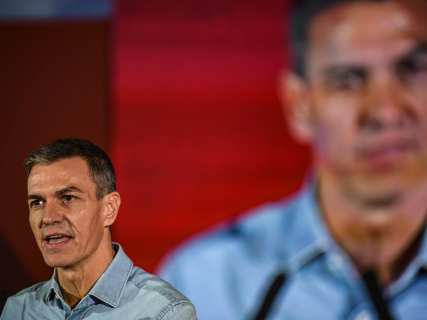
Sánchez expects extraordinary Council of Ministers to move forward social measures before the general elections

Sánchez announces extraordinary Council of Ministers before November 29 to approve pending social measures in the Government and the Congress.

fotonoticia 20261110001609 1920

fotonoticia 20261110001609 1920

Add DEMÓCRATA to Google

Ask FREN

Published

Last updated

1 minute

Most read

Elecciones 29N · Encuestas

La media de las encuestas

Media a 10 de noviembre de 2026 · 14 institutos

  • PP31,4 %
  • PSOE26,7 %
  • Vox19,1 %
  • Frente Amplio6,3 %
  • ERC2,5 %
01020304050ene 2024jul 2024ene 2025jul 2025ene 2026jul 2026

Media del último estudio de cada instituto en 30 días y su evolución semanal desde el 23J. Partidos con al menos un 2 %.

Todas las encuestas

Elecciones generales del 29 de noviembre · Demócrata

The President of the Government, Pedro Sánchez, has announced that, before the appointment with the ballot boxes on 29 November, one or more extraordinary Councils of Ministers will be convened with the aim of giving the green light to new social-type measures.

During the interview granted to the program "La Séptima" and collected by Europa Press, Sánchez has not specified whether, among the matters that will be addressed in those councils, the pardon for the former Attorney General of the State, Álvaro García Ortiz, will be included. However, he has reiterated that the Executive’s intention continues to be to approve it.

Although he has not wanted to specify which initiatives will be submitted for approval, he has gone ahead that in the coming weeks "social measures" related to issues that had been put on hold will be promoted.

Sánchez has explained that his initial will was not to bring forward the general elections and to complete the legislature, which has caused some matters to remain unresolved both in the Council of Ministers and in the Congress of Deputies.

More key points, information and questions with FREN

AI-GENERATED CONTENT

What is the parliamentary status of the new social measures announced by Pedro Sánchez and what are the pending procedures for their final approval?

The measures are not all at the same parliamentary stage. As of November 10, 2026, Pedro Sánchez's most recent announcement combines an initiative for single-parent families still lacking accredited regulatory detail and housing measures for which a forthcoming validation has been announced. Therefore, there is no single pending final approval: it is necessary to distinguish between announcements, government-approved regulations, and decisions requiring parliamentary backing.

Single-parent families: announcement pending specification

In his November 9 interview on La Séptima, Sánchez anticipated that the Council of Ministers on the 10th would approve an initiative aimed at these households. However, he did not detail its content, requirements, cost, or legal instrument. The information consulted does not yet confirm the agreement finally adopted nor its regulatory publication, so it should not be presented as a law in process. This is reflected in Demócrata on the announcement.

Its subsequent course will depend on the form it takes: a regulatory measure does not follow the same procedure as a bill or a royal decree-law. The announcement alone also does not allow setting an application date or affirming that a parliamentary vote is already scheduled.

Housing: identified regulations and pending backing

The identified parliamentary texts are Royal Decree-Law 28/2026, dated October 6, on the stability of rental contracts for primary residences, and Royal Decree-Law 29/2026, of the same date, on protection of the social function of housing and expansion of affordable housing supply.

The Government approved them after the rejection of previous September decrees. In the October 6 appearance, Sánchez explained measures such as interest-free loans of up to 50,000 euros from the Tu Casa program, total financing of 10 billion, and actions to expand affordable housing. These are precedents of the current announcement, not new decisions from November.

In the most recent interview, Sánchez expressed confidence that the Permanent Deputation would validate the following week the decree he calls "Maricarmen." This is a presidential forecast, not a validation already carried out. The sources consulted do not provide the result of that vote nor allow unequivocally linking that name with one of the two identified texts.

What procedures remain?
  • For royal decree-laws: validation is the vote that decides whether they are maintained or repealed. It must occur within the constitutional period of thirty days from their promulgation; with the Cortes dissolved, it corresponds to the Permanent Deputation. It does not require subsequent Senate approval.
  • For new initiatives still announced: the corresponding instrument must first be specified and approved. A closed parliamentary course cannot be attributed to a measure whose text and rank are not yet established.
  • For ordinary bills: the course includes amendments, parliamentary examination, approval by the Congress, Senate intervention, and, when appropriate, final decision by the Congress before publication.

There is also an important caution: the identified decrees are from October 6 and the interview places a vote after November 10. This reference should not be interpreted as an extension of the constitutional deadline. The consulted sources do not specify which text explains that schedule.

In conclusion, the pending matters confirmed are specifying the initiative for single-parent families and resolving parliamentary backing for the housing decree mentioned by Sánchez. The other announced extraordinary councils do not equate to a closed legislative package nor have a complete published schedule.

What are the main competencies and political background of Pedro Sánchez as Prime Minister of Spain?

Pedro Sánchez Pérez-Castejón has been Prime Minister since June 2018 and Secretary General of the PSOE since 2017, after having led the party between 2014 and 2016. His main competencies consist of directing the Executive, coordinating the ministers, and establishing the Government's political orientation. His previous career includes international experience, municipal politics, parliamentary activity, and opposition leadership.

Main competencies as Prime Minister

It is useful to distinguish between the institutional powers of the office and the political responsibilities derived from leading the PSOE. The former correspond to any Prime Minister and are exercised within the constitutional and legal framework; the latter belong to the party's organization and strategy.

  • Direction and coordination of the Executive. He directs the Government's action and coordinates the functions of its ministers, without replacing each one's responsibility over their department. This includes setting priorities and ensuring coherence among the different ministerial policies.
  • Orientation of general policy. He establishes the guidelines of governmental action in domestic and foreign policy. In matters such as defense, economy, or crisis response, his role is to lead and coordinate the Executive, although many decisions correspond to the Council of Ministers.
  • Government organization. He proposes to the King the appointment and dismissal of vice presidents and ministers. He also convenes and presides over the Council of Ministers and sets its agenda.
  • Institutional and international relations. He represents the Government and participates in relations with other institutions. His activity includes bilateral meetings, European gatherings, and multilateral forums such as the United Nations.
  • Political relationship with the Congress. He can raise a vote of confidence, through which he requests the Chamber to confirm its support, and propose the dissolution of the chambers within constitutional limits. Likewise, he responds to parliamentary control over his management.

Political and professional background

He was born in Madrid on February 29, 1972. He is an economist and holds a PhD in Economics; before reaching national responsibilities, he worked as a university professor, advisor in the European Parliament, and member of the cabinet of the United Nations High Representative for Bosnia and Herzegovina. These backgrounds are listed in his institutional biography.

  • Beginnings and municipal politics. He joined the PSOE in 1993. He was a councilor of the Madrid City Council between 2004 and 2009, a stage prior to his incorporation into national parliamentary politics.
  • Experience in Congress. He entered as a deputy for Madrid in 2009 and developed his parliamentary career with interruptions before reaching La Moncloa. His profile in Congress can be consulted.
  • First leadership of the PSOE. He won the membership consultation in July 2014 and was proclaimed Secretary General. He led the party in the 2015 and 2016 elections and resigned during the internal crisis of October 2016.
  • Return to the party. He regained the Secretary General position in 2017 through primaries, against Susana Díaz and Patxi López. Subsequently, he renewed his leadership; the PSOE documented his new candidacy in September 2024.

Access and continuity in the Presidency

He came to Government after the successful motion of no confidence against Mariano Rajoy on June 1, 2018. After the two general elections of 2019, he presided over a coalition government with Unidas Podemos from 2020. In 2023, he formed another with Sumar; his appointment is recorded in the November 2023 BOE.

Overall, his experience combines governmental direction, party leadership, and parliamentary negotiation. The evolution of his five electoral calls up to 2023 is covered in this Demócrata analysis.

What were the results of the last general elections in which PP and Vox participated, and how many seats did each party obtain in Congress?

The last general elections held in Spain in which the Popular Party and Vox participated were on July 23, 2023. In the Congress of Deputies, the PP obtained 137 seats and Vox secured 33. Together they totaled 170 deputies, according to results collected by RTVE.

Results of each party
  • Popular Party: 137 deputies. This is the number of seats the PP obtained in those elections to Congress. Therefore, when referring to the party's electoral result, the figure to use is 137, without adding representatives from other candidacies (Europa Press, 23J results).
  • Vox: 33 deputies. These were the seats obtained by the formation in the same call. This is their own representation, distinct from that of the PP, although both figures can be added to analyze parliamentary arithmetic (RTVE, Congress results).

The difference between the results of both parties was 104 seats: 137 minus 33. This comparison refers exclusively to elected deputies, not to the difference in votes or percentage points of electoral support. It is important to maintain that distinction because the question about how many seats each party obtained is answered with the distribution of representatives in Congress (RTVE, seat distribution).

How many did PP and Vox add up to?

The correct sum of their results was 137 + 33 = 170 seats. It was not 171 between the two. The figure of 171 appearing in some parliamentary analyses corresponds to also adding the deputy from Unión del Pueblo Navarro, UPN, which must be distinguished from the own results of PP and Vox (Demócrata, December 14, 2023).

The distinction can be summarized as follows: one thing is to count the seats obtained by each candidacy in the elections and another is to add representatives from various formations to study possible parliamentary support. In this case, the electoral result of the two parties you ask about does not change: 137 for PP and 33 for Vox (RTVE, 23J results).

What did that sum mean in Congress?

The threshold for an absolute majority was 176 deputies. Therefore, the 170 representatives of PP and Vox were six seats short of that figure. Even adding the UPN deputy, the sum of 171 was still five below the threshold; this is the arithmetic that explains the difference between the two counts (Demócrata, parliamentary arithmetic).

These calculations describe only the distribution of seats and their relation to the absolute majority. They should not be confused with a specific investiture vote nor with the subsequent behavior of each deputy: adding electoral results is a different operation from checking the support received by a particular proposal.

In short, if you need to cite the data briefly and precisely, you can write: "In the general elections of July 23, 2023, the Popular Party obtained 137 seats and Vox, 33, in the Congress of Deputies; together they totaled 170" (RTVE, electoral results).

Play

Test your knowledge with FREN!

How much do you know about this topic? Answer the following 3 questions.

What percentage of voter turnout does Pedro Sánchez foresee for the November 29 elections?

Question 1 of 3

Which organization will organize the electoral debates according to the agreement announced by Sánchez?

Question 2 of 3

What reason did Pedro Sánchez give to justify the difficulty in implementing state measures on housing?

Question 3 of 3