Abascal proposes regulating vulture funds to curb real estate speculation

Abascal asks for regulation of vulture funds, attacks the taxation of housing, and defends his position on Morocco, Israel, and historical memory.

fotonoticia 20261110000544 1920

fotonoticia 20261110000544 1920

Add DEMÓCRATA to Google

Ask FREN

Published

Last updated

3 minutes

Most read

Elecciones 29N · Encuestas

La media de las encuestas

Media a 10 de noviembre de 2026 · 14 institutos

  • PP31,4 %
  • PSOE26,7 %
  • Vox19,1 %
  • Frente Amplio6,3 %
  • ERC2,5 %
01020304050ene 2024jul 2024ene 2025jul 2025ene 2026jul 2026

Media del último estudio de cada instituto en 30 días y su evolución semanal desde el 23J. Partidos con al menos un 2 %.

Todas las encuestas

Elecciones generales del 29 de noviembre · Demócrata

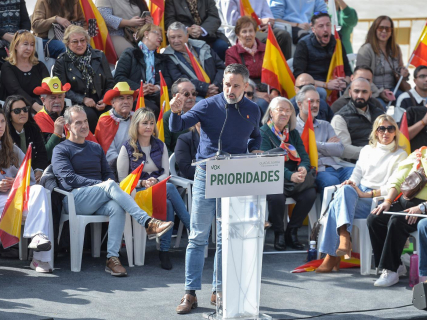
The president of Vox, Santiago Abascal, defended this Monday the need to “regularize” vulture funds in order to prevent them from accumulating homes and fueling real estate speculation, although he avoided specifying what the threshold would be from which those limits would apply.

In an interview on “La Revuelta,” Abascal said that vulture funds seem “bad” to him and revealed that he himself “has been a victim” of price increases “when he was renting.” “It seems to me that a rise in the rent or in housing prices in a sudden way, regardless of the market and only with the aim of getting rich, seems bad to me,” he added during the conversation.

Asked by David Broncano, the leader of Vox showed himself to be in favor of “regulating” vulture funds “so that this kind of practice is not possible” and “so that the increase in the cost (of housing) has to do with the market and not to speculate and hold onto housing.” However, he did not offer details about how he would implement that regulation.

“I think the State has to intervene when there is an abusive practice in the market,” he acknowledged. “If that’s enough for you, I’m not going to tell you starting from how many,” he replied to Broncano when the latter tried to get him to specify the scope of his proposal.

In his analysis of the housing problem, Abascal argued that “the great speculation” comes “from the public sector and the Ministry of Finance placing taxes absolutely in everything related to housing.” In his view, the root of the price increase lies in migratory pressure and in the scarcity of new developments. The leader summarized that “supply and demand don’t match, it isn’t being built, and more and more people are coming in.”

Among the measures he proposed, he mentioned the suppression of taxes on the purchase of the first home, an increase in the construction of public housing, the liberalization of “all” land to build, avoiding it being “strictly protected” for environmental reasons, as well as the repatriation of immigrants who are in an irregular situation and of those, while being legal, who commit crimes or depend on public aid.

Morocco, Israel and Vox’s foreign policy

During the interview, Abascal also referred to the relationship with Morocco and reiterated that it is “impossible” to maintain good neighborhood relations with a country that, according to what he said, “drives” the arrival of “100,000 people” to Ceuta “as part of a hybrid war” while “three of its ministers” are demanding Ceuta and Melilla. “It’s extremely serious,” he emphasized.

The leader also addressed Vox’s alignment with Israel, one of the most tense stretches of the program. He explained that his contacts with Tel Aviv have been limited to three issues: the Hamas attacks of October 7; the request that the Israeli Parliament not recognize the independence of Catalonia; and support for Spain against Morocco’s claims over Ceuta and Melilla.

Broncano reproached him for not condemning “the terrifying genocide” of Palestine in those exchanges with his Israeli partners, which led to a back-and-forth of reproaches. Abascal said that he finds it “terrifying,” and the host replied that “he hasn’t had the balls to tell it” to the Israeli prime minister, Benjamin Netanyahu.

The Vox leader was upset by the comment, and Broncano ended up apologizing. Abascal responded: “Maybe you haven’t had the gall to point to the main person responsible, the one they should appeal to for those deaths, which is the terrorist organization Hamas, that uses people as human shields; that’s what I stand by.”

Civil War, historical memory, and the program format

Another block of the interview focused on the Civil War and the Law of Historical Memory. Abascal clarified that Vox “is not against” excavating mass graves to recover the disappeared and specified that “it’s the only thing” that can be salvaged from that legislation, which his party has repealed in the communities where it governs with the PP and has committed to eliminating at the state level if it comes to power. “It’s the only one; the rest, the only thing it seeks is a confrontation between us,” he opines.

Throughout the program, several moments of tension were experienced between the guest and the host. Broncano revealed that Abascal’s team had “some fear” that the regular audience of the show “would make the conversation difficult and break the rhythm of the interview,” so the politician’s team managed the attendance of viewers, who came from an agency.

True to the custom that guests on “La Revuelta” bring a gift to the host, Abascal arrived with a flag of Ceuta, a territory that has become one of the focal points of his campaign for the general elections on November 29. The Vox leader asked Broncano to keep the banner on the set until the autonomous city “recovers.”

More key points, information and questions with FREN

AI-GENERATED CONTENT

What are the next steps for processing a reform of the legislation on gender-based violence in Spain?

A reform of the legislation on gender-based violence must go through the presentation of a text, debate and amendments in the Congress, the intervention of the Senate, and the final approval. The next step depends on who initiates the reform and the procedure already completed; since you do not specify a particular initiative, this is the general process, not the schedule of a specific file.

1. Presentation and admission of the text

The first distinction is between two routes:

  • Government bill: the text sent to the Congress must be accompanied by a statement of reasons and the necessary background for its examination. The Board orders its publication, opens the period for amendments, and sends it to the competent committee.
  • Parliamentary bill proposal: it can be presented by a group with the signature of its spokesperson, or a deputy with fourteen other signatures. It also requires a statement of reasons and background.

In this second route, the proposal is sent to the Government for it to express its opinion and, when it affects budget credits or revenues, its agreement with the procedure. After thirty working days without an express refusal to the latter, it can be included in the agenda for its initial debate.

2. Initial decision of the Congress

A proposal requires consideration: the Plenary decides whether to start processing it, without yet approving its final content. If accepted, it is sent to committee and the amendment period is opened.

Government bills do not require this initial vote. However, if total amendments are presented, the Plenary debates whether to return the bill to the Government or replace it with an alternative text. If it agrees to return it, the initiative is rejected.

3. Amendments, drafting committee, and committee

The ordinary period for amendments is fifteen working days, although it can be modified. These can delete, modify, or add provisions. In a reform on gender-based violence, this phase allows specifying the scope of the measures and negotiating their wording.

Afterwards, a drafting committee — a small group of parliamentarians — studies the text and amendments and prepares a report. The committee debates the articles and approves an opinion, which contains the resulting text. It can also request documentation and hearings from experts for advice. The Board determines the competent committee according to the content of the reform.

4. Plenary and majority requirement

When the debate corresponds to the Plenary, groups can maintain amendments rejected in committee. If the reform is processed as a organic law, it requires an absolute majority of the members of the Congress in a final vote on the whole. It is not enough to obtain more favorable votes than opposing ones.

If it does not reach that majority, it returns to committee for a new opinion within a month. A second vote without an absolute majority means its rejection.

5. Senate and final decision

Once approved by the Congress, the text goes to the Senate. If the Senate introduces amendments or a veto, it returns to the Congress. Amendments are accepted by simple majority; in the case of an organic law, the text incorporating them must also pass a joint vote by absolute majority. To lift a veto on an organic law, an absolute majority is also required.

6. Deadlines and continuity

There is no automatic total duration. Extensions of deadlines, negotiations, and scheduling of debates influence it. Urgency halves the ordinary deadlines of the Congress. Also, a pending parliamentary reform expires with the dissolution of the Chamber and requires a new presentation to be resumed.

These rules can be consulted in the Congress Regulations, especially in articles 109 to 132 and 207.

What are the powers and functions of the Spanish Prime Minister according to the Constitution?

The Spanish Constitution of 1978 defines the Prime Minister as the central figure of the executive power and political leadership of the country. His powers and functions appear mainly in articles 97, 98, 99, 100, and 112 to 115, as well as some provisions distributed in other articles.

1. Head of the executive power and political leadership

Article 97 establishes the basic function of the Prime Minister:

  • Direct the Government's action: coordinates and guides the work of all ministers, sets priorities, and marks the general line of action of the Executive.
  • Direct internal and external policy: defines the major orientations in areas such as economy, welfare state, relations with autonomous communities, European Union, diplomacy, etc.
  • Direct the civil and military Administration: has authority over the General State Administration and the political command structure of the Armed Forces.
  • Responsible for the defense of the State: without being Commander-in-Chief (a role the Constitution assigns to the King symbolically), the Prime Minister politically directs defense and national security decisions.
2. Confidence relationship with the Congress

The Prime Minister is politically responsible before the Congress of Deputies:

  • Election by investiture (art. 99): proposed by the King, but only becomes Prime Minister if he obtains the confidence of the Congress by majority (absolute in the first vote, simple in the second).
  • Continuous political responsibility: must maintain that confidence; if clearly lost, his continuity can be questioned through parliamentary control mechanisms.
3. Appointment and dismissal of the Government

Within the organization of the Executive itself, the Constitution assigns key functions to the Prime Minister (arts. 98 and 100):

  • Propose the appointment and dismissal of ministers: the King appoints and removes ministers at the Prime Minister's proposal, who decides the Government's composition and portfolio changes.
  • Configure the governmental structure (within the legal framework): can create, merge, or suppress ministries through the corresponding regulations.
  • Dismiss the entire Government: when the Prime Minister ceases (due to resignation, loss of confidence, etc.), the Government ceases as a whole and remains in office until the new Executive takes office.
4. Instruments for relations with the Cortes

The Prime Minister has several constitutional tools to manage his relationship with the Cortes Generales:

  • Vote of confidence (art. 112): can present it before the Congress for it to ratify its support on a program or general policy statement. If lost, the Prime Minister must resign.
  • Dissolution of the Cortes and calling elections (art. 115): can propose to the King the dissolution of the Congress, the Senate, or the Cortes Generales and the calling of elections, respecting certain limits (for example, cannot do so while a motion of censure is in process).
  • Participation in legislative and regulatory initiative: although the Government as a whole has legislative initiative, it is the Prime Minister who politically directs it and decides priorities of bills and royal decree-laws.
5. Parliamentary control: motion of censure

Although the motion of censure (art. 113) is an instrument of the Congress, it directly affects the Prime Minister:

  • If a motion of censure succeeds (a "constructive" motion proposing an alternative candidate), the Prime Minister ceases and is replaced by the approved candidate.
  • This possibility conditions the Prime Minister's actions, who must govern paying attention to the stability of his parliamentary majority.
6. Functions in the formation and replacement of the Government

In the Government formation phase, the Prime Minister comes into play after the King's proposal and parliamentary investiture. Once elected:

  • Swears or promises the office before the King and takes office.
  • Proposes the appointment of ministers and starts government action.
  • In case of vacancy, resignation, or death, the Government remains in office and a new investiture process opens.
7. Representation and coordination functions

Although not always expressly stated in specific articles, other practical functions derive from his constitutional position:

  • Political representation of the Government domestically and abroad: leads international summits, participates in European Councils, and regularly appears before Parliament.
  • Territorial coordination: leads political relations with autonomous communities, although each has its own government.
  • Promotion and coordination of cross-cutting public policies: sets priorities in areas such as ecological transition, digitalization, social cohesion, or institutional reforms.

Overall, the Constitution configures the Prime Minister as the figure concentrating political leadership and ultimate responsibility of the Executive, always subject to the confidence of the Congress and framed in a parliamentary system where the government depends on the majority of the lower chamber.

What are the differences between the functions of the Prime Minister and those of the King according to the Constitution? How exactly does the investiture procedure of the Prime Minister work step by step? What mechanisms does the Congress have to control and, if necessary, force the dismissal of the Prime Minister?

What was Santiago Abascal's political trajectory before leading Vox?

Before leading Vox, Santiago Abascal developed almost two decades of political activity in the People's Party, mainly in the Basque Country. He was a councilor, leader of the New Generations, member of the General Assemblies of Álava, and regional parliamentarian. Later he held positions in the Community of Madrid and presided over the Foundation for the Defense of the Spanish Nation, before leaving the PP in 2013 and participating in the creation of Vox.

His beginnings in the Basque PP

Abascal grew up in Amurrio, Álava, in a family with political ties: his father, Santiago Abascal Escuza, was a leader of Alianza Popular and later of the PP. He joined the People's Party in 1994, at 18 years old, and began taking responsibilities in the Álava organization. His first stage took place in a context marked by ETA's violence against political representatives and the confrontation over Spain's territorial model. These circumstances are part of the environment in which he started his career, according to biographical reconstructions by El Diario Vasco.

Councilor and leader of New Generations

In 1999 he obtained his first elected position: PP councilor in the Llodio City Council, where he remained until 2007, during two municipal terms. At the same time, he worked as an advisor to the Government Subdelegation in Álava between 1999 and 2003.

His rise within the party continued with the presidency of New Generations of the Basque PP, which he held between 2000 and 2005. That responsibility allowed him to combine municipal representation with political organization tasks. The consulted biographies also mention his participation in PP's governing bodies, including its National Board. Vozpópuli reviews these early positions.

His time in Basque institutions

Between 2003 and 2004 he was a procurator of the General Assemblies of Álava, that is, a representative in the parliamentary institution of the territory. Then he moved to the Basque Parliament, where he served in two periods: from January 2004 to February 2005 and from October 2005 to January 2009. Therefore, the usual reference to his parliamentary stage between 2004 and 2009 does not mean he held the seat continuously.

His trajectory before Vox thus included municipal, territorial, and regional experience, as well as internal responsibilities. A summary of that trajectory can be consulted at Telecinco.

DENAES and positions in Madrid

In 2006 he participated in the creation of DENAES, the Foundation for the Defense of the Spanish Nation, which he presided over until 2014. This activity, focused on defending Spain's unity, overlapped with his last years in the PP and the birth of Vox.

Later he moved part of his activity to Madrid. Between 2010 and 2012 he directed the Data Protection Agency of the Community of Madrid, during Esperanza Aguirre's government. In 2013 he took over the direction of the Foundation for Patronage and Social Sponsorship, also linked to the regional administration. These were appointed positions, different from his previous elected responsibilities, as explained by Infobae.

The break with the PP and the leap to Vox

Abascal left the PP in 2013, citing disagreements with Mariano Rajoy's leadership, especially about national unity and the response to nationalism. He then participated in the creation of Vox along with José Antonio Ortega Lara and other promoters. The party was publicly presented in January 2014, according to Cadena SER. In September of that year he was elected president: his leadership came after a previous political trajectory, not as his first institutional experience.

Play

Test your knowledge with FREN!

How much do you know about this topic? Answer the following 3 questions.

What housing measure did Santiago Abascal defend on 'La Revuelta'?

Question 1 of 3

Why did Abascal's team request to manage the audience on the program?

Question 2 of 3

What term did Abascal use to refer to Pedro Sánchez during the interview?

Question 3 of 3