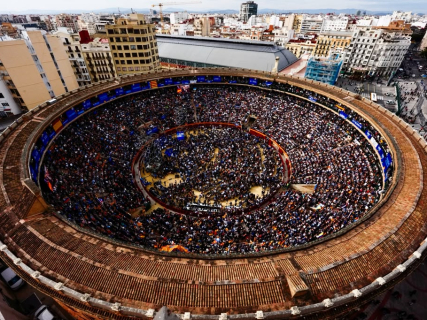
The PP conspires in the bullring in Valencia to lift Feijóo on their shoulders on 29N

The Populars fill Valencia's bullring again, with 12,000 attendees according to the organizers, and display muscle one week before the elections. Feijóo asks not to be satisfied with the “emotional victory” of the debate and calls for an “electoral victory”

WhatsApp Image 2026 11 21 at 12.42.40

WhatsApp Image 2026 11 21 at 12.42.40

Add DEMÓCRATA to Google

Ask FREN

Published

Last updated

3 minutes

Most read

Elecciones 29N · Encuestas

La media de las encuestas

Media a 21 de noviembre de 2026 · 19 institutos

  • PP31,0 %
  • PSOE28,0 %
  • Vox18,9 %
  • Frente Amplio6,2 %
  • ERC2,6 %
01020304050ene 2024jul 2024ene 2025jul 2025ene 2026jul 2026

Media del último estudio de cada instituto en 30 días y su evolución semanal desde el 23J. Partidos con al menos un 2 %.

Todas las encuestas

Elecciones generales del 29 de noviembre · Demócrata

Valencia. The Popular Party enjoys itself and has fun. A week before the ballot boxes open, with favorable polls and spirits boosted by the face-to-face between Alberto Núñez Feijóo and Pedro Sánchez, the populars have filled Valencia’s bullring.

At the rhythm of Hall of fame, Feijóo has made his entrance onto a talismanic stage for the PP. It is the ninth time they achieve the “sellout” with 12,000 attendees, according to sources from the organization. Valencian PP leaders always like to claim they are up to the task when “they are needed,” and on the way to 29N, the image of the bullring could not be missing. Feijóo described the event as “the biggest rally of the campaign”.

For the feat, 300 buses have been brought from every point in the Community of Valencia. A large part of the noble staff from Génova 13 has also arrived in the sandpit. They have the goal clear: for the 29N Feijóo goes out carried on the shoulders of the ballot boxes and on to Moncloa.
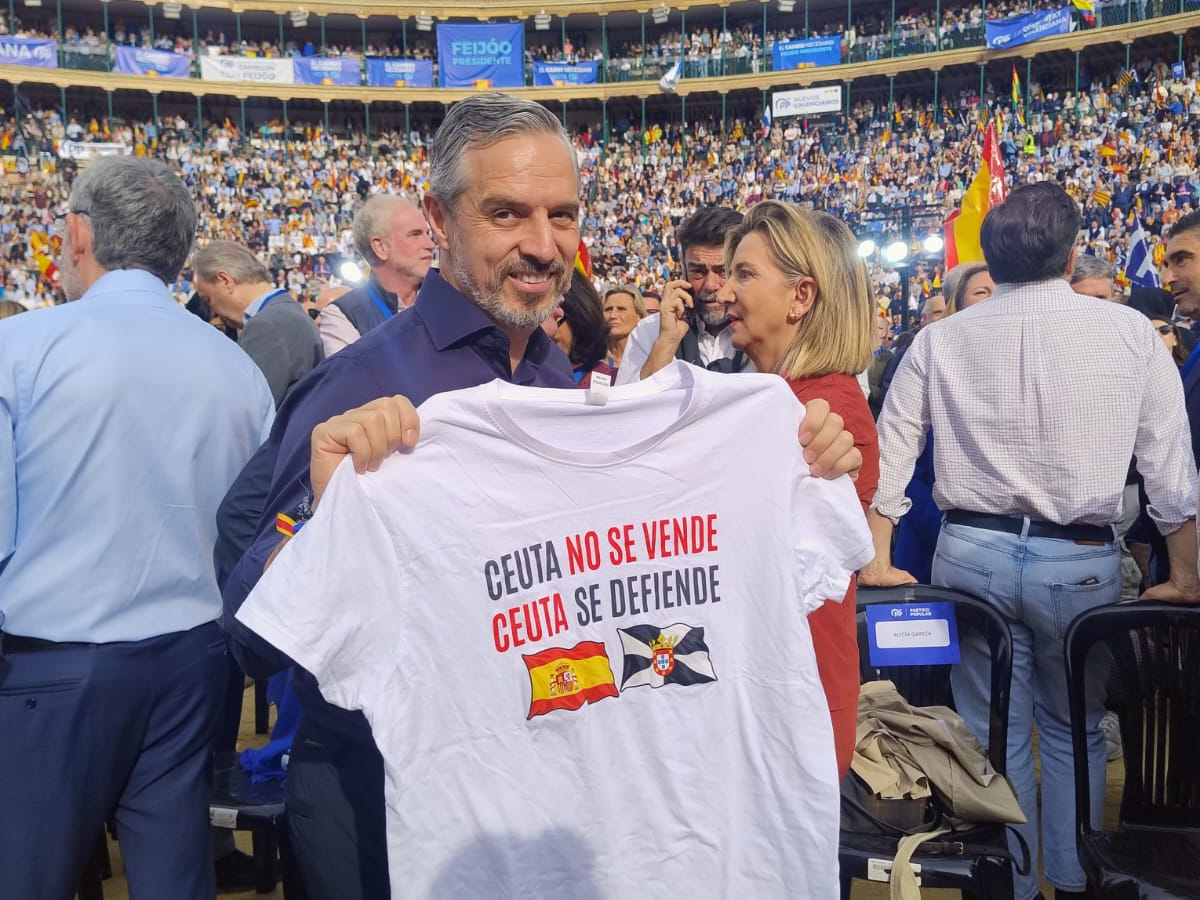
Juan Bravo posa para DEMÓCRATA en la plaza de toros | L. G.
Juan Bravo posa para DEMÓCRATA en la plaza de toros | L. G. -

In search of the lost vote

Feijóo has converted a large part of his speech into a direct request for a vote, with corruption, immigration, and the economy as the main arguments. “With me there will be no impunity for anyone, I will never grant a pardon to a politician accused of corruption,” he has promised, before defending an “legal, orderly, and respectful” immigration with coexistence, women, and homosexuals. He has also appealed to those who want “working to help you make ends meet and have a decent home,” and he has claimed the role of business owners and self-employed workers against an Executive whom he accuses of persecuting those who create wealth.

Among his commitments, he has reiterated the promise to build a million homes, to promote “healthy” growth in public debt, and to approve “an anti-squatter law”. This announcement has triggered one of the biggest ovations of the morning in the square.

He has also committed to “pursue sexist violence until it is eradicated.” “That starts with a Government that respects women, not like they do,” he said, before criticizing the “makeshift laws” and the “bracelets that don’t work”.

The leader of the PP has also wanted to anticipate what his future Executive would look like, ensuring that the preparation of its members will prevail over political loyalty. "I’m not going to surround myself with yes-men or hooligans on Twitter; I’m going to surround myself with the best", he has proclaimed. With an eye on next Sunday’s polls, he has closed his call by appealing for political change: "Spain needs change and together we’re going to achieve it".

The opposition leader has also taken pride in his step during the face-to-face meeting with the president of the Government: "I felt millions of people behind me, who would want to be able to tell him things to his face". "But this isn’t over; we have to finish it." In the collective memory, the sum of seats that it did not give on 23J: "Victory isn’t enough; we have to go for electoral victory."

Taking roll

At the national president of the party, they have served as ushers Vicente Mompó, president of the Provincial Council of Valencia, María José Catalá, mayor of the city and head of the provincial list for Congress, and Juanfran Pérez Llorca, president of the Generalitat. Feijóo has had himself looked after by the entire territorial leadership while continuing to say who will be his candidate for the autonomous presidency. Six months before the autonomous and municipal elections, the PP has still not named its "number 1".

While some of his colleagues such as Cayetana Álvarez de Toledo, advocate putting an end to the use of co-official languages in the Lower House, Mompó has spoken in Valencian and has reaffirmed the "pride of being right-wing" and "of the PP".
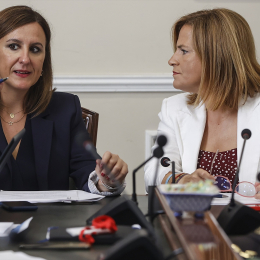
In his turn, Catalá has ensured that "national politics cannot be tabloid news; it has to be up to par" and has pointed to Feijóo as the only president capable of "recovering the values of the Transition". "Don’t lie and keep your word", she has repeated to her national president, while also asking to "not get complacent".

A glove that has been picked up by the president of the Generalitat, who has asked all those present to make known the "PP program" and has claimed credit for management in the Community, days away from the first anniversary of his time at the head of the Palau.

During the "great PP party", there were also words of remembrance for Rita Barberá, whose death is being marked on Monday with ten years.

More key points, information and questions with FREN

AI-GENERATED CONTENT

What is the parliamentary processing status of the anti-squatter law promised by Feijóo?

The “anti-squatter law” promised by Feijóo is neither approved nor in force. As of November 21, 2026, it is necessary to distinguish his commitment to promote a new regulation after the November 29 elections from previous PP proposals. These did not complete their approval: the one presented in Congress in 2026 had reached the amendment phase and expired with the dissolution of the Cortes.

Which initiative had reached Congress

The most recent initiative was the Organic Law Proposal against the illegal occupation of properties and for neighborhood coexistence and the protection of the safety of people and property in homeowners' communities. It was presented by the Popular Group on February 6, 2026, and was classified on February 10; it was a parliamentary proposal, not a government bill (Congress of Deputies).

On May 19, it passed the consideration phase, the vote by which Congress decides whether to start processing a proposal. It passed with 171 votes in favor, 164 against, and 11 abstentions. That decision allowed the text to be studied and modified but did not turn its measures into legal obligations (official Congress note).

Afterwards, its study was entrusted to the Interior Commission and the period to submit amendments, i.e., modification proposals, was opened. That is the last accredited parliamentary progress: the commission report, final approval by Congress, and subsequent processing in the Senate had not been completed (processing agreement).

Why there is also talk of a Senate proposal

There was also an earlier PP initiative, with a very similar title, originating from the Senate. Its continuation in Congress accumulated successive extensions of the amendment period; Demócrata reported in November 2025 that it had 66 extensions. Therefore, it had also not completed the necessary procedure to become law (Demócrata, November 2025).

This difference explains why some news refer to a regulation promoted in the Senate and others to a proposal admitted by Congress in May 2026. They are different parliamentary precedents: their progress should not be combined as if they corresponded to a single text already approved by both chambers.

What the electoral call implies

The dissolution of the Cortes caused the expiration of the pending proposals. Therefore, describing these initiatives today only as texts with the amendment period open would leave out the decisive change produced at the end of the legislature. Their previous processing does not continue automatically after the elections: a new initiative will need to be presented.

The most recent promise points precisely to that next stage. On October 21, Feijóo announced that, if he comes to government, he will promote within his first hundred days a law against occupation that allows evictions within 48 hours. That announcement is a future political commitment, not a parliamentary approval nor an effective date (Demócrata, October 21).

In short: previous proposals were not approved and expired; the new promised law must begin its course in the next legislature. There is no definitive approval of that promise that allows the announced eviction to be applied yet.

What are the powers and functions of the President of the Generalitat Valenciana according to the Statute of Autonomy?

The President of the Generalitat Valenciana has three main functions: to lead the regional government, represent the Valencian Community, and exercise the ordinary representation of the State within it. The core of his powers is in Article 28 of the Statute of Autonomy, complemented by Articles 27, 29, and 30, which regulate his relationship with Les Corts and the Consell.

1. Leadership of the Valencian Government

According to Article 28.1, the President of the Generalitat is also the President of the Consell, that is, the regional government. The provision establishes that "he directs the action of the Consell, coordinates its functions." Therefore, he is responsible for exercising the political leadership of the government and coordinating its actions.

It is important to distinguish his personal powers from those of the body he presides over: Article 29.1 attributes to the Consell, as a collegiate body, the executive and regulatory power and the direction of the administration. The Statute does not concentrate all these powers in the president individually.

2. Institutional representation

Article 28.1 attributes to him "the highest representation of the Valencian Community, as well as the ordinary representation of the State within it." These are two distinct responsibilities that converge in the same office: he heads the institutional representation of the autonomous community and performs the ordinary state representation within its territory.

3. Appointment of consellers

Article 29.2 provides that the members of the Consell, called consellers, are appointed by the President of the Generalitat. This power allows him to form the government team. The Statute itself refers to a law of Les Corts for the regulation of their functions, composition, and manner of appointment and dismissal.

4. Vote of confidence relationship with Les Corts

Article 30 allows the president, after deliberation of the Consell, to raise a vote of confidence: asking Parliament to confirm its support for his program, a political decision, or a bill. It is approved by a simple majority. When it concerns a bill, it is considered approved according to the text sent by the Consell, unless a qualified majority is required.

As a counterbalance, Articles 28.2 and 3 establish his political responsibility before Les Corts. The chamber may approve by absolute majority a motion of censure that includes an alternative candidate. If it succeeds, the president and the Consell cease, and the included candidate is appointed president by the king.

5. Parliamentary dissolution and elections

Article 28.4 empowers the president, with prior agreement of the Consell, to order by decree the dissolution of Les Corts. He cannot do so while a motion of censure that meets regulatory requirements is being processed.

Additionally, Article 27.6 contemplates a specific function of the acting president: to call new elections if, after two months from the first investiture vote, no candidate obtains parliamentary confidence. In that case, the dissolution corresponds to the president of Les Corts, by agreement of the Board.

6. Proposal of popular consultations

Article 28.5 allows him to propose popular consultations within the Valencian scope on matters of general interest in regional or local matters, in accordance with state legislation. It is a power of proposal, not an unlimited authorization to call them unilaterally.

Overall, the Statute configures a presidency of political leadership and institutional representation, subject to parliamentary control and express limits. The text can be consulted in the Statute published in the BOE, extensively reformed by the Organic Law 1/2006.

What legal requirements currently exist for the construction of one million public housing units in Spain?

Building one million public housing units requires compliance with urban planning, technical, environmental, and budgetary requirements for each development. The figure does not activate a special authorization nor allow skipping procedures. Currently, there is no single state authorization that replaces planning, regional competencies, or municipal controls.

Additionally, it is important to distinguish public housing, linked to a publicly owned stock, from protected or affordable housing, which can also be promoted and owned by private entities. The chosen formula determines the conditions regarding land, contracting, financing, and allocation.

1. Competences and administrative coordination

A national program must respect the competencies of autonomous communities in housing and urban planning and municipal competencies over planning, urban management, and permits. The State can provide land, financing, and cooperation mechanisms but cannot replace those procedures through an announcement. The Housing Law 12/2023 includes instruments for planning, cooperation, and public-private collaboration.

2. Available and urbanistically suitable land

It is not enough to have public land: residential use and buildability must be compatible with applicable planning. When they are not, their modification or the corresponding instrument must be processed. Also, depending on each development, parceling — redistribution of plots and charges —, mandatory transfers, and urbanization, including access and services, must be resolved.

The basic framework is the consolidated land text, approved by Royal Legislative Decree 7/2015, along with regional legislation. Allocating land for facilities or office buildings to housing is not an automatic possibility: it requires normative and urban planning coverage.

3. Project, permits, and building quality

Each development needs a technical project and the corresponding enabling urban planning title. It must comply with regional habitability conditions and the Building Technical Code, approved by Royal Decree 314/2006: structural safety, fire protection, healthiness, acoustic protection, accessibility, and energy saving. Public ownership does not eliminate these requirements.

4. Environmental assessment and sectoral reports

Plans and projects must undergo environmental assessment when they fall under the assumptions of Law 21/2013 and regional regulations. Not every development requires the same procedure. Depending on its location, reports or authorizations on water, roads, coasts, heritage, or natural risks will also be necessary. These controls must be integrated into planning.

5. Contracting and sufficient financing

Works and services contracted by public entities must comply with the applicable regime of Law 9/2017 on contracts: justification of need, budget availability, publicity, competition, and award criteria. Collaboration with private companies does not allow evading these obligations; land transfer also requires the appropriate patrimonial instrument.

A program of this scale needs budgetary financing and legally approved multi-year commitments. Subsidies and European funds add their own conditions of eligibility, execution, and justification; when applicable, State aid rules must be respected. An investment forecast is not equivalent to financing granted for each housing unit.

6. Protection, allocation, and maintenance

If the housing is classified as protected, the corresponding regional regime must be applied: recipients, income limits, sizes, maximum prices or rents, and duration of protection. Transparent allocation procedures and resources for maintenance and management must also be established.

In conclusion: the decisive requirement is not to approve a specific law to reach the million, but to ensure suitable land, permits, financing, and legal execution for each development, coordinating the competent administrations.

Play

Test your knowledge with FREN!

How much do you know about this topic? Answer the following 3 questions.

What was one of Feijóo's main promises during the PP event in Valencia?

Question 1 of 3

Which measure received one of the biggest ovations during the event in Valencia?

Question 2 of 3

What aspect did Feijóo highlight about his future Government if he reaches Moncloa?

Question 3 of 3