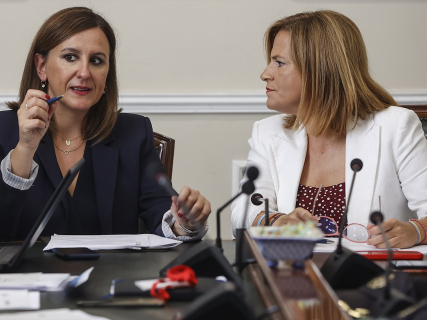
The 29N anticipates the municipal duel in Valencia: Catalá and Bernabé, face to face for Congress

The mayor will head the list of the PP for Valencia and the former government delegate will be the candidate of the PSOE. Both also aspire to contest the mayoralty in May 2027, just six months after the general elections.

EuropaPress 5466840 alcaldesa valencia maria jose catala delegada gobierno comunidad valenciana

EuropaPress 5466840 alcaldesa valencia maria jose catala delegada gobierno comunidad valenciana

Add DEMÓCRATA to Google

Ask FREN

Published

Last updated

3 minutes

Most read

Elecciones 29N · Encuestas

La media de las encuestas

Media a 23 de octubre de 2026 · 15 institutos

  • PP31,4 %
  • PSOE26,9 %
  • Vox18,8 %
  • Sumar6,3 %
  • Podemos3,1 %
  • ERC2,2 %
010203040ene 2024jul 2024ene 2025jul 2025ene 2026jul 2026

Media del último estudio de cada instituto en 30 días y su evolución semanal desde el 23J. Partidos con al menos un 2 %.

Todas las encuestas

Elecciones generales del 29 de noviembre · Demócrata

All the cards on the table. It has taken a while, but the Popular Party has already announced its head of list for Valencia for the general elections on the upcoming November 29: María José Catalá. The mayor of Valencia has accepted the proposal from Alberto Núñez Feijóo and will compete at the polls with Pilar Bernabé, candidate of the PSOE for Congress and also a candidate for the Mayor of the city in 2027.

The coincidence leaves a particular electoral paradox: the two leaders who will compete for the Valencia City Council next May will first face each other in a general election. We are thus before a preview of the municipal duel at the polls on November 29.

Catalá accepts Feijóo's proposal

The mayor of Valencia confirmed this Friday that she will head the PP candidacy for Congress for the province after accepting the proposal from the popular president, Alberto Núñez Feijóo. She announced it through a video shared on her social networks, in which she defended the need to get involved in the upcoming electoral event.

"Defending Spain and defending Valencia is the moment, a decisive moment for our country and for our city," Catalá has stated, justifying her decision by appealing to the national political situation.

"When everything is at stake, one must be willing to do what is necessary. That is why I have said yes to President Feijóo's proposal to head the list for the Congress of Deputies for the province of Valencia," she explained.

The popular leader also wanted to clear up doubts about her continuity at the head of the city council. "I will continue to be the mayor of Valencia, at the service of the city and its residents", she assured, while claiming the municipal project initiated in June 2023 and insisting that Valencia will remain her "top priority".

Her decision incorporates one of the main municipal leaders of the PP into the national campaign without renouncing her responsibilities in the City Council. In this way, Catalá will face Bernabé directly in the general elections before the next municipal appointment.

Bernabé will fight

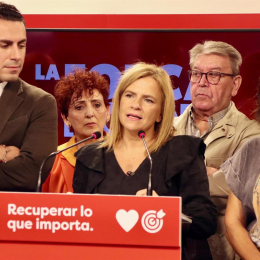
In the case of the PSOE, the designation of Pilar Bernabé as the head of the list for Valencia was announced on October 12. The socialist leader will lead a candidacy that also includes Minister Arcadi España, as number two, and the Secretary of Organization of the PSOE, Rebeca Torró, in third position.

Bernabé, who will also be the socialist candidate for the Mayor of Valencia in May 2027, has openly acknowledged the connection between both campaigns. Last Wednesday, during the registration of the electoral lists, she defined the general elections of November 29 as "a prelude" to the municipal and regional elections, which she described as "the mother of all campaigns".

The socialist leader has insisted that her "final and ultimate goal" is to become the mayor of Valencia. Furthermore, she has defended the compatibility of her two candidacies and announced that she will take advantage of the general election campaign to tour the metropolitan area, a territory that, she criticized, Catalá has "totally forgotten".
Game of incompatibilities

The double candidacy also raises a legal question about the compatibility of positions. The Organic Law of the General Electoral Regime (LOREG) allows one to be a mayor or councilor and a national deputy at the same time, as its articles 154 and 155, which regulate parliamentary incompatibilities, do not establish a general prohibition for members of local corporations.

Therefore, Catalá could retain the Mayor's Office of Valencia and occupy a seat in Congress if elected. The same would happen with Bernabé if she managed to gain parliamentary representation on November 29 and subsequently obtained a councilor's position in the municipal elections of May 2027.

The situation of the Government Delegation is different, a position incompatible with the condition of national deputy. Bernabé, who served as the representative of the central Executive in the Comunitat Valenciana, has had to leave that responsibility to run for the general elections.

The race begins

With Catalá's confirmation, the main parties have already defined their heads of list for Congress for the province of Valencia. The mayor of the capital will head the PP candidacy, while the former Government delegate Pilar Bernabé will do the same for the PSOE.

For his part, Ignacio Gil Lázaro will again be number one for Vox, while Àgueda Micó will lead the candidacy of Compromís–Front Valencià, the coalition made up of Compromís, Podemos, Esquerra Unida, and Esquerra Republicana del País Valencià

More key points, information and questions with FREN

AI-GENERATED CONTENT

What is the status of the processing of the Organic Law of the General Electoral Regime, and have there been proposals to modify the incompatibilities between local and national positions?

The Organic Law 5/1985, of June 19, on the General Electoral Regime (LOREG), is in force: it is not a law pending approval. What has been processed are various reforms of its content. As of October 23, 2026, the government amendment project presented in 2025 has expired; regarding incompatibilities between local and national positions, the consulted sources do not allow identifying a specific proposal aimed specifically at prohibiting that accumulation.

Status of the LOREG reform

The main file located is the organic law project 121/000063. It was registered in Congress on July 9, 2025, and its text was published on July 24. After the amendment period opened, 39 extensions followed, the last until September 30, 2026. Finally, it expired on October 6, 2026, with the dissolution of the Cortes. Therefore, its processing no longer continues, and its presentation did not by itself modify the current legislation. The published project and the dissolution decree can be consulted.

It should be distinguished from another reform that did culminate: the Organic Law 2/2026, of June 30, published on July 2, adapts the LOREG to the reform of article 69.3 of the Constitution. Its processing corresponds to a different initiative —122/000280 in Congress and 624/000010 in the Senate—, whose initial text was published on May 12, 2026. Its approval should not be confused with that of the expired government project. See the text published in BOE.

Incompatibilities: what is established

The LOREG contains the parliamentary incompatibility regime. Its article 157 establishes that the mandate of deputies and senators will be exercised under a regime of absolute dedication and regulates their relationship with other paid activities and public positions. However, this provision should not be interpreted in isolation as a general prohibition to simultaneously hold any municipal and parliamentary position: to resolve a specific case, the applicable causes and rules on remuneration must be examined. The normative reference is the LOREG published in BOE.

Regarding modification proposals, initiatives on ineligibility —impediments to be elected— and other incompatibilities have been located, but not an identified proposal whose specific purpose is to prevent mayors or councilors from also being deputies or senators:

  • The proposal 122/000110, presented by the Popular Group and published on June 7, 2024, intended to modify the causes of ineligibility. Congress rejected initiating its processing on October 15, 2024. Its located content does not prove a specific reform of the accumulation of local and national positions. See the original proposal.
  • Another initiative from the Popular Group on causes of ineligibility, 622/000048 in the Senate and 124/000028 in Congress, expired on October 6, 2026. It also does not prove that specific prohibition. See its parliamentary publication.

In conclusion: the LOREG remains in force and the government project has expired. There are precedents of reforms on ineligibility and incompatibilities, but it would not be accurate to present them as proposals to separate local and national positions without a text that expressly establishes that objective.

What are the main legal competencies of a mayor in Spain according to current legislation, and to which political party does María José Catalá belong?

A mayor in Spain leads the municipal government and administration and represents the city council, but shares decisions with the Plenary and, when it exists, the Local Government Board. The basic regulation is in Law 7/1985, of April 2, Regulating the Bases of the Local Regime. For her part, María José Catalá belongs to the Popular Party (PP) and is mayor of València (Demócrata, October 23, 2026).

Main powers of the mayor

Article 21 of the Law on the Bases of the Local Regime establishes the competencies of the Mayor's Office in the common municipal regime. The main ones are:

  • Direction and representation: lead the municipal government, represent the city council, and promote, direct, and inspect municipal services and works.
  • Operation of bodies: convene and preside over the Plenary and the Local Government Board, with legal exceptions, and resolve ties by casting vote.
  • Decisions and execution: issue decrees and order the publication, execution, and compliance of municipal agreements.
  • Economic management: develop the approved budget, allocate expenses within their competencies, order payments, render accounts, and arrange credit operations within legal limits.
  • Personnel and police: exercise the superior leadership of personnel and the leadership of the Municipal Police; approve the public employment offer according to the budget and staff; and adopt certain appointments and sanctions.
  • Urban planning, works, and licenses: approve certain instruments of urban development and management, urbanization projects, and projects of works and services. Also grant licenses, unless sectoral legislation assigns that function to another body.
  • Sanctions and legal defense: sanction ordinance infractions and disobedience to their authority when appropriate, and exercise judicial and administrative actions in matters of their competence.
  • Emergencies: personally adopt necessary measures in the face of catastrophes, public misfortunes, or serious risk, giving immediate notice to the Plenary.

Delegation and control of the Plenary

Not all these functions must be exercised personally. Many admit delegation. However, in the common regime, among others, the direction of the municipal government, issuing decrees, resolving ties with casting vote, superior leadership of personnel, and personal measures in catastrophes cannot be delegated. Article 21.3 contains the exclusions and establishes specific rules for certain matters.

The mayor also cannot substitute the Plenary in decisions that the law reserves for this body. The Plenary controls the municipal government and adopts essential decisions on regulations, budget, organization, and urban planning. Therefore, leading the city council does not mean being able to unilaterally decide all its matters.

The difference in large population municipalities

Title X establishes a special distribution. Its article 124 maintains in the mayor the political direction, representation, superior leadership of personnel, and police leadership. It also allows delegations with rules different from those of the common regime.

In this model, the Local Government Board has its own executive competencies: it approves the budget project, grants licenses except for legal exceptions, manages numerous personnel matters, and exercises sanctioning power when it does not correspond to another body. The Plenary approves the budget and ordinances and oversees the government. This distinction is important: municipal competencies do not automatically belong to the mayor; their distribution depends on the organizational regime and applicable legislation.

What was the result of the last municipal elections in Valencia and how many councilors did each of the main parties obtain?

The last municipal elections in the city of Valencia were held on May 28, 2023. The Popular Party won with 13 councilors, followed by Compromís, with 9; PSPV-PSOE, with 7; and Vox, with 4. The City Council was composed of 33 councilors and no party reached an absolute majority alone, set at 17.

Result of the main parties

The distribution of councilors and vote results were as follows, according to electoral information from the Valencia City Council and the results published by El País:

  • Popular Party: 13 councilors. It obtained 151,482 votes, equivalent to 36.62%. It was the most voted candidacy and the one that obtained the most municipal representatives. However, its 13 councilors were four short of the 17 needed for an absolute majority.
  • Compromís: 9 councilors. It received 99,122 votes and 23.96%. It was the second candidacy both in number of votes and municipal representation. The difference compared to the PP was four councilors.
  • PSPV-PSOE: 7 councilors. It added 78,499 votes, 18.97%. It occupied third position, with two fewer representatives than Compromís and six fewer than the Popular Party.
  • Vox: 4 councilors. It obtained 52,695 votes and 12.74%. It was the fourth candidacy with representation. Its four councilors, added to the thirteen of the PP, allowed exactly reaching the absolute majority of the plenary.

What the distribution meant

The key to the result was the difference between winning the elections and having an absolute majority. The PP came first, but its 13 councilors were not enough to reach that threshold without other support. Therefore, the result was not an absolute majority for the Popular Party, but a victory with a relative majority: it had more councilors than any other candidacy, but less than half plus one of the plenary.

The sum of PP and Vox reached 17 councilors, while that of Compromís and PSPV-PSOE gathered 16. That difference of one representative explains the importance of the final distribution: the former could gather the absolute majority and the latter were one councilor short. These sums describe the composition arising from the polls, not a new distribution of votes among parties.

Parties that did not obtain councilors

Among the candidacies that were left out of the City Council were Podemos-EUPV, with 9,677 votes; Ciudadanos, with 9,588; and PACMA, with 3,664. None obtained municipal representation. Therefore, although they received votes, they did not add councilors to the distribution among the four candidacies that did enter the plenary.

It is also important to distinguish these results from those of the province or the regional elections: the above figures correspond exclusively to the municipality of Valencia and its City Council. They should also be distinguished from subsequent polls, which express estimates and do not modify the electoral result of May 2023. The portal of municipal electoral information allows consulting the different calls.

In short, the essential data is: PP, 13; Compromís, 9; PSPV-PSOE, 7; and Vox, 4. The four parties summed the 33 seats of the municipal plenary. To consult the detailed scrutiny, you can also refer to the RTVE electoral coverage.

Play

Test your knowledge with FREN!

How much do you know about this topic? Answer the following 3 questions.

Who will lead the PP candidacy for Congress in Valencia in the general elections on November 29?

Question 1 of 3

What position did Pilar Bernabé have to leave in order to run in the general elections?

Question 2 of 3

Which law regulates the compatibility of being a mayor and a national deputy in Spain?

Question 3 of 3