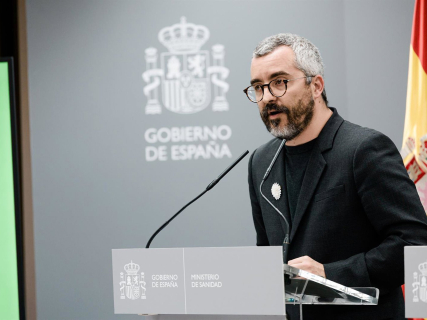

The Secretary of State for Health, Javier Padilla, explained this Tuesday that the implementation of a single command in the City of Ceuta, after the massive influx of immigrants from Morocco a month ago, will not modify the healthcare that they already receive, given that the Ministry of Health maintains its competencies through INGESA, but he emphasized that "it will change for the health conditions of this population."
At the same time, he ruled out the confinement of the city requested by the Government by the Secretary General of the PP, Alberto Núñez Feijoo, and announced in statements to RTVE, reported by Europa Press, that the vaccination of the migrant population will begin "in the coming days," after the agreement of the Public Health Commission this Monday to send 45,000 doses to Ceuta through the solidarity mechanism between CCAA and the Ministry, as a preventive measure in light of the situation in the autonomous city.
Padilla insisted that, "as we have been saying since the beginning of this crisis, for the health of the population in these circumstances there are fundamental elements such as sanitation, hygiene, sanitation, water safety, and food, and greater coordination among the different actors and having a single command, with the capacity to demand and coordinate the accommodation and location of these people in more specific places, very likely to improve."
He recalled, in line with what was stated by the Minister of Health, Mónica García, during her recent visit to the city, that it "caught their attention that in 2021 from the city of Ceuta there was a very proactive approach in the cession of spaces to accommodate migrant people so that they would not have to be wandering the streets or in settlements that were not safe and healthy for them, and to this day it seems that this has been greatly delayed."
He considers it to be a "fundamental element" in which "much progress has been made in the last week," key to preventing possible outbreaks of gastroenteritis or scabies, and he hopes that the single command will expedite the processing of files and the different individual cases, so that locations can be determined for those who remain on the street and move them to "managed spaces owned by the city of Ceuta, which until now they could not do."
Regarding the healthcare situation, it has been detailed that hospital occupancy is below 50% and that "there is a division between the circuits for migrant population and for the population that was already living in the city of Ceuta. This occurs both in the Hospital of Ceuta and in the Health Center of Tarajal or in the Health Center of Otero." Although it admits an increase in healthcare pressure, it emphasizes that "we are very far from what we could call a collapse," thanks to more than 90 reinforcement professionals who, in coordination with Doctors of the World and Red Cross, directly assist in the places where migrants are housed.
It has specified that the profile of the newcomers is mostly young and, in general, healthy, so that "between 30 to 40 percent of the consultations being seen are related to treatments, to wounds, and not to the development of specific pathologies." As it has explained, "in terms of healthcare activity, the number one objective is to preserve the normality of healthcare activity with the Ceuta population, while providing the assistance that the arriving migrant population needs, and the second element is to continue reinforcing to ensure that our professionals, whom I have to thank for the umpteenth time for the work done during all this time, continue to carry it out."
Regarding the health risks associated with overcrowding, food security, or water quality, it has assured that "there has been a lot of improvement in recent days."
Accelerated vaccination plan
In this context, Padilla has referred to the accelerated vaccination plan, "the type of vaccination plan that is done with the migrant and refugee population when they arrive in our country, which was approved in June and is now going to be implemented here in the city of Ceuta." It has indicated that part of the doses are already in the city and that this Tuesday personnel from the vaccination area of the General Directorate of Public Health of the Ministry are moving to work alongside the autonomous city and the INGESA service.
It has wanted to emphasize that "it is not that vaccinations are being given to control any public health crisis" and that, regarding the diseases for which vaccines will be sent from the autonomous communities (diphtheria, tetanus, chickenpox, measles, rubella...), after the agreement of the Public Health Commission on Monday, "there has not been a single diagnosed case among the migrant population that has arrived."
"We only have two cases of chickenpox in the population that already lived here, which has no connection with the population that entered on the 30th and 31st. Now, we have a group of people possibly not well vaccinated, incompletely vaccinated, or unvaccinated, for whom the responsible thing is to vaccinate them, and that is the fundamental element for prevention. It is not so much to control something that happens, but to prevent anything from happening," he added. His expectation is to start vaccination in the coming days with the doses from INGESA, those that will be provided by External Health of the Ministry, and subsequently, those sent by the autonomous communities.
Debate on the isolation of the city
Regarding the proposal from the leader of the PP, Alberto Núñez Feijóo, to decree confinement in Ceuta due to "health risk," he pointed out that "the first thing that should happen is that the Popular Party should know what they are talking about." He recalled that, "on a daily basis, in all autonomous communities, whether governed by the Popular Party, the Socialist Party, the PNV, whoever, there are already programs in which a person with a diagnosis that considers they have an infectious capacity is isolated for the benefit of the rest of the population."
He emphasized that these are always individual isolations and warned that "if we confined all migrant people simply for having come on the 30th and 31st to the city, having entered through the border of Ceuta with Morocco, we would very likely be promoting that in the event of a single case, the rest of the people could become infected."
Therefore, he defended that "what needs to be done is to continue acting based on the existing protocols approved by all autonomous communities that determine that in the face of certain diagnoses, measures are taken to cut the chains of transmission, and those measures, at times, involve the isolation of those people."