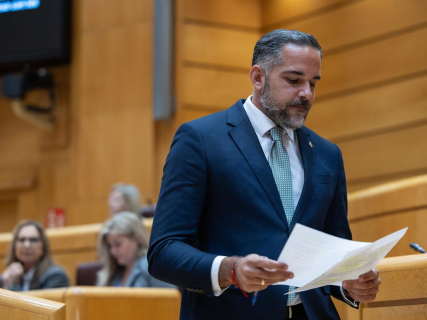

The PSOE health secretary, Kilian Sánchez, has advanced this Friday that the party will incorporate into its electoral programme new measures to cut waiting list times. Among them is the fact that 85 percent of patients who go to Primary Care will be able to obtain an appointment within a maximum of 48 hours.
To make this goal possible, he has proposed a specific reinforcement of Primary Care, supported by the interconnection of national healthcare data systems and an improvement in capillarity, cross-cutting work, and teamwork in multidisciplinary teams.
"We have to further increase the Primary Care strategy and strengthen the role of healthcare professionals, in order to have the capacity for longitudinal care," Sánchez emphasized during his appearance at Diálogos ID.
In the same vein, he has confirmed that the PSOE will include in its programme the commitment to dedicate, at minimum, 7 percent of GDP to health.
After that, the PSOE health secretary has stressed that, among the priorities of his formation, four major legislative initiatives are also included: the medicines law, the tobacco law, the alcohol and minors law, and the inclusion of patient organizations in governance bodies.
In relation to the medicines law, Sánchez has defended the urgency of reviewing regulations that have been in place for two decades without being updated, with the intention of ensuring the future of the pharmaceutical industry and responding better to patients’ demands.
Within this framework, he has advocated for strengthening accessibility, promoting innovation, and consolidating the production of strategic medicines, "to reduce Spain’s dependence on Europe and Europe’s dependence on other countries."
As for the dynamic prices contemplated in the medicines law, he has pointed out that they must take into account health outcomes and provide protection to the companies that manufacture strategic drugs. "Especially those dedicated to generics that offer necessary treatments at low cost," he specified.
Launch of the State Agency for Public Health
In parallel, Sánchez has pointed out that another of the PSOE's priority lines, if it finally assumes the leadership of the Ministry of Health, will be to set in motion “once and for all” the State Agency for Public Health. He has indicated that its headquarters would foreseeably be in Zaragoza, although he has reminded that the decision is not yet final. “It is an advanced matter, but still pending formalization,” he said.
In addition, he explained that the PSOE sets as one of its other goals to renew the current Framework Statute for healthcare professionals. On this matter, he criticized that in the previous legislature a “dissent” text was drafted when “it should have been consensus.”
“We defended a Framework Statute in which doctors were integrated into the body of healthcare professions, with specific articles for the medical profession,” he concluded.