From the eviction of Maricarmen to Congress: the street forces in six days two housing decrees and an urgent vote

The eviction of Maricarmen, 87 years old, has triggered a mobilization that has brought the housing crisis from a portal in Madrid to the Council of Ministers.

6 minutes

EuropaPress 7808934 decenas personas asamblea informativa 29 septiembre 2026 madrid espana

EuropaPress 7808934 decenas personas asamblea informativa 29 septiembre 2026 madrid espana

Add DEMÓCRATA to Google

Ask FREN

Published

6 minutes

The eviction of Maricarmen Abascal was carried out on Wednesday, September 23. Nine days later, on Friday, October 2, the 350 deputies of Congress will have to vote on two royal decree laws on housing whose approval has been accelerated after the social outrage caused by her case.

Between these two moments, a massive demonstration, encampments for housing in different cities, an agreement for Maricarmen to return to her home, a last-minute negotiation between PSOE and Sumar, and a delayed Council of Ministers while the partners finalized the content of the measures have taken place.

The result is two decrees that are already in provisional effect, but whose continuity depends on an extraordinary parliamentary validation called for this Friday. Junts and Podemos, decisive for resolving the vote, have not yet confirmed the direction of their votes.

An eviction that turned a particular case into a political crisis

Maricarmen, 87 years old and with reduced mobility, was evicted from the Madrid home where she had lived for more than seven decades. The execution of the eviction, without her having a stable housing alternative, turned her situation into a symbol of a much broader problem.

The images of the elderly woman leaving her home amid a strong police presence brought the housing conflict to the center of the political agenda. Sumar demanded that PSOE immediately recover the decree that both partners had been negotiating for months and the Tenants' Union dubbed their proposals the "Maricarmen decree."
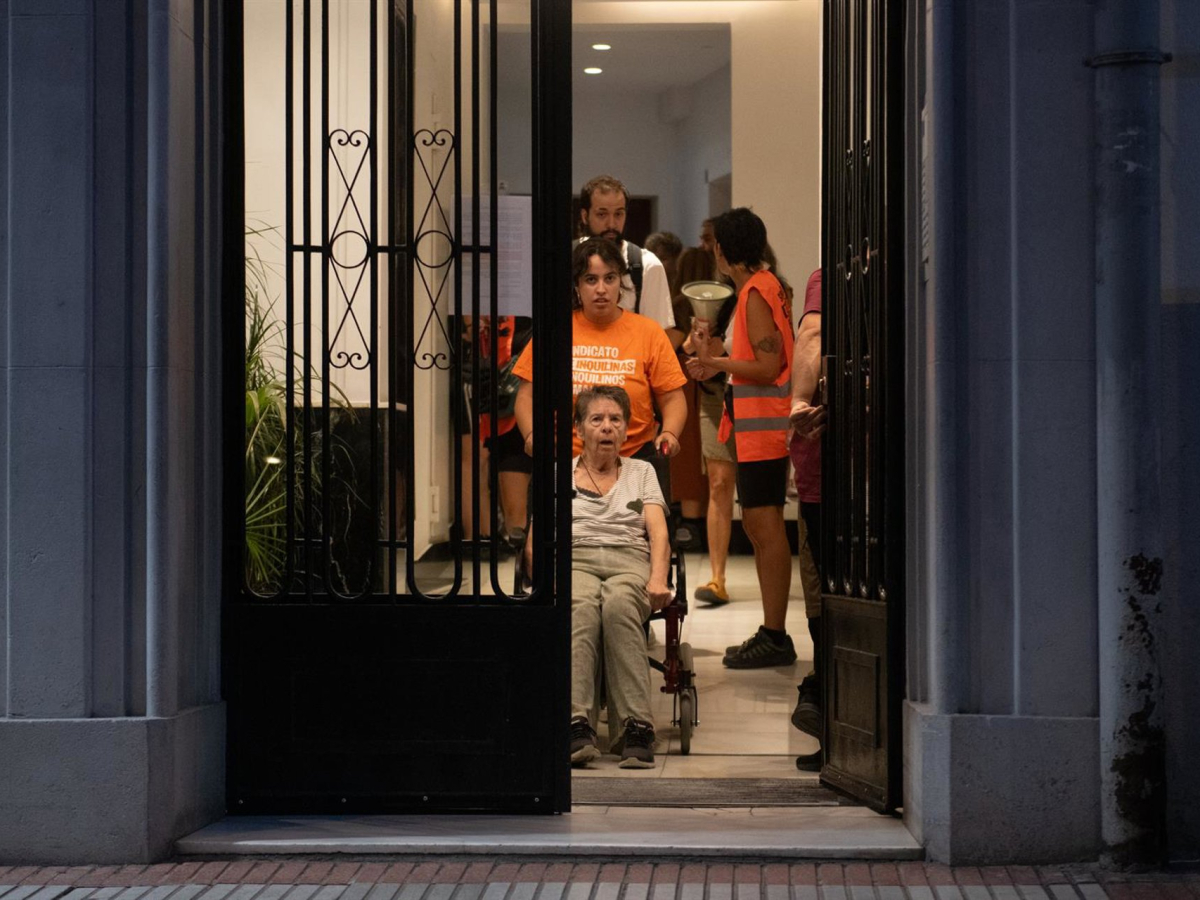
Maricarmen leaves the entrance of her house accompanied by the tenants' union Fernando Sánchez - Europa Press
Maricarmen leaves the entrance of her house accompanied by the tenants' union Fernando Sánchez - Europa Press -

The case also triggered a chain of accusations between administrations. The central government pointed to the regional and municipal competencies in housing and social services, while the City Council and the Community of Madrid blamed the Executive and state legislation.

But the debate soon ceased to be limited to who should offer a solution to Maricarmen. The question became how many tenants could find themselves in a similar situation when their contract ended and the landlord demanded an unaffordable increase or decided to reclaim the property.

The demonstration leads to a camp in Sol

On Saturday, September 26, thousands of people took to the streets of Madrid to demand measures against evictions, the increase in rents, and the purchase of homes by investment funds.

At the end of the mobilization, a part of the attendees decided to remain at Puerta del Sol. What began as an extension of the protest turned into a organized camp that resisted during the following days, also under the rain.

The mobilization spread to other cities, including Barcelona, Palma, Sevilla, Málaga, Santiago, Murcia, and Zamora. In Palma, the campers announced their intention to stay at least until the vote on Friday in Congress.

Dozens of people during the informational assembly | Europa Press
Dozens of people during the informational assembly at Puerta del Sol | Europa Press -

The immediate goal was to pressure the Government so that the Council of Ministers would approve concrete measures. The main demands were the automatic renewal of contracts, the prohibition of evictions without housing alternatives, the regulation of temporary and room rentals, the freezing of rents, and the limitation of investment fund operations.

The Tenants' Union particularly demanded indefinite contracts as long as the tenant fulfilled their obligations and there was no justified cause to terminate the lease.

PSOE and Sumar accelerate a negotiation blocked for months

The pressure from the streets altered the Government's calendar. PSOE and Sumar resumed a negotiation that had been stalled for months due to differences over the intensity and duration of the measures.

The minority partner demanded a deeper intervention in the rental market. The socialists sought a text capable of securing the votes of Junts and the PNV and avoiding a repeat of the defeat of previous measures in Congress.

The automatic renewal of contracts became the main obstacle. Sumar considered it essential to prevent landlords from using the expiration of the contract to evict the tenant or impose a significant rent increase. Junts and the PNV, on the other hand, expressed their concerns about a general limitation on landlords' ability to reclaim their homes.

The solution was to divide the measures into two royal decree laws. The first gathers the provisions that the Government considers to have the greatest chances of passing the vote. The second contains the automatic renewal of contracts, the most ambitious measure and also the one that arrives at Congress with the least assured support.

The Council of Ministers approves two decrees

The Council of Ministers began this Tuesday an hour late while PSOE and Sumar finished closing the agreement.

The first of the decrees includes, among other measures:

  • The extension until 2030 of protection against evictions for vulnerable people.
  • The regulation of seasonal rentals and room rentals.
  • The temporary prohibition of the purchase of homes by investment funds until 2028.
  • The extraordinary extension of two years for contracts in force that end before December 31, 2028.

The second royal decree law incorporates the automatic renewal of rentals, one of the main demands of the encampment and the Tenants' Union.

The separation allows Congress to vote on the texts independently. Therefore, the first decree can remain in force even if the second is rejected.

The Government itself acknowledges that the text on automatic renewal has had less negotiation time with parliamentary groups.

Congress will have the final word this Friday

The approval by the Council of Ministers does not guarantee the continuity of the measures. The royal decree laws come into force after their publication in the BOE, but Congress must validate or repeal them.

The Government has pushed for an extraordinary plenary session for this Friday, October 2, without exhausting the constitutional deadline of 30 days. The speed of the call immediately shifts the pressure from the Puerta del Sol to the hemicycle.

PSOE and Sumar will support both texts, but they do not alone add up to enough votes. ERC, EH Bildu, BNG, and Compromís have expressed support for strengthening tenants' rights, although they must assess the final wording.

Junts could facilitate the first decree because it includes their proposal to halt the purchases of homes by investment funds. However, it maintains its reservations about the automatic renewal and demands that the measures do not harm small property owners.

Podemos has not clarified its vote yet. The purple formation considers the separation of the package into two decrees a "trap" and demands deeper measures, although the automatic renewal coincides with one of the main demands of housing collectives.

On Friday, there will not be a single vote on housing, but two different majorities to build. The first decree has greater chances of being validated. The second represents the decisive battle over the stability of rental contracts.

Maricarmen will return to her home, but the mobilization continues

In parallel to the political negotiation, the representatives of Maricarmen and Urbagestión reached an agreement for the woman to return to her home when she receives hospital discharge.

The pact includes a new eight-year contract and a rent that will not exceed 30% of her income, around 500 euros monthly. The Municipal Housing and Land Company of Madrid will supervise its compliance.

The particular solution has not put an end to the protest. In Sol, the demonstrators celebrated Maricarmen's return as a victory of the mobilization, but decided to maintain the camp. They believe that the problem does not end with the repair of a single eviction and demand guarantees for all tenants.

Sumar has also described the decrees as a "first step" and has encouraged maintaining social pressure. The mobilization is now pending the complete drafting of the regulations and what happens on Friday in Congress.

A week that altered the institutional agenda

The course of the case shows the speed with which a mobilization can modify the political agenda. A decree that accumulated months of negotiations and disagreements has gone from blockage to approval in less than a week.

The eviction provided a recognizable face to the problem. The demonstrations transformed indignation into political pressure. The camp set an immediate calendar. The Government responded by dividing the measures into two texts and Congress will have to take a stand this Friday.

The vote will determine whether that course ends with new regulations in force or with another parliamentary defeat. It will also show how far the capacity of the street goes to condition a fragmented majority: from the portal where Maricarmen was evicted to the hemicycle of Congress in just nine days.

More key points, information and questions with FREN

AI-GENERATED CONTENT

What are the pending procedures and next steps for the ratification of the royal decree laws on housing in the Congress?

According to the information available as of September 30, 2026, the royal decree-laws on housing approved by the Government have already been published in the Official State Gazette (BOE) and are in force, but the key parliamentary control procedure is still pending: their ratification (or repeal) by the Plenary of the Congress. This control will be concentrated in an urgent extraordinary plenary session convened for Friday of this week, in which both texts will be voted on separately.

1. Current situation of the housing decrees

  • The Council of Ministers approved two royal decree-laws on housing, which include, among other measures, expanded protection against evictions, regulation of seasonal and room rentals, limitations on purchases by investment funds, and extensions of rental contracts until 2028.[source]
  • After their approval, they have been published in the BOE and are in force, as provided by the use of the royal decree-law.
  • The Constitution (art. 86.2) and the Congress Regulations require the Plenary to decide within a maximum period of 30 days on their ratification or repeal.[Congress Regulations]
  • The Government has expressly requested the Congress to accelerate the schedule to avoid exhausting the deadline and provide legal certainty, so the Board and the Spokespersons' Committee have agreed on an extraordinary plenary session this Friday.

2. Pending procedures until the ratification vote

Between today and Friday, the pending steps are essentially organizational and political:

  • Adjustment of the parliamentary calendar: the Congress is rearranging its agenda to include the extraordinary plenary session, as other sessions had been scheduled for these days.[source]
  • Final setting of the time and agenda: the intention is to start the Plenary on Friday at 11:00, with a specific item of “ratification or repeal” of the two housing decrees, which will be debated and voted on separately.
  • Political negotiation of support: the Government lacks an absolute majority and needs to rebuild an ad hoc majority. According to Demócrata's analysis, the arithmetic is different for each decree:
    • The first decree, focused on protection against evictions and investment funds, has more options if PSOE, Sumar, and left-wing partners (ERC, Bildu, BNG, Compromís) plus Junts and PNV join, who have conditioned their support on certain nuances in favor of small property owners.[source]
    • The second, which concentrates on the automatic renewal of contracts, faces more resistance from Junts and PNV and depends on whether any of those groups change their position or abstain.

3. Development of the ratification plenary

On Friday, the procedure will follow the scheme established by the Congress Regulations (article 151) for royal decree-laws:

  • Government defense: a member of the Government (likely the Minister of Housing or the Minister of the Presidency) will present the reasons of “extraordinary and urgent necessity” justifying each decree.
  • Debate with the groups: a debate similar to totality debates will be held, with turns for parliamentary groups to state their position on the content and timeliness of the measures.
  • Separate votes: each decree-law will be subject to a specific vote. A simple majority is required: more votes in favor than against; abstentions reduce the necessary threshold.[source]
  • Possible additional decision: if a decree is ratified, in the same session the Presidency may ask if any group wishes it to be processed as a bill. If approved by simple majority, an abbreviated legislative procedure (urgency) would open allowing amendments.

4. Next steps after the plenary: possible scenarios

  • If both decrees are ratified:
    • They will remain in force as norms with the rank of law.
    • If their processing as a bill by urgency is also agreed, a brief period for amendments, committee work, and a new Plenary step will open before, if applicable, sending the text to the Senate.
  • If only one is ratified:
    • The ratified decree will remain in force; the rejected one will be immediately repealed.
    • The Government could try to reconfigure the package in new initiatives (another decree-law or ordinary bills), but without retroactive effect on what was repealed.
  • If a key decree is repealed (for example, the one on automatic renewals):
    • The measures would cease to apply from the vote, as has happened this year with other housing decrees that did not pass ratification.[source]
    • Political and social pressure would likely shift to new negotiations to channel part of the content via ordinary law.

In summary, the only major pending procedure is the extraordinary plenary this Friday, in which the Congress will decide, by separate votes and simple majority, whether to keep in force or repeal the two royal decree-laws on housing, and whether or not to open a second phase as bills to adjust their content via amendments.

Can you break down what each of the two housing decree-laws to be ratified contains, clearly differentiating eviction, rental, and investment fund measures? Explain in more detail what numerical majority each decree needs in Friday's plenary and what vote combinations could result in one being ratified and the other repealed. If one of the decrees is later processed as an urgent bill, what specific deadlines and phases would that processing have and at what points could relevant changes be introduced?

What are the legal competences in housing matters of the central Government, autonomous communities, and municipalities according to Spanish legislation?

In Spain, housing is a matter involving all three levels of government, but with a very clear distribution of competences: the State sets the basic framework, the autonomous communities assume the main competence in housing policy and land planning, and the municipalities execute and manage at the local level. Below is a detailed explanation of what each can do “according to Spanish legislation,” mainly based on the Constitution and the basic laws on local regime and urban planning.

1. Competences of the central Government (State)

The State does not have exclusive competence over “housing” as such, but it does have several competences that decisively affect this matter. In summary, it can:

  • Establish basic legislation that conditions housing policy nationwide, in areas such as:
    • General economic regulation and budgetary stability.
    • Basic regime of property rights and urban leases.
    • Basic conditions ensuring equality in exercising the right to housing throughout the country.
  • Approve state housing plans with public aid (direct subsidies, guarantees, tax deductions) to:
    • Promote affordable rental and rehabilitation.
    • Support youth, vulnerable groups, or specific programs (energy efficiency, accessibility, urban regeneration, etc.).
    These plans are usually executed through agreements with autonomous communities, which manage the aid in their territory.
  • Regulate financial and fiscal aspects affecting housing:
    • Rules on mortgage credit and banking supervision.
    • State-owned taxes (e.g., in personal income tax or VAT applicable to certain real estate operations), without prejudice to autonomous competences.
  • Manage and regulate the state-owned housing stock, such as the assets of the General State Administration or its public bodies.
  • Promote cross-cutting policies related to housing: energy efficiency, universal accessibility, fight against energy poverty, or urban rehabilitation financed with European funds.

2. Competences of the autonomous communities

The autonomous communities assume the main competence in housing. Most statutes of autonomy expressly attribute competence in housing, urbanism, and land planning. This means they can:

  • Approve their own housing legislation, always respecting the state bases:
    • Define what is understood as protected housing, its types, and requirements.
    • Establish autonomous registries of applicants for protected housing.
    • Regulate measures to promote affordable rental and mobilization of vacant housing.
  • Plan autonomous housing policy:
    • Draft autonomous housing and land plans.
    • Decide priorities (rehabilitation, new construction, social rental, rural areas, etc.).
  • Manage autonomous public housing:
    • Promote and manage social or affordable housing stock.
    • Establish allocation and use criteria.
  • Regulate and supervise urbanism (urban plans, land classification), which determines what land can be allocated to housing, reserved land for protected housing, densities, etc.
  • Channel and manage state housing funds in their territory, signing and executing agreements with the State.

3. Competences of the municipalities

Municipalities play an essential role in the management and execution of housing policy, especially through their urban planning competences and proximity social services. Their main functions include:

  • Detailed urban planning and management:
    • Approve general and partial plans that regulate land use.
    • Classify land for housing, including reserves for protected housing.
    • Grant building and first occupancy licenses.
  • Promotion of municipal public housing, directly or through public land and housing companies:
    • Construction and management of social housing stock.
    • Allocation of municipal land for affordable housing projects.
  • Intervention in residential vulnerability situations:
    • Municipal social services attending cases of evictions, homelessness, or residential exclusion.
    • Emergency housing programs (temporary accommodations, urgent aid).
  • Application of municipal ordinances related to housing use:
    • Regulation of tourist uses, coexistence, healthiness, or substandard housing.
    • Inspection and urban discipline actions within the municipal area.

4. Key idea: cooperation between levels

In practice, housing policy results from the coordinated overlap of these three levels:

  • The State sets the basic rules of the game and finances part of the policies.
  • The autonomous communities design and regulate housing policy in their territory, within the state framework.
  • The municipalities make it effective “on the ground” through planning, licenses, land management, and social emergency assistance.

Any specific analysis (for example, on rent price control, tourist housing, or social rental) requires simultaneously seeing what each government level has done within this general distribution.

Can you explain with concrete examples how the State, autonomous community, and municipality coordinate in a housing plan? What differences are there between autonomous protected housing and municipal social housing? How do the State's rules on urban leases influence autonomous housing policies?

What legal requirements must be met for a royal decree-law to be definitively ratified by the Congress of Deputies?

The ratification of a royal decree-law by the Congress is not a mere political formality: it is surrounded by very precise material, formal, and procedural requirements, mainly established in article 86 of the Constitution, Law 50/1997 of the Government, and the Regulations of the Congress of Deputies (art. 151 and related).

1. Material requirements (what a royal decree-law can regulate)
  • Enabling premise: article 86.1 CE requires a situation of “extraordinary and urgent necessity”. The Government must justify it, and the Congress can, when ratifying or repealing, accept or reject that assessment (in addition to being reviewable by the Constitutional Court).
  • Material limits: the royal decree-law cannot affect:
    • the basic institutions of the State,
    • the rights, duties, and freedoms of Title I of the Constitution,
    • the regime of the autonomous communities,
    • nor the general electoral law.
    If it invades these areas or lacks the urgency premise, it can be annulled in an unconstitutionality appeal or a question of unconstitutionality.
2. Formal approval requirements by the Government
  • According to Law 50/1997, of the Government, royal decree-laws are decisions adopted by the Council of Ministers in the form of a Royal Decree-law, exercising the power of article 86 CE.
  • The Government Law establishes that:
    • the Council of Ministers approves the text and sends it for publication in the Official State Gazette,
    • there must be an abbreviated regulatory impact analysis report, justifying the urgency and other basic aspects, although many ordinary regulatory drafting procedures are relaxed due to the urgency itself.
  • The royal decree-law comes into force as provided in its final validity provision, but always conditioned on subsequent ratification by the Congress.
3. Procedural requirements for ratification in the Congress

The procedure mainly comes from article 86.2 CE and article 151 of the Congress Regulations:

  • Deadline: the royal decree-law must be submitted to debate and totality vote in the Congress within 30 days from its promulgation. If the Chamber is not convened, it must be called; in case of dissolution or between legislatures, the Permanent Deputation acts, assuming the Congress's powers regarding royal decree-laws.
  • Competent body: the Plenary of the Congress (or the Permanent Deputation) debates and votes on ratification or repeal.
  • Agenda: the Regulations allow including the royal decree-law in the agenda as soon as it has been published in the BOE.
  • Debate development:
    • a Government member presents to the Chamber the reasons that led to issuing the royal decree-law,
    • the debate proceeds according to the rules of totality debates (turns for and against, group position statements, etc.),
    • once the debate concludes, a single vote is held on ratifying or repealing.
  • Required majority: neither the Constitution nor the Regulations require a qualified majority; the general rule of simple majority of votes cast applies (more yes than no). Affirmative votes are understood as favorable to ratification; negative votes, to repeal.
  • Publication of the agreement: the ratification or repeal agreement is published in the BOE.
4. Effects of ratification and processing as a bill
  • If the Congress ratifies the royal decree-law, the norm maintains its validity as a decree-law.
  • Immediately after, the Presidency asks if any parliamentary group wishes it to be processed as a bill. If a group requests it and the Chamber agrees, the text is processed:
    • as a bill,
    • by the urgency procedure,
    • without allowing totality return amendments (modification amendments are allowed).
  • If the Congress repeals the royal decree-law, it loses validity; the temporal scope and effects on created situations are specified, if applicable, by the Constitutional Court when it hears appeals or unconstitutionality questions.
5. Constitutional control
  • Besides the political control of ratification, any ratified royal decree-law can be challenged before the Constitutional Court through:
    • unconstitutionality appeal,
    • or unconstitutionality question raised by judges and courts.
  • The Court verifies both the extraordinary and urgent necessity premise and respect for the material limits of article 86.1 CE and other constitutional provisions.

In summary, for a royal decree-law to be definitively ratified, it is required: that it respects the material limits of article 86 CE and that there is a reasonably justified urgency; that it has been validly approved and published by the Government; that it is debated and voted by the Plenary (or the Permanent Deputation) within 30 days from its promulgation; and that it obtains a favorable simple majority in that vote, without prejudice to subsequent control by the Constitutional Court.

Can you explain with examples from the Constitutional Court jurisprudence how “extraordinary and urgent necessity” has been interpreted in royal decree-laws? How does the parliamentary processing of a royal decree-law ratified as an urgent bill differ from that of an ordinary bill? What exact role does the Permanent Deputation have in the ratification of royal decree-laws during periods between legislatures or outside ordinary sessions?

Play

Test your knowledge with FREN!

How much do you know about this topic? Answer the following 3 questions.

What event triggered the acceleration of the approval of two housing decrees in the Government?

Question 1 of 3

What is the most controversial measure included in the second housing royal decree law?

Question 2 of 3

Which parliamentary groups are decisive for the approval of the housing decrees in Congress?

Question 3 of 3