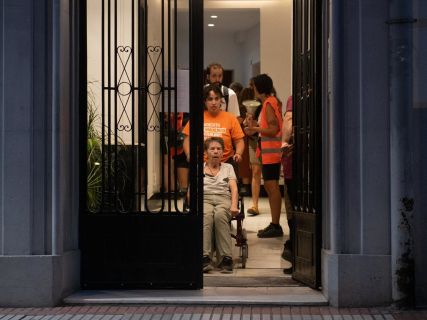
Urbagestión and Maricarmen have reached an agreement for the 87-year-old woman to be able to return to the home in the Madrid neighborhood of Retiro from which she was evicted last week, after the meeting held this Monday with the mediation of the City Council of Madrid.
Most read
More key points, information and questions with FREN
AI-GENERATED CONTENTWhat are the next legal and administrative steps for the agreement between Urbagestión and Maricarmen to become definitive?
I do not have sufficient information —neither about the specific legal framework nor the exact nature of the agreement between Urbagestión and Maricarmen— to rigorously detail the legal and administrative steps that would make that agreement “definitive.” Moreover, my expertise is specialized in Spanish politics and public institutions (public regulations, parliaments, governments, public administrative procedures, etc.), not in private legal advice or specific civil or commercial contracts between particular parties.
For that reason, I cannot replace the analysis that a legal professional must perform with access to the file, the signed documentation (drafts, contracts, annexes, powers of attorney, prior deeds, etc.), and the complete context (for example, whether there is an ongoing urban planning procedure, whether a city council is involved, whether the agreement is linked to a license, an urban planning agreement, or a homeowners’ association, etc.).
What I can do is explain in general terms what types of issues are usually relevant when a private agreement needs to be legally consolidated, so you know which points to review with your lawyer or advisor:
- Clarity about the nature of the agreement: it is usually key to determine whether we are dealing with a sales contract, a lease, a purchase option, a barter contract, an assignment of urban development rights, a collaboration agreement, etc. Each legal figure has different requirements and effects, both in civil law and, where applicable, administrative law.
- Form required by law: some agreements can be perfected by private writing, while others require a notarial public deed to be fully effective against third parties or to be registered (for example, transfers of real rights over real estate).
- Intervention of a public administration: if the agreement affects urban licenses, zoning changes, parceling projects, agreements with a city council, or the execution of an urban plan, then specific administrative procedures come into play (plenary approvals, publications in official bulletins, technical and legal reports, public information periods, etc.) that must be analyzed case by case.
- Suspensive or resolutory conditions: contracts are often signed conditioned on obtaining a license, approval of a project in the municipal plenary, constitution of a homeowners’ association or compensation board, or granting of financing by a financial entity. Identifying which conditions remain unmet is key to knowing which “steps” are truly missing.
- Registry inscription (if applicable): in real estate matters, for an agreement to fully produce its effects, it usually requires registration in the Property Registry, which in turn requires a public deed and compliance with all applicable formal and material requirements.
- Coordination with other involved parties: there may be third parties whose consent, notification, or non-opposition is necessary (co-owners, mortgage creditors, homeowners’ association, local administration, etc.), each with its own legal channel.
A lawyer specialized in civil/commercial law and, where applicable, urban or local administrative law, will be able to:
- Review the text of the agreement between Urbagestión and Maricarmen.
- Check which specific regulations apply (Civil Code, Land Law, regional urban planning regulations, municipal ordinances, etc.).
- Identify exactly which procedures remain pending (notarial signing, registration, license application or modification, approval of agreements in municipal plenary, etc.).
- Define a schedule and a logical order of actions until the agreement is fully consolidated.
On the other hand, where I can help you in detail is in everything that has a direct relation with Spanish public institutions: for example, explaining how a general urban development plan is processed, what steps an urban planning agreement with a city council follows, how a municipal ordinance is approved, how a licensing procedure is structured, or what role a municipal plenary plays in these types of decisions.
If you want to guide me towards any of these more “public” aspects (for example, “what steps must the city council follow to approve the urban planning agreement linked to this deal”), I can give you a very precise explanation of the corresponding institutional procedure.
What competencies does the Madrid Municipal Housing and Land Company (EMVS) have regarding rental intermediation?
The Madrid Municipal Housing and Land Company (EMVS Madrid) is the main instrument of the City Council to implement its housing policy, especially regarding affordable rental housing. Within this scope, it has relevant competencies in rental intermediation and mediation between landlords and tenants, which it exercises through specific programs and services, mainly the Rental Intermediation Service (SIA) and the ReViVa program.
1. General framework of rental competencies
According to official information from the City Council and EMVS itself, the public company can:
- Promote, build, acquire, and rehabilitate housing to allocate it to affordable or social rental, integrating it into the municipal housing stock.
- Manage the rental housing stock of the City Council, including contract formalization and monitoring, tenant assistance, and incident processing.
- Develop collaboration programs with private owners to mobilize vacant housing towards affordable rental, acting as intermediary and manager.
- Provide advisory and intermediation services in urban leases, aimed at both landlords and tenants, within the framework of municipal competencies.
These functions are included in institutional documentation (statutes, service charter, and municipal transparency), where EMVS Madrid is defined as the entity responsible for facilitating access to housing through affordable rental and for articulating mediation instruments between lessors and lessees (EMVS Madrid institutional profile).
2. Rental Intermediation Service (SIA)
One of the key intermediation instruments is the SIA, repeatedly mentioned in municipal press releases. It is a free program that:
- Connects property owners in the city of Madrid with potential tenants seeking affordable rental housing.
- Offers personalized advice to both parties on contract conditions, rights and obligations, and resolution of basic legal doubts.
- Performs comprehensive management of the leasing process: registration of owners and interested parties, property valuation, search and selection of suitable tenants, and support during contract signing.
- Assesses the solvency of potential tenants to reduce the risk of non-payment and provide more security to the owner.
- Provides additional guarantees, such as home insurance and even free non-payment insurance during the contract term, as detailed in recent municipal communications about EMVS financing for affordable rental programs (press release 04/30/2025 and 03/12/2026).
In practice, the SIA acts as a municipal rental pool with added guarantees: EMVS mediates in the contractual relationship, reduces landlords’ uncertainty, and facilitates stable conditions for tenants within the affordable rental segment.
3. ReViVa Program and vacant housing management
Another relevant competency in intermediation is the management of the ReViVa program, aimed at mobilizing vacant private housing towards affordable rental. According to recent official notes:
- Owners assign the usufruct of their property to EMVS Madrid for a period (usually between 5 and 10 years), retaining ownership.
- They receive a guaranteed monthly rent, regardless of whether the property is occupied or not.
- EMVS assumes comprehensive rental management: tenant search, contract signing, incident handling, relationship with the homeowners’ association, and monitoring of property use.
- The public company covers expenses such as property tax (IBI), home insurance, ordinary community fees, and ordinary repairs; it can even advance up to 45,000 euros for rehabilitation works at 0% interest, which are deducted from the owner’s rent (02/23/2024 and 07/17/2026).
From the intermediation perspective, ReViVa positions EMVS as a structural manager and mediator of the rental contract: it interposes itself between owner and tenant, assuming risks, management obligations, and much of the costs, in exchange for incorporating the property into the municipal affordable rental stock.
4. Specific mediation in conflicts or individual cases
Beyond these systematic programs, the City Council and EMVS use the SIA as a case-by-case mediation tool. For example, in high-profile eviction procedures, the municipality has formally offered its Rental Intermediation Service to bring owners and tenants together and explore negotiated solutions (rent reductions, new contracts, etc.), with EMVS acting as a neutral and technical third party (Demócrata coverage on the Maricarmen case).
In these actions, EMVS’s competence is neither jurisdictional nor sanctioning: it is limited to mediating, advising, and proposing solutions, within the legal framework of urban leases and municipal housing policy.
5. Limits and competency fit
All these functions fit within the distribution of competencies provided by Spanish regulations:
- The Community of Madrid holds the main competency in housing and urban planning.
- The Madrid City Council develops its own housing policy within that framework.
- The EMVS is the City Council’s instrumental entity to practically execute affordable rental, mediation, and rental intermediation policies.
In summary, EMVS Madrid has very broad operational competencies to mediate in the rental market: it designs and manages affordable rental programs, acts as a bridge between landlords and tenants, assumes risks and expenses to encourage housing rental, and offers mediation and advisory services aimed at stabilizing lease relationships and expanding the affordable housing stock in the city.
What requirements must housing meet to be incorporated into the ReViVa program in Madrid?
The ReViVa program of the Madrid City Council, managed by EMVS Madrid, mobilizes vacant private housing to allocate it to affordable rental (and, in some lines, to purchase for public stock). For a property to be incorporated into the program, it is not enough that it is vacant: it must meet a series of technical, location, and legal status requirements set by the City Council and included in its regulatory bases and municipal documentation.
1. Location and type of housing
- It must be located within the municipality of Madrid, inside the municipal boundaries, according to the program bases and consulted municipal information.
- It must comply with the conditions of the Madrid General Urban Development Plan (PGOUM), that is, meet the urban planning and habitability parameters that this plan requires for housing.
- Notes from the City Council and EMVS indicate that housing in multi-story buildings is required; single-family homes are excluded from the purchase line.
- The housing must be above ground level. In buildings without an elevator, municipal information specifies that only housing up to the third floor is accepted; in the rental program documentation, housing up to the fourth floor is mentioned, but operationally the limit is around those ground–third floors without elevator.
2. Minimum habitability conditions
The regulatory bases of the ReViVa program and City Council fact sheets detail a series of minimum physical characteristics:
- It must be an exterior dwelling, with openings (windows) to the facade or courtyards that meet minimum dimensions. It is required that it has no windowless bedrooms.
- It must have at least one bedroom. In the affordable rental version, it is requested to have at least two main rooms (living room and one or more bedrooms) with natural light to the exterior.
- It must have a full bathroom, equipped with a sink, toilet, and bathtub or shower.
- It must meet the minimum habitability conditions provided in the PGOUM (usable surfaces, ventilation, lighting, etc.), which is verified, among other means, through housing regulations and, where applicable, the Technical Building Inspection (ITE).
- The housing must be in good state of conservation or, if it requires works, be technically rehabilitable. Press releases explain that EMVS can advance up to 45,000 euros at 0% interest for renovations, but always on housing that, once rehabilitated, meets safety and habitability standards.
3. Housing status: use, utilities, and community
- The program is aimed at vacant housing, not at properties already rented or second homes in ordinary use.
-
In the purchase line described in municipal documentation, it is required that the housing:
- Be in good state of conservation.
- Be up to date with community fees.
- Have electricity, water, and gas supplies activated or capable of immediate activation.
- Have passed the ITE, when applicable.
- In the usufruct assignment for affordable rental, EMVS later assumes expenses such as community fees, home insurance, ordinary repairs, and property tax (IBI), but to enter the program it is verified that the registry status and encumbrances allow such assignment without conflicts.
4. Difference between housing and owner requirements
The above requirements are property-specific. Additionally, the program sets specific conditions for:
- Owners: usufruct assignment to EMVS for a minimum period (generally five years and up to ten), maximum number of properties that can be contributed, etc.
- Tenants: income brackets (around 3–5.5 times the IPREM in the initial bases, expanded in later updates), rent effort cap below 30% of income, and possible additional aids for youth, elderly, disabled persons, large families, victims of gender violence, etc.
5. Where to consult the current version
The specific requirements may have been updated through new bases or calls. To ensure your property meets the current conditions, it is advisable to review:
- The regulatory bases of the ReViVa Program, available on the EMVS Madrid website (linked, for example, on the ReViVa program page).
- The program fact sheet on the Madrid City Council’s electronic headquarters, where updated requirements and documentation are summarized.
If you need, I can help you review a specific case (type of apartment, floor, condition, etc.) to see if, according to these criteria, it would reasonably fit into ReViVa.
Play
Test your knowledge with FREN!
How much do you know about this topic? Answer the following 3 questions.