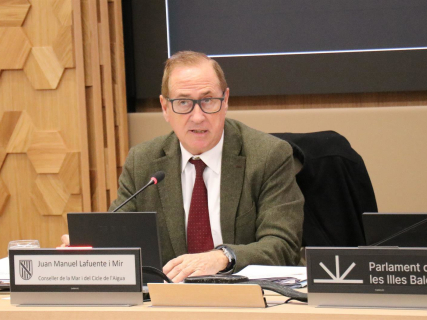

The Government has said that it has not found an “alarming increase” in the levels of chlorides in the Maó aquifer, since they remain in the same line as previous measurements, although it has admitted that there are two sectors where the situation is “more worrying”.
This was stated by the Minister of the Sea and the Water Cycle, Juan Manuel Lafuente, during his appearance before the Territorial Planning, Housing, Mobility, Sea and Water Cycle Commission of the Parlament, where he provided an account of the state of the island of Menorca’s aquifers.
The minister appeared this Wednesday following a written question from the PSIB deputy Carolina Marquès, who demanded data from the Menorca Groundwater Monitoring Network from 2023 to 2026, a matter which, according to her, would not have been clarified initially.
The parliamentarian insisted that her request sought to know the results of water quality and the levels in the monitoring wells, and criticized that this information was not provided to her on the grounds that it was “too technical,” referring her instead to the documentation published by the Government online.
For this reason, she reproached Lafuente that with that response he “would not have complied” with the rules of the Parlament and, after reviewing the official database, she said that the records are not updated since last year. She also criticized that she was referred to the current hydrological plan, whose analyses cover from 2013 to 2018.
In Marquès’s view, the minister’s intention would be to “hide” the reality of Menorca’s aquifers, pointing out that in those of Migjorn and s’Albaida the situation would be “alarming,” with an accumulated drop of “several meters”.
The deputy has warned that, while the Government talks about recovery of the aquifers, “it does not say” either the volume or the quality of the available freshwater. She has focused on the case of Maó, where from June to August the level would have gone from 23 to 40% “without rain” during the summer.
In this context, she asked whether there has been a risk of seawater intrusion and, if levels have fallen, in what way the concentration of contaminants would have been affected. She also recalled that Menorca continues in a pre-alert situation for drought.
Lafuente replied that the size of the information requested by the deputy was “enormous” and that is why he referred it to the portals where the data already appear.
"On the part of the Conselleria, there is no inconvenience, and it is sent to where the information is posted without political interference and without anyone telling the officials when they should do it," he has underlined.
At the same time, he has indicated that since September almost 300 written questions have been formulated to the Conselleria with thousands of data, and for that reason he has reiterated that "there is no intention to hide anything".
The councillor has detailed that the information required affects 223 monitoring points, where 3,940 measurements and 1,115 analyses have been carried out. "The amount of information in a written question was enormous and it was impossible to provide all of the information," he has argued.
Marquès has reproached him that during his appearance he would have "avoided questions" and has insisted on his accusation of "hiding" data, since the information that was supposed to be included in the web pages to which he was directed "was not published".
Likewise, he has defended that his warning about a possible salinization of the aquifers stems from the "lack of transparency" and has again cited the case of Maó, which, as he has stated, over the three years of the legislative term would have been "drained".
The PSIB deputy has recalled that at the start of the Menorca mandate, the island had the best water reserves in the Balearic Islands and that, in her view, it will now end up as "the worst". She has also criticized that investment in the water cycle "leaves much to be desired".
In addition, she has asked how many cubic meters would have been extracted from Menorca's wells and has questioned why the water dispenser of the desalination plant was tendered at the end of the legislative term, when in Mallorca it was installed in 2016, in Formentera in 2019, and in Eivissa in 2024.
Lafuente has responded that in the previous legislative term —in which the PSIB governed— "no" investment measure was adopted in water supply, and he has counterposed that inaction to the actions of the Maó Town Hall, which, as he has said, "hid" from the public the existence of non-potable water in the network, despite the fact that "it knew".
He has also reproached Marquès for basing his hypothesis about salinization "on the basis of his intuition" and on his "great lack of knowledge" of the matter, without providing data or elements that support it.
Along these lines, he has accused her of carrying out an "irresponsible" opposition and has assured that the Maó Town Hall has the results of the latest analyses, and for that reason he has insisted that the deputy's statement "does not match reality".