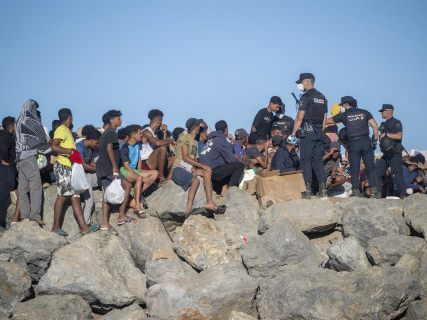

The PP has presented in the Parliament an initiative to express its support for Ceuta and demand that the Government of Spain also strengthen the protection of the maritime border of the Balearic Islands.
In this non-legislative proposal (PNL), the 'popular' highlight that both territories, despite their different geographical characteristics, face particularly intense migratory pressure and require that the State "fully exercise" its powers in matters of immigration and border control.
According to what the PP has indicated in a press release, the "late reaction" of the Executive to the crisis in Ceuta after the massive entry of migrants "should serve to reinforce" the protection of the border in the Islands.
The 'popular' deputy in the Parliament Cristina Gil has criticized the President of the Government, Pedro Sánchez, for taking 26 days "to react in Ceuta." "In the Balearic Islands, we cannot wait for the situation to overflow for the State to act," she warned.
In her opinion, the fact that the mechanisms of National Security have now been activated, a single command has been established, and measures have been announced to expedite returns "demonstrates that there were instruments to act from the beginning."
In this line, the PNL condemns the "delay" in calling the National Security Council and demands that the central Executive "clarify the alerts and prior warnings received about the risk of a massive entry in Ceuta."
"In the Balearic Islands, we know perfectly well the consequences of the lack of anticipation from the Government of Spain. We are the external maritime border of Spain and the European Union and we need prevention, surveillance, and means before problems overflow," Gil has claimed.
For this reason, the 'popular' propose in the PNL a specific plan for the maritime border of the archipelago, coordinated with the Govern and the island councils, which includes more human, maritime, aerial, and technological resources for the Civil Guard and the National Police, an increase in surveillance over irregular immigration routes, and more means to combat organizations dedicated to human trafficking.
Likewise, they demand that the Government defend before the European Union that "specifically take into account" the Balearic Islands in the planning and distribution of European funds intended for border surveillance, the prevention of irregular immigration, and the fight against human trafficking networks.
"The competencies are of the State and Sánchez cannot transfer his responsibilities nor shift their consequences onto the communities that bear a greater migratory pressure," the deputy emphasized.
The initiative urges to execute with "maximum diligence and all legal guarantees" the return procedures for those who do not have the right to remain in Spain and, in the case of unaccompanied foreign minors, to proceed with their proper identification, locate their relatives, and promote, always considering their best interest, their family reunification in their countries of origin.
Likewise, it demands from Morocco the "effective compliance" with its commitments regarding border surveillance, prevention of irregular departures, combating human trafficking networks, and readmission.
"What happened in Ceuta must serve as a warning. Defending Ceuta and Melilla and protecting the maritime border of the Balearic Islands is part of the same obligation of the State: to protect our borders, guarantee the safety of citizens, and defend the sovereignty and territorial integrity of Spain," he concluded.