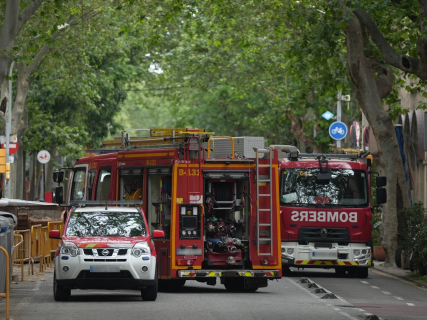
A fire in Collserola forces the confinement of Torre Baró and Ciutat Meridiana

The fire has been declared near Canyelles and temporarily affects about 25 hectares of forest land. Civil Protection has activated the Infocat in alert phase and has asked residents to stay at home with doors and windows closed.

2 minutes

WhatsApp Image 2026 07 01 at 10.33.48

WhatsApp Image 2026 07 01 at 10.33.48

Add DEMÓCRATA to Google

Ask FREN

Published

Last updated

2 minutes

Most read

A fire declared this Tuesday afternoon in the north of Collserola, near the Barcelona neighborhood of Canyelles, has forced the preventive confinement of the residents of Torre Baró and Ciutat Meridiana due to the presence of smoke. The initial data from Agents Rurals places the affected area at about 25 hectares of forest land, while firefighters work with ground and aerial means.

The fire started around 3:20 PM in an area of scrubland located above the Alta de Roquetes road, heading towards Sant Cugat. The column of smoke has been visible from various points in Barcelona and nearby municipalities.

Civil Protection has sent an ES-Alert notice to the population of Torre Baró and Ciutat Meridiana to order the preventive confinement. The recommendation is to stay indoors, close doors and windows, and avoid going outside while the smoke affects the area.

The Special Emergency Plan for Forest Fires in Catalonia, Infocat, remains activated in alert phase.

About 25 hectares affected

The provisional data from Agents Rurals places the affected area at around 25 hectares.

The fire is advancing through a vegetation area in the Collserola surroundings, and the firefighting teams are concentrating part of their efforts on the right flank.

The operation involves personnel from the Bombers de Barcelona and the Bombers de la Generalitat, with ground units, aerial means, and personnel from the Grup d'Actuacions Forestals (GRAF). Europa Press initially reported the deployment of five aerial means and three water vehicles from the Generalitat, along with municipal personnel.

Traffic cuts in the area of the fire

The Guàrdia Urbana has closed several accesses near the affected area.

The cuts affect the road from Horta to Cerdanyola, the road of the Collserola Cemetery, and the Alta de les Roquetes road, according to information released by the Barcelona City Council.

The emergency phone 112 had initially received 380 calls related to the fire shortly after it was declared. Subsequent sources raise the number of alerts, so this is a figure that continues to be updated as the emergency progresses.

Second fire in Collserola in less than two weeks

The fire this Tuesday is the second significant fire recorded in Collserola in less than two weeks.

On August 14, another fire was declared in the vicinity of Sant Pere Màrtir that affected around ten hectares of forest land and forced the preventive confinement of neighbors from Can Caralleu.

For that episode, the Urban Guard later arrested a man as the alleged author of the fire.

The City Council of Barcelona had deactivated just a week ago the Municipal Action Plan for forest fires that was launched due to that fire.

Emergency teams are maintaining this Tuesday the device deployed in the north of Collserola while the extinction tasks and the monitoring of the evolution of the smoke over the nearby neighborhoods continue.

More key points, information and questions with FREN

AI-GENERATED CONTENT

What procedures and processes does the Special Emergency Plan for Forest Fires in Catalonia (Infocat) include when the alert phase is activated?

When the alert phase of the Special Emergency Plan for Forest Fires in Catalonia (INFOCAT) is activated, a chain of formal procedures and processes is set in motion, ranging from administrative decision and operational coordination to the adoption of specific measures concerning the population and the territory. The new INFOCAT, revised in 2024, especially strengthens the protection of the population and coordination among operational bodies.

1. Activation decision and operational framework

The activation of INFOCAT in the alert phase occurs when the fire risk is very high or extreme, usually linked to level 4 of the Pla Alfa of the Agents Rurals, as explained by Interior and Protecció Civil in the presentation of the new INFOCAT plan (Government note, 15/04/2024) and in subsequent alert activation notes (26/07/2025).

From the civil protection perspective, the INFOCAT alert practically equates to an operational situation 1: the regional plan is activated, but the fire (or the extreme risk episode) is considered manageable with own resources, without the need to declare a national interest emergency yet. According to the state guideline explained by Demócrata (article on levels 0‑1‑2‑3), this situation implies:

  • Formal activation of the regional civil protection plan.
  • Coordination of operational centers and communication with affected municipalities.
  • Mobilization of resources foreseen in the plan.
  • Issuance of warnings and instructions to the population when appropriate.

2. Activation of the CECAT and reinforcement of technical management

Once the alert is declared, the Directorate General of Civil Protection activates the Catalonia Operational Coordination Center (CECAT) as the management core. The new INFOCAT has strengthened the Technical Committee as a body attached to the CECAT to assess risk and advise the plan management, and has “specified the decision-making flows and the application of emergency measures to the population” (INFOCAT 2024).

In this phase, the following are processed:

  • The activation resolution of INFOCAT in alert, which defines the territorial scope (affected counties or municipalities) and the duration of the episode.
  • The convocation of the technical committee and, if necessary, other coordination bodies (such as interdepartmental committees or equivalents to CECOPAL at the local level).
  • The allocation and redistribution of resources from Bombers, Agents Rurals, SEM, Mossos d’Esquadra, and other operational services, which must coordinate their prevention, surveillance, and extinction actions.

3. Protection measures and restrictions on the ground

The operational core of the alert phase consists of preventive and emergency measures concerning the population and the territory. The revised INFOCAT details and tightens these measures:

  • Confinement and evacuation criteria: the criteria and processes to establish confinement and evacuation in case of forest fire have been “detailed,” reserving evacuation for situations of imminent vital risk and leaving other cases as recommendations (INFOCAT 2024). In practice, this has been applied, for example, in mass confinements in Les Gavarres or Gavà, described by Demócrata (Les Gavarres fire).
  • Restriction of access to forest areas: the plan “enables the restriction of access to forest environments (closure of massifs)” in extreme risk situations, linked to the new level 4 of the Pla Alfa. This restriction is formalized via resolution, with closures of certain massifs or natural spaces.
  • Suspension of vulnerable activities in forest areas: the plan foresees the “restriction or suspension of vulnerable activities” (camps, routes, children’s leisure activities or similar) in forest areas, with specific instructions on transfer to inhabited centers or suspension when safety conditions are not met (alert of 26/07/2025).
  • Limitation of interurban mobility: INFOCAT incorporates as a new measure the “limitation of interurban mobility” when it is necessary to reduce the presence of people on roads, especially secondary ones, to avoid risk situations in rapidly evolving fires.
  • Reinforcement of surveillance and operational devices: in parallel, Bombers de la Generalitat reinforce deployments in the highest risk areas, surveillance by Agents Rurals and ADF is increased, and personnel can be relocated from regions with lower danger to the most affected ones.
  • Attention to vulnerable population: the new plan requires incorporating specific attention to vulnerable and disabled persons in all operational actions, also at the municipal level.

4. Warnings to the population and use of the ES-Alert system

Activation in alert may involve the use of the ES‑Alert system for mass mobile warnings. The Generalitat specifies that when the civil protection authority decides to give instructions to the population, it is the CECAT that drafts and issues the message (Demócrata, 24/08/2026).

In fires under INFOCAT alert, ES‑Alert has been used to order confinements and mobility restrictions, as in Les Gavarres or other relevant hotspots, complementing dissemination through official social networks, media, and Protecció Civil websites.

5. Monitoring, de-escalation, and deactivation

Throughout the alert phase, continuous monitoring of the situation is carried out from the CECAT and sectoral operational centers, updating information to municipalities and citizens. When fires stabilize and meteorological risk decreases, the resolution to close the alert and lift restrictions is processed, as in the official note “Protecció Civil closes the ALERT of the INFOCAT Plan” of 2/08/2024 (link).

What are the main competencies and functions of the Bombers de Barcelona and the Bombers de la Generalitat in forest emergency management?

In Catalonia, the main competence in prevention and extinction of forest fires lies with the Generalitat, which organizes its own Bombers device and campaign plans. The Bombers de Barcelona act as a specialized municipal service within the city limits, especially in the urban‑forest interface (Collserola), while the Bombers de la Generalitat assume command over the entire Catalan forest territory and large fires.

Bombers de Barcelona in forest emergencies

The Bombers de Barcelona are part of the Service of Civil Protection, Prevention, Fire Extinction, and Rescue of the City Council. Their forest-related functions focus on:

  • Territorial scope: priority action in forest areas within the municipal term of Barcelona, especially in the Parc de Collserola inside the city (about 1,800 hectares, according to council notes), and in the urban‑forest interface areas of districts such as Les Corts, Sarrià‑Sant Gervasi, Horta‑Guinardó, Nou Barris, or Gràcia.
  • Prevention and surveillance: deployment of permanent forest campaign devices with:
    • daily programmed patrols and recognitions of the forest environment;
    • inspection of accesses, paths, and hydrants and detection of critical intervention points;
    • activation of own meteorological pre-alerts linked to temperature, humidity, and wind (Fabra Observatory), reinforcing resources and neighborhood awareness;
    • Information and self-protection campaigns for citizens in mountain neighborhoods.
  • Municipal planning: activation and execution of the Municipal Action Plan for Forest Fire Risk in alert and emergency phases, coordinating local response when the Generalitat raises the Pla Alfa or INFOCAT.
  • Extinction and population protection: direct intervention with their ground teams and specific means (all-terrain vehicles, ambulances adapted to forest environments, drones) to:
    • attack the fire in its initial phase;
    • protect inhabited areas, critical urban infrastructures (such as Tibidabo, facilities, schools), and manage confinements or evacuations in coordination with the Urban Guard and other services.
  • Local Advanced Command Center (CCA): in drills and fires in Collserola within the municipality, Bombers de Barcelona can establish and lead the CCA from which the rest of the municipal services and resources of other bodies are coordinated while the fire remains in Barcelona.

Bombers de la Generalitat in forest emergencies

According to the general explanation about forest fires compiled by the newspaper Demócrata, prevention and extinction of forest fires generally correspond to autonomous communities. In Catalonia, this translates into:

  • Main competence: the Generalitat organizes the Bombers device, approves forest campaign plans, and manages its ground and aerial means (command and water-dropping helicopters, surveillance and attack planes, ground fleet of more than 800 vehicles according to 2024‑2025 campaigns).
  • Extinction throughout Catalan territory: intervention in large forest fires in any county (Les Gavarres, Sentmenat, Anoia, Guimerà, Aiguamúrcia, etc.), with dozens of ground teams and aerial means and, when necessary, requesting reinforcements from the UME or other territories.
  • Operational command of major emergencies: in large fires, Bombers de la Generalitat assume command of the forest emergency, define attack strategy, and coordinate from the CCA the rest of the bodies (Protecció Civil, Agents Rurals, SEM, Mossos, ADF, UME…).
  • Risk planning and management:
    • definition of the annual Forest Campaign (personnel reinforcement, deployment of specialized GRAF units, intensive use of drones, improvement of command centers and operational doctrine);
    • application of the Pla Alfa (levels 0‑4 of fire danger) and INFOCAT, which condition access restrictions to natural environments, forestry work, etc.;
    • coordination with forest management policy and aid to ADFs for structural risk prevention.
  • Interterritorial cooperation: deployment of personnel outside Catalonia to support large fires in other communities when requested, as recently occurred in Huesca.

Coordination and practical division of functions

In practice, in a forest fire affecting Barcelona and neighboring municipalities, there is a shared and tiered command:

  • While the fire remains within the municipal term of Barcelona, Bombers de Barcelona lead the local intervention and the CCA, integrating the Command Unit of Bombers de la Generalitat as support.
  • When the fire extends to other municipalities or acquires a supra-municipal dimension, Bombers de la Generalitat assume overall operational command of the forest emergency, maintaining Bombers de Barcelona as a key body in protecting the city and the urban‑forest interface.

In summary, Bombers de Barcelona are the city’s specialized service in prevention and immediate response in Collserola and the urban‑forest interface, while Bombers de la Generalitat are the regional reference device for comprehensive management of forest fires and major emergencies throughout Catalonia.

How has the number of forest fires in the Collserola area evolved in recent years and what preventive measures have been implemented?

The consulted sources do not provide a detailed year-by-year statistical series of the number of fires and burned area specifically for the Serra de Collserola Natural Park since 2010. However, there is qualitative information and some concrete data that allow describing the recent evolution and, above all, the strong reinforcement of preventive measures in the area.

Evolution of fires in Collserola and context

Fire services and several experts place Collserola in a scenario of high potential risk, more due to the possibility of a large fire than an explosive increase in the number of smaller fires:

  • On an extreme day, a fire in Collserola could cover the equivalent of 800 hectares per hour and, in a very unfavorable scenario, burn up to 70% of the mountain range in about eight hours, according to calculations cited by the sub-inspector of Bombers de la Generalitat Asier Larrañaga (New Barcelona Post).
  • In Catalonia, the total annual burned area has decreased compared to the 1980s–1990s decades (from about 12,000 ha/year on average to about 2,000 ha currently), but when a fire "escapes" it tends to be much more violent — the so-called sixth-generation fires — which is especially concerning in a peri-urban environment like Collserola.
  • In August 2026, a forest fire was recorded in the Barcelona municipality affecting about 10 hectares of scrub and woodland, practically within the scope of the Parc Natural de Collserola, according to Bombers and Agents Rurals (City Council note).

In summary, the available information suggests that there is no explosive escalation in the number of incidents, but there is a structural risk increase due to prolonged drought, biomass accumulation, and urban pressure, which leads to treating Collserola as a critical point within the Catalan fire strategy.

Main preventive measures in Collserola

1. Priority Protection Perimeter (Generalitat de Catalunya)
  • The Department of Climate Action has approved a Priority Protection Perimeter (PPP) of Collserola, which identifies the areas with the highest risk and forest continuity where large fires (GIF) may occur and defines strategic infrastructures (low fuel load areas, tracks, water points) to limit their spread (2024 note and 2025 note).
  • Within that PPP, the “largest prevention operation ever carried out in Collserola” is being executed, with treatments on about 255–256 hectares spread among Barcelona, Sant Cugat del Vallès, Molins de Rei, and El Papiol: clearings, pruning, reduction of the shrub layer, and shredding of residues to create Strategic Management Points (PEG) that break fuel continuity.
  • These actions are financed within the framework of the 2022‑2025 Forest Fire Prevention Plan of the Generalitat, endowed with more than 72 million euros for all Catalonia.
2. Municipal device of Barcelona and protection strips

The Barcelona City Council has notably reinforced its own device over the part of Collserola within the municipal term (about 1,800 hectares):

  • Forest prevention strips: annual work of clearing herbaceous and shrub layers and vegetation management over about 346 hectares, with a budget of about 400,000 €, to facilitate surveillance and extinction (note from 5/2/2026).
  • Reinforced forest campaign:
    • Seasonal activation of the Vallvidrera Fire Station to shorten response times.
    • Resource increase: light 4x4 vehicles, 4x4 ambulance, permanent patrols with daily routes through Collserola to check accesses, hydrants, and key points (5/21/2026 and 8/7/2026).
    • Use of drones for observation and team safety.
  • Municipal Action Plan for Forest Fire Risk: activated in alert phase when the Generalitat raises the Barcelonès to level 3 of the Pla Alfa, reserving specific means for Collserola and requesting maximum citizen caution (prohibition of spark-generating work less than 500 m from the forest, barbecues, etc.). See activations of 7/7/2026 and 24/7/2026.
  • Drills and training: forest fire drills with risk for the urban‑forest interface (for example in Torre Baró) and informative sessions in mountain districts on self-protection, confinement, and evacuation.
3. Landscape management: grazing and agricultural uses

Besides classical engineering (firebreaks, tracks, water points), a landscape management based on extensive livestock and recovery of olive groves and other crops in the mountain is promoted, which reduce fuel load and create discontinuities in the forest mass. Sheep and goats grazing in Collserola by municipal initiative and projects like olive planting on about 160 hectares are mentioned as strategic pieces of this “territorial” prevention (2026 article).

Conclusion

In summary, although a detailed numerical series for Collserola is not publicly available, the risk of large fires is considered increasing due to drought and biomass accumulation. The institutional response — Generalitat, Parc Consortium, Barcelona City Council, and surrounding municipalities — has focused on strongly reinforcing structural prevention (PPP, PEG, strips, and forest management), operational planning (municipal plans, drills, reinforcement of Bombers, and use of technology), and territory management with grazing and agricultural uses that reduce available fuel.

Can you break down only the actions of the Priority Protection Perimeter (PPP) of Collserola and its detailed financing? What implications does the activation of Pla Alfa 3 and the Municipal Action Plan for fire risk have for residents of neighboring neighborhoods? How does the Collserola Park Consortium coordinate with the different municipalities and the Generalitat in case of a large fire?

Play

Test your knowledge with FREN!

How much do you know about this topic? Answer the following 3 questions.

Which neighborhoods have been preventively confined due to the fire in Collserola?

Question 1 of 3

How many hectares of forest land have been provisionally affected by the fire according to the Agents Rurals?

Question 2 of 3

Which emergency plan remains activated due to the fire in Collserola?

Question 3 of 3

Hola, soy Fren. ¿Cómo te ayudo?