
Crisis in Ceuta: Has the Government of Pedro Sánchez reached the point of no return?

The crisis in Ceuta no longer measures only the capacity of the State to regain control of the border. Almost a month after the massive entry, the single command arrives late, Defense and Interior disagree on the warnings from the CNI and the parliamentary partners raise the price of each decision. The polls do not bring any sign yet of deterioration due to Ceuta, but they do detect something more dangerous for Pedro Sánchez: a breakdown of trust in his management that reaches part of the socialist electorate.

10 minutes

fotonoticia 20260817140054 1920

fotonoticia 20260817140054 1920

Add DEMÓCRATA to Google

Ask FREN

Published

Last updated

10 minutes

Most read

Although Pedro Sánchez and his Government have not yet crossed an institutional or electoral border that makes the end of their Government inevitable and a crisis does not dissolve a legislature, the question has ceased to be a rhetorical exaggeration.

The problem for Moncloa is no longer just what happened on July 30 and 31, when tens of thousands of people crossed the border from Morocco. It is what has happened since then: 26 days until activating a single command, figures that still do not fit, a city that feels overwhelmed, a public struggle between two State ministries and a partner like Junts willing to transfer the crisis to Congress.

Ceuta can continue to be an emergency that the State manages to channel. It can also be fixed in political memory as a test of loss of control. That second possibility, more than the projection of a specific seat, is what places the Government in its most dangerous phase.

The crisis is no longer measured at the border

The first consolidated assessments placed entries above 72,000 and returns to Morocco around 70,000. Subsequent updates have raised the estimate of arrivals to about 80,000 people. Almost a month later, there is not even a single public figure regarding the population that remains in the city.

The Executive has calculated that up to 5,000 people could need shelter - about 2,500 minors and just as many potential asylum seekers. Juan Jesús Vivas, on the other hand, claims that around 10,000 remain, in addition to those who already lived in an irregular situation.

Vivas states that this population amounts to about 15% of the residents of the city and has summarized the situation with a very untechnical image, but politically effective: "Ceuta is in the ICU." The return to classrooms narrows the accommodation alternatives, the Ceuta government rejects the occupation of its sports centers and hundreds of neighbors have mobilized against the use of new facilities this very afternoon, in a climate of tension.

The local pressure is real. The latest assessment from the Center for Coordination of Alerts and Health Emergencies considers the risk of infection transmission for the Ceuta population to be low and moderate for migrants, especially due to overcrowding and life on the street.

The single command is a solution and a rectification

The Council of Ministers has declared for the first time a "situation of interest for national security" and has placed Ángel Víctor Torres at the head of a functional authority. In the new body will be the Autonomous City, the Government Delegation, the involved ministries, the CNI, and the National Security Department. Moncloa has also announced that it will extraordinarily expand the socioeconomic plan for Ceuta.

The decision certifies in political terms that the previous coordination model was not enough. Vivas had been demanding that command for weeks, and the Executive activates it when the most acute phase of the entries has already passed, not before it occurred.

The Government accompanies the shift with 25 million extraordinary for the care of minors and with a draft bill to adapt the asylum and immigration laws to the European pact. A legislative reform will need months and does not eliminate the obligation to individually study each return, protection request, or file of a minor.

Crisis policy is not judged only by the amount of resources mobilized. The later authority is concentrated, the easier it is for a necessary correction to be read as recognition that the Government lost several weeks.

Robles and Marlaska turn the delay into a credibility crisis

The appearance of Margarita Robles has changed the debate. Until now, it was discussed whether the Executive had reacted quickly enough. Since this Tuesday, the focus has also returned to what was known, who received the information, and why two ministers offer different versions. The Government Delegation in Ceuta has also joined the clash between ministers supporting Marlaska's version late Tuesday.

Robles explained that the CNI agents stationed in Ceuta verbally warned the Government Delegation on July 29 of a call to try to enter the next day, coinciding with a Moroccan holiday. Fernando Grande-Marlaska has insisted that "there was no report" that anticipated an entry of the dimension that ultimately occurred. The Minister of Defense has also admitted the delay and has apologized: "If we arrived late, we arrived late."

Although there may be a technical compatibility between the two statements and a notice about a call does not equate to a precise forecast of 80,000 politically, however, it is beginning to be noted that this distinction does not solve the problem. If there was a signal, the Government is starting to feel increasing pressure to explain how it was evaluated. If it did not allow anticipating the magnitude, it must show what failed in the alert chain. And if the ministers disagree only on the meaning of the word "report," Moncloa needs a common version before the nuance seems like a pretext, especially if the Ceuta Government Delegation joins the chorus.

Credibility was already damaged. Vivas recounted that Sánchez proposed to him on July 31 a joint appearance to symbolically close the crisis. The Ceuta president refused because he wanted to talk about Morocco and the causes of the episode. According to his account, Sánchez also assured him that Marlaska would remain in the city until achieving "absolute normality"; the minister left the next day.

The true point of no return is a crisis of competence

In politics, the point of no return for a Government cannot be dated with a bad cover or with a photograph of voting intention. It arrives when an episode permanently modifies the judgment that citizens make about its ability to govern.

Several investigations demonstrate that the effect on votes of a crisis of this magnitude is given by the poor management of the crisis and not so much by the political narrative. That is to say, in polls that do not recover a few months before general elections, it will be necessary to look at those that start to come out if voters, as political science shows, punish above all the quality they attribute to the management, rather than the original responsibility of the Executive in the severity of the disaster. In other words: Sánchez may convince many citizens that Morocco, social networks, or mafias caused the avalanche and, even so, be penalized if they believe that the State prevented it poorly, reacted late, or has not managed its consequences.

Robles' self-criticism may serve the Government more than a closed defense of all actions. Admitting a mistake offers a point from which to repair. The problem is that this apology comes while Interior maintains that everyone acted correctly.

What the polls say and, above all, what they do not say

The most delicate demographic data for Sánchez is not the estimate of seats. It is the assessment of his management. In the survey by SocioMétrica conducted on August 5 and 6 and published by El Español, only 20.2% approved of the president's response and 74% disapproved. Among those who declared having voted for the PSOE, 38.3% rated his performance poorly. Vivas, by contrast, received the support of 75.2% of the interviewees.
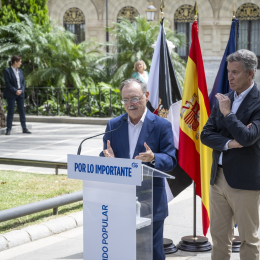
This contrast indicates that a considerable part of public opinion attributes the local response to Vivas and the insufficiency of the national response to Sánchez. Furthermore, 80.6% of socialist voters demanded an immediate appearance by the president. The Government has already promised that it will go to Congress, but it has not yet set a date.

Electoral estimates paint a very bad scenario for the investiture bloc. SocioMétrica placed the PP at 33.8% and 149 seats, the PSOE at 26% and 103, and Vox at 17% and 57 deputies. NC Report estimated the PP at 34.2% and between 145 and 147 seats, the PSOE at 25.2% and between 101 and 103, and Vox at 18% and between 61 and 63. In both cases, the PP and Vox would comfortably exceed the absolute majority in the first polls just after the migration crisis.

Although the right already started with a structural advantage and the first measurements after the avalanche did not detect a new socialist collapse, it remains to be seen how the narrative 'lands' after a month of delays, clashes in the Government, and tension.

Ceuta brings the crisis to the parliamentary majority

Immigration and border control are particularly uncomfortable issues for a progressive coalition. If the Government hardens its discourse and accelerates returns, it strains Sumar and part of its electorate. If it prioritizes reception without offering visible results in Ceuta, it leaves the security ground to the PP and Vox. And if it distributes minors among communities, it turns the humanitarian emergency into a territorial negotiation.

Junts has already warned that it will not give "a single vote" to the Government if Catalonia is not excluded from the distribution of minors arriving in Ceuta. The threat is a new test of resistance on the parliamentary majority.

The electoral literature also explains why the passage of time harms Moncloa. When immigration dominates the agenda, the parties that have been appropriating the issue for years have an advantage. The Government not only competes to offer solutions: it competes in a framework -border, authority, control- that PP and Vox can impose if normality does not return soon.

Morocco prevents closing the external front

The crisis does not end in Ceuta either. This Tuesday, during a ceremony presided over by Mohamed VI, the Moroccan Minister of Religious Affairs, Ahmed Toufiq, evoked the liberation of "occupied cities" in a historical allusion to Ceuta and Melilla. The Spanish Government responded that both cities are Spain and are part of the southern border of Europe.

The Moroccan formulation remains making it impossible for Moncloa to treat the bilateral relationship as if nothing had happened. In another survey by SocioMétrica, also in El Español, 89% of respondents -including 85% of socialist voters- believed that Morocco had allowed or encouraged the entries. It is a perception, not proof of authorship, but politically it puts unbearable pressure on the Government to point to Morocco, something it has avoided doing on all occasions.

The more the Executive avoids verbalizing the conflict, the more space it leaves for the opposition to present cooperation as subordination; the more it raises the tone, the more it risks a Moroccan response that re-tensions the border.

"Another crisis that Pedro Sánchez resolves"

The crisis, moreover, has developed in an August that has been nothing positive in terms of political communication for the socialists, who have managed to overshadow the crisis in Madrid due to the purchase and sale of a penthouse in Chamberí by the Government of Díaz Ayuso. It is in Oscar Puente, the most digital of Sánchez's ministers, where the delicacy of Pedro Sánchez's moment has been most evident, both for succumbing to the temptation to declare the Ceuta crisis closed too soon and for opening the debate about his succession, although Puente later downplayed the headlines. It is worth remembering that, without a doubt, Óscar Puente is one of the ministers who has always defended the president most forcefully.

On August 1, after Marlaska assured that the Government had "reversed the situation in 24 hours," Puente posted on X: "Another crisis that Pedro Sánchez resolves."

The phrase of the 24 hours was from Interior, not from the Minister of Transport, but Puente assumed and amplified that political conclusion twenty-four days later, Ceuta continues under extraordinary pressure, the Government has had to create a single command, has declared for the first time a situation of interest for national security and its ministers still disagree on the warnings from the CNI.

Puente also opened another important can of worms this weekend, placing the eventual replacement of Sánchez at the end of the next legislature, in four or five years and he has not been ruled out as a possible candidate when that moment arrives. He has done so while defining the president as the best possible leader and the "Michael Jordan" of the PSOE.

Although they are still reflections of the minister himself, who in the second case has also been careful to clarify, it is true that both evinced a certain communication crisis in the political narrative of Moncloa, trying to close a crisis that had just begun to unfold its consequences and now starting at a bad moment an attempt to sketch the future of the PSOE when Sánchez is still struggling to regain control of the present in Ceuta.

Has Ceuta slipped out of Sánchez's hands?

The political time has slipped out of his hands. The Government allowed Vivas to set the narrative of abandonment, took almost a month to centralize coordination and now must explain why Defense and Interior do not describe the prior warnings in the same way. It has also lost the monopoly on closing the crisis: Ceuta, Morocco, Vivas, the opposition, the partners, the United States, and the very streets of the city can reopen it every day.

The next two or three weeks will decide whether Ceuta becomes a serious episode or a lasting symbol that starts the clock on the general elections, especially if, as some voices fear, Morocco continues to escalate its verbal claim to the territoriality of Ceuta and Melilla, neighborhood tensions continue, or normal management is not returned to the territory. And even worse, if the scenario of massive illegal entries is repeated, something that would politically shock the Government of Spain. Although the majority of those who entered returned to Morocco, there is already a single authority, Brussels is studying the Spanish request for emergency aid, and the Government retains legal, budgetary, and diplomatic instruments, the idea that the end of the legislature may depend on Ceuta is there.

More key points, information and questions with FREN

AI-GENERATED CONTENT

What is the parliamentary process for declaring a situation of interest for national security in Spain and what steps follow the declaration?

In Spain, the declaration of a situation of interest for national security is regulated by Law 36/2015, of September 28, on National Security. It is not a state of alarm or exception, it does not suspend fundamental rights, and its distinctive feature is the enhanced coordination of existing authorities under the Government's direction, with subsequent political control by the Cortes Generales.

1. Basic regulatory framework

The figure is mainly regulated in Title III of Law 36/2015 (crisis management), particularly in the provisions that:

  • Define the situation of interest for national security as a crisis that, due to the severity of its effects and the urgency and cross-cutting nature of the measures, requires enhanced coordination of the competent authorities, under the Government's direction.
  • Establish that it is addressed with ordinary powers and means of public administrations and that it cannot imply suspension of fundamental rights.
  • Assign to the President of the Government the competence to declare the situation, and to the National Security Council a central role of support, direction, and coordination.
  • Provide for the obligation to immediately inform the Congress of Deputies of the measures adopted and the evolution of the crisis.

2. Who declares and how is the decision articulated?

The material decision procedure is governmental, with subsequent parliamentary control:

  • Decision-making competence: the Law assigns to the President of the Government the power to declare the situation of interest for national security.
  • Legal instrument: the declaration is made by royal decree of the President of the Government.
  • Council of Ministers and National Security Council:
    • The Government establishes and directs national security policy and approves the National Security Strategy.
    • The National Security Council, as a delegated commission of the Government, assists the President and determines liaison and coordination mechanisms, as well as advising on crisis management.

Although the Law does not formally describe a “parliamentary authorization phase,” jurisprudence (STC 184/2016) emphasizes that the declaration must be articulated respecting the distribution of competences and cooperation with the Autonomous Communities, which must be involved in the provision and organization of resources.

3. Minimum content of the declaration royal decree

The royal decree declaring the situation of interest for national security must include, at least:

  • Definition of the crisis (nature and main causes).
  • Geographical scope affected (entire territory or specific areas).
  • Initial duration and, if applicable, the possibility of extension.
  • Appointment of a functional authority, if considered necessary, and determination of their powers to direct and coordinate actions.
  • Determination of necessary human and material resources, both those foreseen in preparation and resource provision plans and any additional resources.

4. Role of Parliament: control, not authorization

Unlike states of alarm, exception, and siege, the National Security Law does not require prior parliamentary authorization or ratification of the declaration. The “parliamentary process” focuses on subsequent political control:

  • The Government must immediately inform the Congress of Deputies of the measures adopted and the evolution of the situation.
  • The Cortes may exercise all ordinary control instruments:
    • Questions, interpellations, and motions.
    • Appearances of the President or competent ministers.
    • Monographic debates in Plenary or in the Joint National Security Commission, where the Government periodically reports on national security and presents the Strategy.
    • Investigation commissions, if politically appropriate.

That is, Parliament does not declare or validate the situation, but can politically condition its continuity, scope, and management.

5. Steps following the declaration and termination

Once the situation is declared, several levels of action are activated:

  • Crisis management: developed through instruments of prevention, detection, response, return to normality, and evaluation, using ordinary structures and competences of the Administrations.
  • Direction and coordination:
    • The President of the Government directs national security policy and the National Security System.
    • The National Security Council, and if applicable the Situation Committee, assist in daily management and coordinate system components.
    • If a functional authority has been appointed, they direct and coordinate operational actions.
  • Obligation to provide resources: the declaration entails the duty of competent authorities to make available the necessary human and material means under their dependency.
  • Territorial and sectoral cooperation: Autonomous Communities and local entities participate in providing resources and in coordination mechanisms established by the National Security Council and resource plans.
  • Parliamentary monitoring: the Government updates the Congress on the evolution and measures adopted, with Parliament able to intensify political control.
  • Return to normality: when the circumstances justifying the declaration cease, the President of the Government ends the situation (by a new royal decree or other formal decision), and the phase of evaluation and normalization begins, including plan review and parliamentary accountability.

In sum, the center of gravity of the procedure is governmental, while the Parliament intervenes through intense and continuous political control, without a specific authorization or ratification phase of the declaration.

What are the competences and political background of Ángel Víctor Torres as the designated functional authority in Ceuta?

The figure of Ángel Víctor Torres in the Ceuta crisis is articulated on two levels: his political background, which explains why the Government places him at the head of the response, and the legal framework of his role as coordinator — the so-called functional authority or “single command” — provided for in the National Security Law. Based on the sources consulted, his profile and the competences associated with that function can be described with considerable precision.

Political background of Ángel Víctor Torres

According to his profile in the public office database, Ángel Víctor Torres Pérez (Arucas, 1966) is a politician and teacher with a degree in Hispanic Philology who worked as a professor and writer before fully dedicating himself to politics. He has been:

  • Mayor of Arucas and responsible for various positions in the Cabildo of Gran Canaria, where he gained experience in territorial management.
  • Secretary General of the PSOE of the Canary Islands since 2017, a position he still holds, making him a key figure in Canarian socialism.
  • President of the Government of the Canary Islands between 2019 and 2023, leading the community in matters closely related to Ceuta and Melilla: immigration, coordination with the State, territorial cohesion policies, and emergency response.
  • Minister of Territorial Policy and Democratic Memory since November 2023, with state rank and direct competences over coordination between the central Government and autonomous communities and cities.
  • Member of the Permanent Deputation of the Congress since June 2023, which strengthens his connection with the parliamentary dimension of Executive decisions.

His official biography also records that in 2025 he underwent surgery for cancer and temporarily withdrew from political activity, although he resumed his ministerial functions.

Specific role in Ceuta before the “single command”

As Minister of Territorial Policy and Democratic Memory, Torres had already been playing a central role in the Government's relationship with Ceuta:

  • In April 2024 he visited the city and, together with Ceuta's president Juan Jesús Vivas, monitored the Comprehensive Socioeconomic Development Plan for Ceuta and Melilla, whose coordination had been entrusted to his ministry. Official notes highlight his promotion of measures in health, education, housing, connectivity, and transport (for example, health investments and improvement of road 352). (Ministry note)
  • In December 2024 he announced an economic allocation for the management of unaccompanied minors in Ceuta, committing a budget modification and framing this action within the Government's effort to support the city in reception and protection of migrant minors (Ministry note).
  • In 2025 he chaired coordination meetings with Government delegates from Ceuta, Melilla, and the Canary Islands on the relocation of unaccompanied migrant minors, reinforcing his role as a central piece of interterritorial coordination.

Competences as “functional authority” or single command in Ceuta

Political press and the newspaper Demócrata explain that, faced with the migratory crisis in Ceuta due to the massive entry of people at the end of July, the Government has decided to place Ángel Víctor Torres “at the head of coordination” of the state response in the autonomous city (Demócrata). This role is supported by two legal figures:

  • The declaration of a “situation of interest for National Security”, regulated in articles 23 and 24 of Law 36/2015, on National Security. The President of the Government, by royal decree, defines the crisis, the affected territory, the duration, the necessary resources, and, if applicable, the appointment of a functional authority.
  • That functional authority — politically called “single command” — has the function of directing and coordinating the actions of the different administrations involved (Interior, Defense, Immigration, Government Delegation, Autonomous City, etc.), articulating a joint and reinforced response, but:
    • Does not assume extraordinary powers nor suspend fundamental rights.
    • Does not alter the distribution of competences: each administration maintains its attributions, although acting under enhanced coordination.
    • Must work with the ordinary means of the administrations, which are obliged to make available the resources determined in the royal decree.
    • The Government is obliged to inform the Congress about the measures adopted and the evolution of the crisis.

In practice, as detailed by Demócrata, the Executive foresees that Torres, as Minister of Territorial Policy, leads that coordination in Ceuta: centralizing operational planning, harmonizing the means of Interior, Defense, and the General State Administration with the services of the Autonomous City, and supervising the execution of decisions adopted within the framework of the National Security Council and the Council of Ministers.

In summary, his appointment is based on a background closely linked to the management of border territories (Canary Islands) and State-territory coordination, and the competences associated with the functional authority in Ceuta focus on inter-administrative direction and coordination of the crisis, without implying unlimited power over the city's institutions.

What requirements does Spanish legislation establish for the return of unaccompanied foreign minors and asylum seekers?

Spanish regulations combine the general immigration regime with international protection to regulate the return or repatriation of unaccompanied foreign minors (MENA) and asylum seekers. The basic framework includes, among others, Organic Law 4/2000, on the rights and freedoms of foreigners (LOEx) and its reforms, its regulation approved by Royal Decree 557/2011, Law 12/2009 on asylum and subsidiary protection (Asylum Law), child protection legislation (Law 26/2015, Organic Law 8/2021), and the Framework Protocol on actions with unaccompanied foreign minors (Resolution of 13.10.2014), as well as Constitutional Court doctrine on border rejection and non-refoulement.

1. General principles: best interests of the child and non-refoulement

The legal system is based on two axes:

  • Best interests of the child: the LOEx refers to the general child protection system; reforms such as Law 26/2015 and Organic Law 8/2021 reinforce that all actions with minors, including unaccompanied foreigners, must prioritize their protection, integration, and development, above migration control considerations.
  • Principle of non-refoulement: the Asylum Law, relying on the Geneva Convention, prohibits returning, expelling, or transferring a person to a country where their life or freedom is at risk or where they may suffer torture or inhuman or degrading treatment. The article on revocation of international protection expressly states that no revocation or subsequent expulsion may result in sending to a country where such risk exists.
2. Requirements for return or repatriation of minors and applicants

The LOEx regulates the sanctioning procedure, expulsion, and return, while the Asylum Law connects protection denial with immigration consequences.

  • Identification and age determination: the Framework Protocol and child protection regulations require the initial identification of the minor, attempting to verify age and origin; if in doubt, age determination tests are foreseen with the participation of the Public Prosecutor's Office.
  • Assumption by protection services: once identified as an unaccompanied minor, they become tutored by the public child protection entity of the competent autonomous community; this shifts the logic from purely migratory to child protection.
  • Competent authorities: Government Delegations/Subdelegations are competent in expulsion/return; in asylum matters, the Asylum and Refuge Office decides, with Interior's intervention. In the case of MENA, return decisions must be coordinated with child protection and the Public Prosecutor's Office.
  • Basic procedural rights: the LOEx recognizes the right of all foreigners to legal assistance and interpreter in procedures of entry denial, return, expulsion, and international protection (LOEx article on legal assistance). These assistances are free if the person lacks resources, according to free legal aid regulations.
  • Judicial review: acts and resolutions in immigration matters are appealable in administrative and contentious-administrative proceedings. Expulsion and return procedures are preferential but maintain access to judicial protection.
  • Hearing of the minor and Public Prosecutor: child legislation and the Framework Protocol require that the minor be heard according to their maturity and that the Public Prosecutor supervises that any possible return is adopted considering their best interests.
3. Unaccompanied minors applying for asylum

When the unaccompanied minor applies for asylum or subsidiary protection, guarantees accumulate:

  • They are recognized as applicants for international protection, with the right to reception services, education, health, and other benefits that the Asylum Law and the reception system regulation approved by Royal Decree 220/2022 assign to beneficiaries.
  • While the application is processed, expulsion or return cannot be executed, without prejudice to rules on responsible State (European common asylum system).
  • Denial or inadmissibility of the application, according to the Asylum Law itself, will in principle entail return, expulsion, mandatory exit, or transfer to the responsible State; but only if there are no grounds to grant stay, residence, or other immigration titles, or humanitarian reasons, according to the LOEx.
  • For minors, the Administration must strongly weigh the best interests, family unity, and risk in the country of origin before any forced departure decision.
4. Limits and prohibitions on return or expulsion

Beyond non-refoulement, the regulations establish material limits:

  • Risk to life, integrity, or freedom: the Asylum Law prevents returning to a country where the person faces persecution, serious harm, torture, or inhuman or degrading treatment, or lacks effective protection against further return to the persecuting country.
  • Protection of victims of trafficking and other vulnerabilities: the LOEx contains specific provisions protecting victims of trafficking or serious violence from expulsion, reinforced when minors are involved.
  • Family unity and reunification: the LOEx guarantees the right to family life and regrouping of minor children; in asylum, the 2009 Law provides for extending protection to family unity and preferential regrouping procedures. These elements act as brakes on returns that would break up family units or separate the minor from their references.
  • Constitutional control of border rejection: Constitutional Court rulings on the Citizen Security Law and the border rejection regime in Ceuta and Melilla emphasize that any immediate rejection mechanism must respect the principle of non-refoulement and guarantee real access to identification, legal assistance, interpreter, and the possibility to apply for asylum, including minors and vulnerable persons.

In summary, in the case of unaccompanied minors and asylum seekers, return or repatriation is only legally possible after an individualized examination, with the intervention of child protection and the Public Prosecutor, full legal and linguistic assistance, and an explicit weighing of the best interests of the child and the principle of non-refoulement, which act as genuine material limits to expulsion.

Play

Test your knowledge with FREN!

How much do you know about this topic? Answer the following 3 questions.

How many days did the Government take to activate a unified command after the start of the migration crisis in Ceuta?

Question 1 of 3

What percentage of respondents approved Pedro Sánchez's response to the Ceuta crisis according to the SocioMétrica survey?

Question 2 of 3

What body has been created to coordinate the management of the crisis in Ceuta after the declaration of a situation of interest for national security?

Question 3 of 3

Hola, soy Fren. ¿Cómo te ayudo?